

 mxene academic
IF 26! Aligning sculpture-like two-dimensional nanosheet architectures through predictive low magnetic fields
QQ Academic Group: 1092348845
Detailed
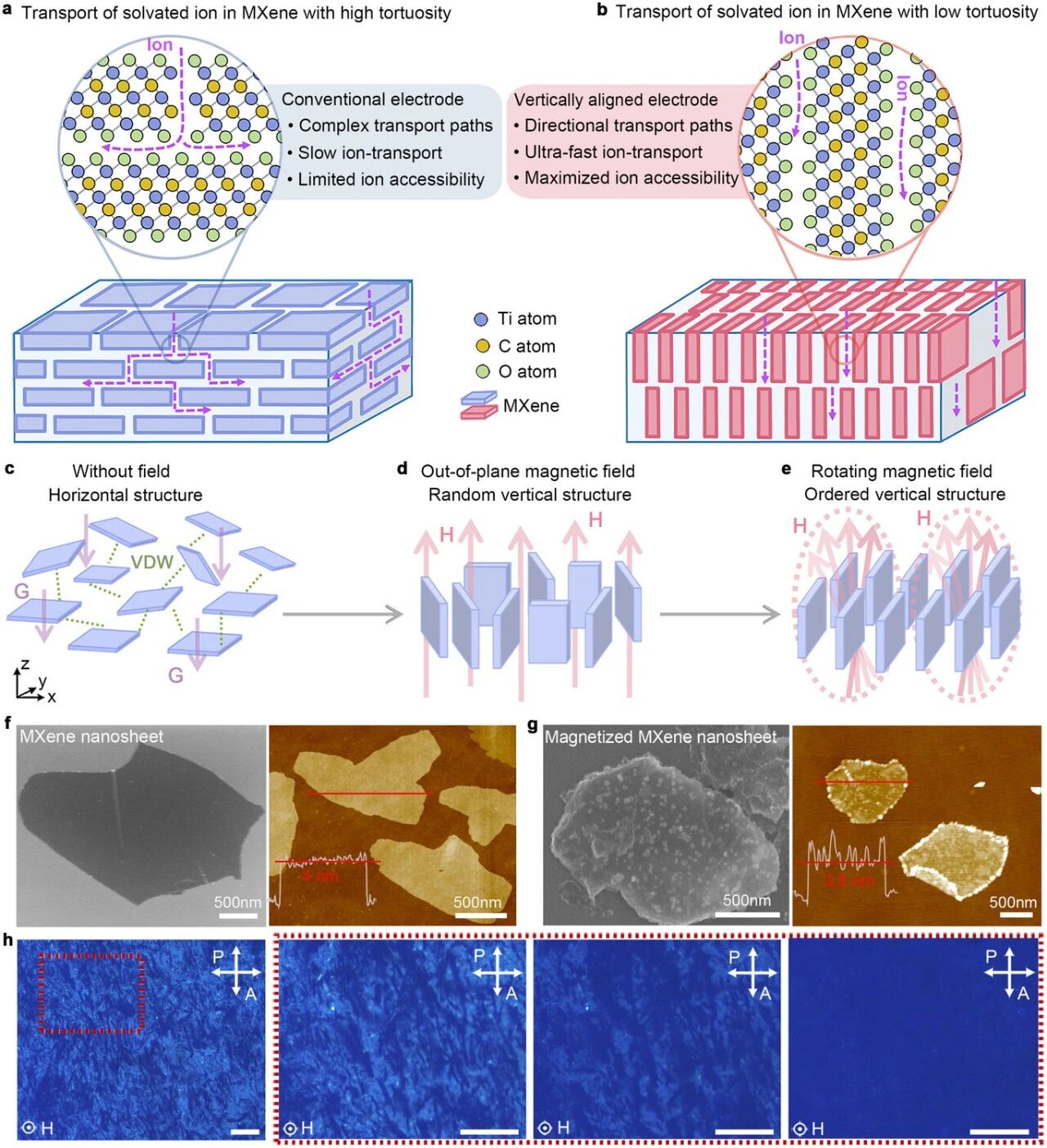
Controllably assembling two-dimensional nanosheets into functional ordered structures on a macroscopic scale is a central challenge in the field of materials science. Their intrinsic tendency to restack often results in dense, disordered films, severely limiting their potential in applications that rely on directional transport, such as catalysis and energy storage. The oriented arrangement of atomically thin nanosheets has long been a major obstacle, traditionally attributed to the effects of thermal motion, but this study reveals that its root cause lies in the deep kinetic potential wells formed by dominant many-body van der Waals interactions.Here, we overcome this limitation through a low-field (<50 mT) magnetic control strategy, achieving predictable structural regulation. We established a parameter-matching model to analyze the complex energy barrier landscape, transforming the assembly process into a rational design framework. This technology enables us to construct functional architectures such as vertically aligned, bidirectionally ordered MXene structures, creating ion ultra-fast transport channels with ultra-low tortuosity.As a demonstration, MXene electrodes engineered through structural design exhibit outstanding rate performance in supercapacitors and sodium-ion batteries. This study provides a universal and scalable platform for the architectural design of two-dimensional materials, unleashing their potential value in applications where directional transport is critical.
Original link
Sculpting 2D Nanosheet Architectures via Predictive Low-Field Magnetic Alignment
Pub Date : 2025-12-31
DOI: 10.1002/aenm.202506366
Yubing Li, Shuaikai Xu, Dan Huang, Zhiqun Tian, Tangming Mo, Yuanhao Wang, Ya Yang
Advanced Energy Materials ( IF 26 )
- Previous: IF 16! Disulfide Toxic
- Next: Bioactive Materials |


