

 mxene academic
Bioactive Materials | Supramolecular Helicity-Dependent Osteogenesis and Angiogenesis Crosstalk of Periodontal Ligament Stem Cells
QQ Academic Group: 1092348845
Detailed
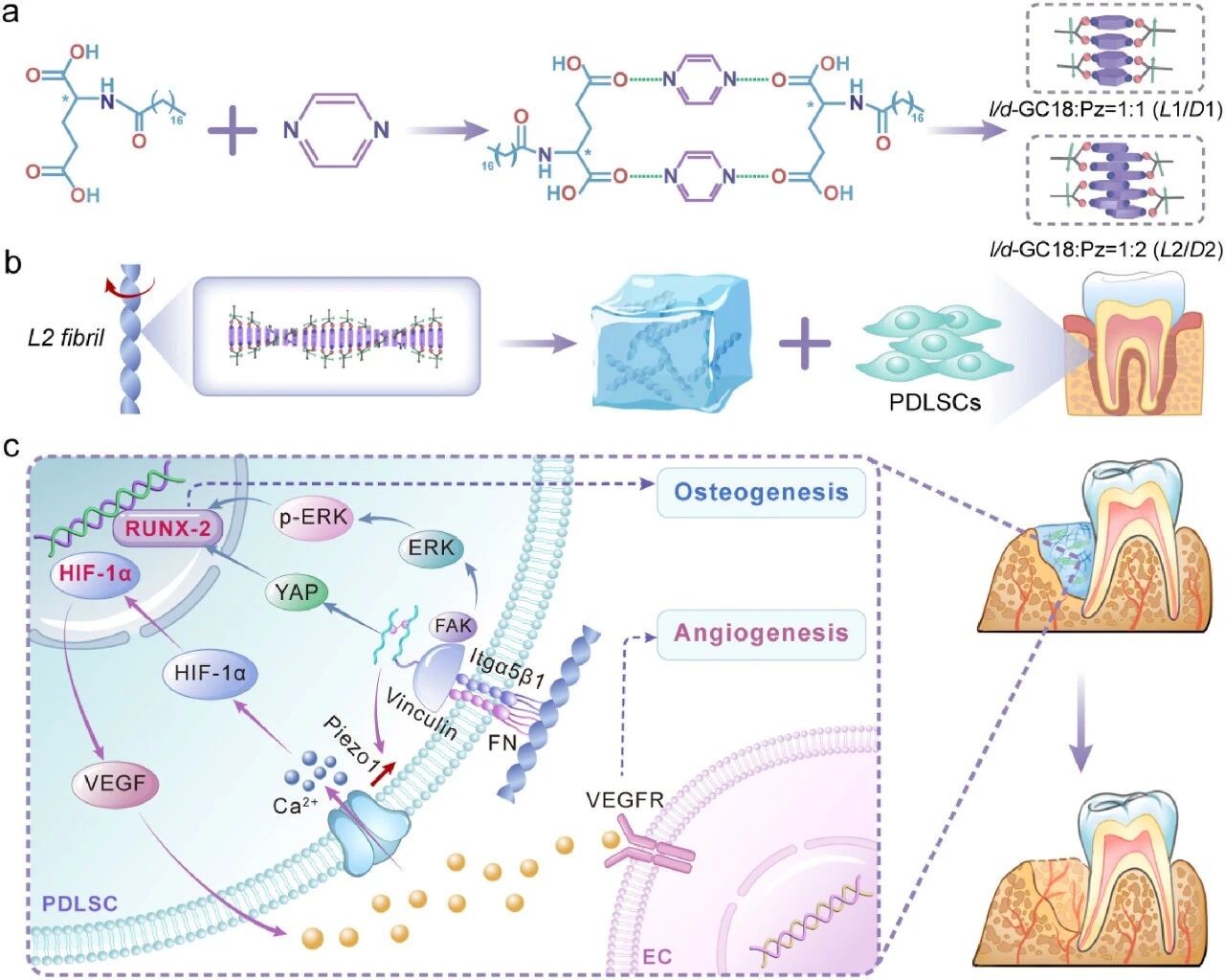
The two major pillars supporting effective tissue regeneration are pluripotent stem cells and matrix materials that guide differentiation. The chirality of the extracellular matrix, as a key structural feature affecting stem cell fate, still requires further investigation into its mechanism of action. At present, little is known about the effect of molecular chirality or supramolecular helicity on the differentiation of periodontal ligament stem cells (PDLSCs), a safe and easily accessible source of stem cells. This study examines enantiomers of chiral amino acid derivatives (L/D-GC18).Fibrous structures were constructed through co-assembly with bridge-linked pyrazine molecules. The helicity of these fibers depends on both the molecular chirality of the amino acids and the stoichiometric ratio of the two components. The results indicate that molecular chirality and supramolecular helicity work synergistically: the left-handed fibers formed by the assembly of L-GC18 and pyrazine significantly promoted osteogenic differentiation of PDLSCs in vivo.In addition, chiral fibers effectively promoted bone regeneration in mouse models of cranial and alveolar bone defects. Notably, left-handed fibers induced osteogenic differentiation through an integrin-dependent pathway, thereby activating Piezo1-mediated vascular endothelial growth factor (VEGF)-driven angiogenesis. These findings provide a theoretical blueprint for next-generation regenerative therapeutic strategies based on PDLSCs.
Reference News:
https://www.sciencedirect.com/science/article/pii/S2452199X25006486#sch1
- Previous: IF 26.8! Magnetoelectr
- Next: Bioactive Materials |


