

 Academic Frontier
Chemical Engineering Journal | Bimetallic nanoenzymes with strong antibacterial activity achieved through precise regulation of multiple metals, for infected wound healing
QQ Academic Group: 1092348845
Detailed
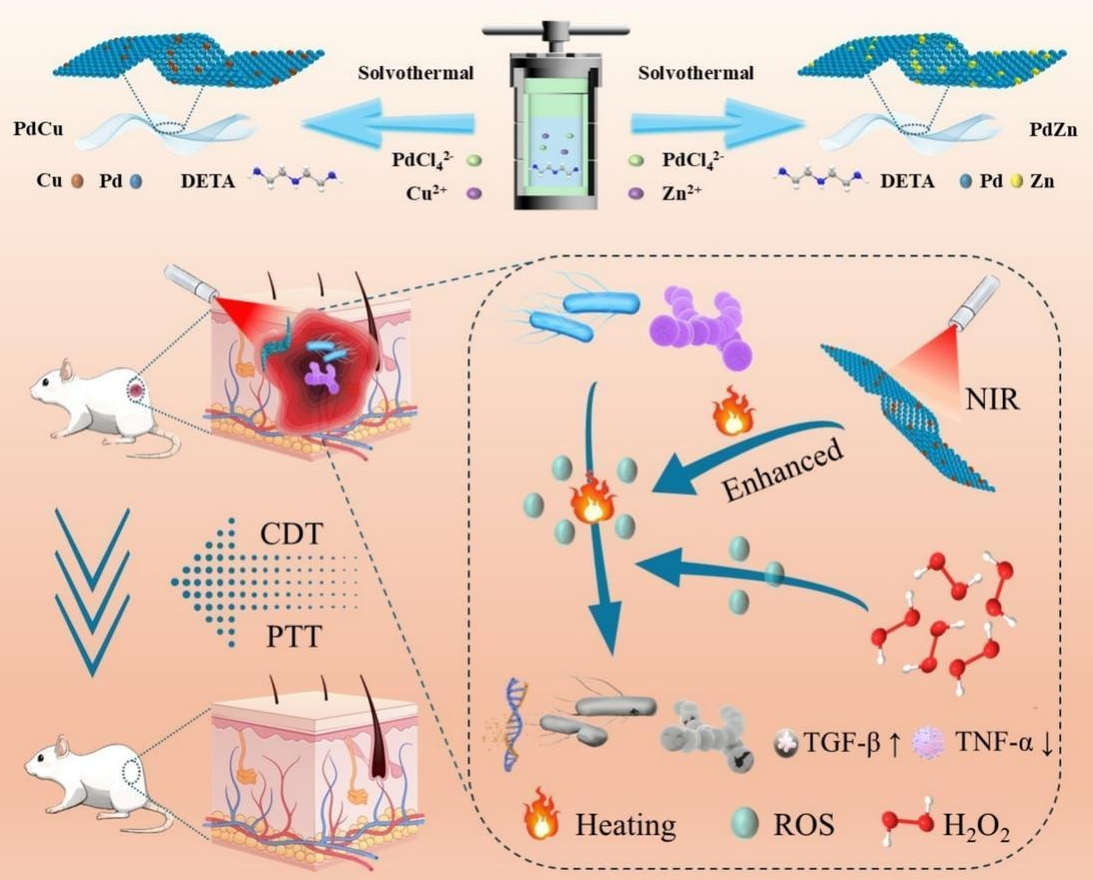
The misuse of antibiotics has exacerbated the problem of bacterial resistance, making antibiotic treatments ineffective and, in severe cases, even life-threatening. Therefore, novel antibacterial materials and their clinical applications have attracted significant attention from healthcare professionals. Bimetallic nanozymes hold great potential in treating clinical bacterial infections due to their excellent antibacterial activity and good biocompatibility. In this study, PdZn and PdCu bimetallic nanozymes with folded structures were synthesized via a one-step hydrothermal method. Their photothermal and peroxidase-like catalytic activities were compared, and computational studies were conducted to analyze the reasons for the differences in their catalytic performance.In addition, the antibacterial efficacy and wound healing potential of these two nanozymes were also evaluated. Experimental results showed that PdCu exhibited superior catalytic performance compared to PdZn, which is consistent with density functional theory calculations confirming its enhanced catalytic capability. In vitro antibacterial experiments successfully demonstrated that PdZn and PdCu can effectively inhibit the survival of Escherichia coli and Staphylococcus aureus to below 2% through the synergistic effect of photothermal catalysis using a 980 nm near-infrared laser. In vivo antibacterial experiments showed thatPdZn and PdCu nanozymes can promote wound healing and alleviate inflammatory responses. Compared with PdZn, PdCu shows superior ability in promoting wound healing. PdCu H2O2 NIR and PdZn H2O2 NIR reduce the wound area to 9.37% and 6.04%, respectively, while the control group only decreases to 41.21%. Overall, this study further explores the potential of Pd-based nanozymes in biological applications and provides guidance for the synthesis of efficient Pd-based two-dimensional nanobiomaterials.
Reference News:
https://www.x-mol.com/paper/1915453203260092416/t?adv
- Previous: Chemical Engineering J
- Next: Bioactive Materials|离子


