已传文件:photo/1768440185.png
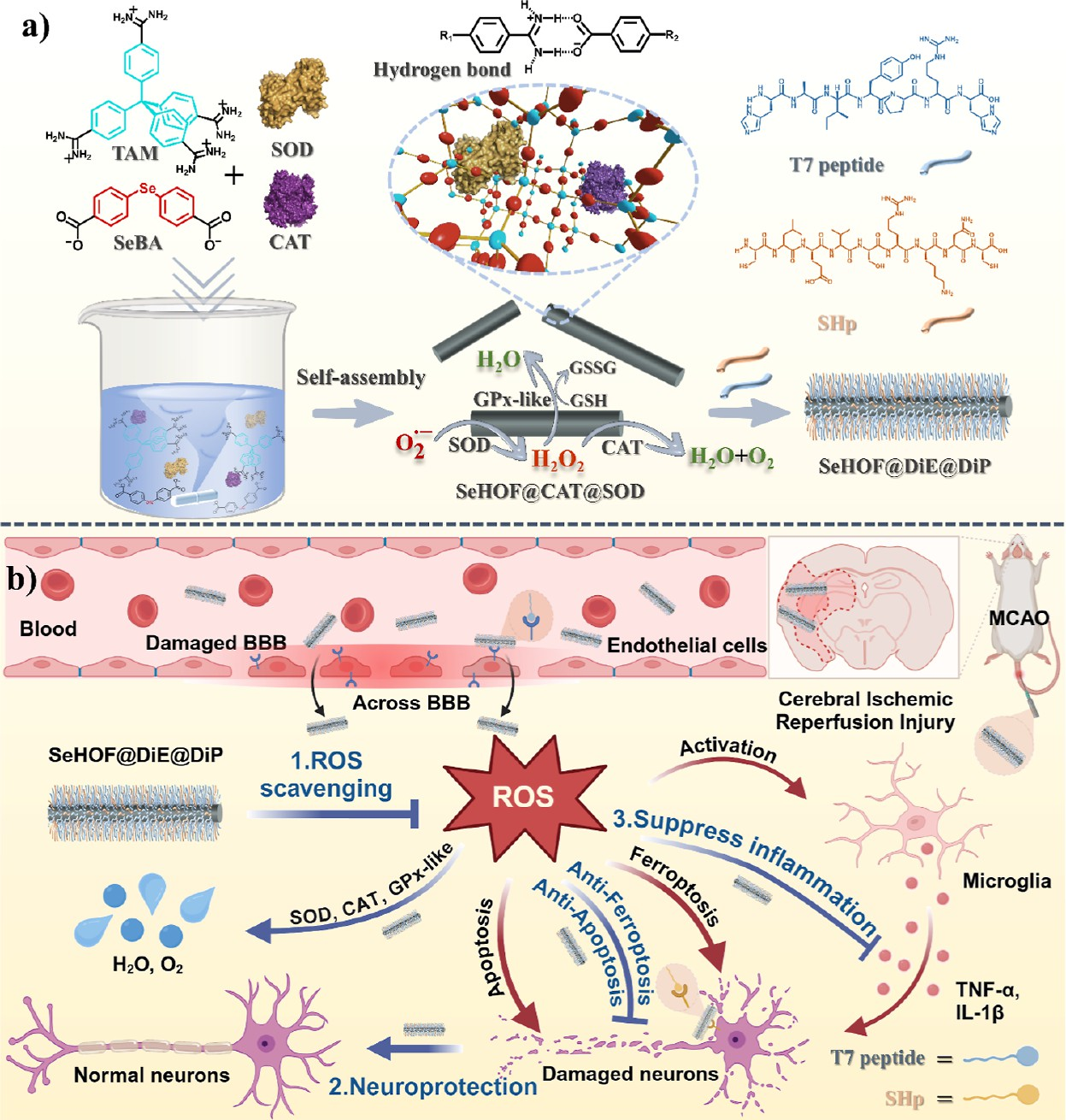
Metal-free hydrogen-bonded organic frameworks (HOFs) are porous materials formed through hydrogen bonding of organic components, exhibiting excellent biocompatibility and enzyme compatibility in biomedical applications. However, using HOFs to create multi-enzyme cascade antioxidant nanozymes for the treatment of cerebral ischemia-reperfusion injury (CIRI) remains challenging. Here, selenium-containing nano HOFs (SeHOFs) were synthesized as glutathione peroxidase mimics, with superoxide dismutase (SOD) and catalase (CAT) encapsulated in situ.Forming a hybrid cascade antioxidant system (SeHOF@CAT@SOD). SeHOFs exhibit enhanced catalytic activity, maintain enzyme function, and can protect them from temperature, proteolysis, and denaturation. The metal-free nanozymes demonstrate excellent biocompatibility and cascade catalytic efficiency, capable of scavenging reactive oxygen species, and reducing cell apoptosis and ferroptosis in vitro. Peptide modification enhances accumulation at the site of occlusion, effectively reducing infarct volume, oxidative stress, neuronal apoptosis, ferroptosis, and inflammation in the CIRI model. This study highlights the potential of nano HOFs as a platform for the development of advanced therapeutic nanozymes in the treatment of ischemic stroke.
The ingenious aspect of this design lies in its integration of the advantages of artificial nanozymes and natural enzymes. Experiments have shown that this nano-framework not only maintains the high activity of the encapsulated enzymes (retaining approximately 83.5% and 92% of their activity, respectively), but also provides strong protection for the enzymes, allowing them to remain stable under harsh conditions such as high temperatures, proteases, and denaturants. Its porous structure facilitates the free movement of small molecule substrates like reactive oxygen species, ensuring efficient catalytic reactions.
Reference News:
https://pubs.acs.org/doi/full/10.1021/acsnano.5c20015