已传文件:photo/1768440185.png
Frontiers of Bio-Nano Materials
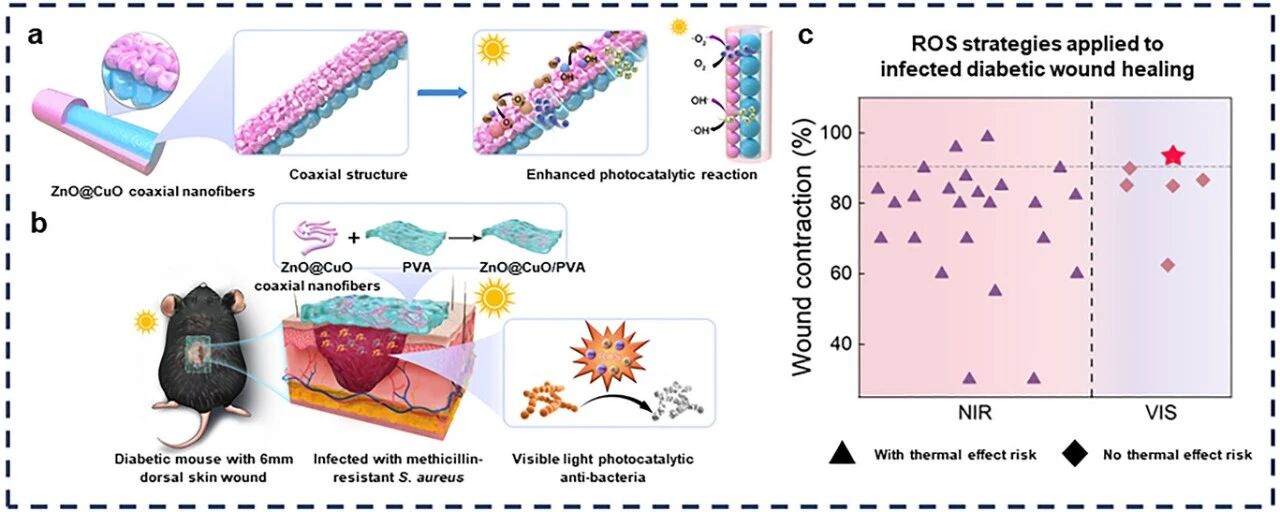
Antimicrobial strategies based on reactive oxygen species (ROS) offer a promising approach for non-invasive regulation of photocatalytic materials, providing a potential method for healing infected wounds under comorbid conditions. However, most ROS-generating photocatalytic materials rely on ultraviolet (UV) or near-infrared (NIR) light activation, which poses challenges for convenient application and biosafety. In this study, we developed novel zinc oxide@copper oxide (ZnO@CuO) nanofibers with a robust coaxial structure, which can be activated by visible light to generate ROS through photocatalytic reactions. The orderly arrangement of the inner and outer semiconductor layers enhances the contact efficiency of the p-n heterojunction.This enhances the efficiency of electron-hole separation in nanofibers. The improvement in p-n junction contact efficiency is a key mechanism driving the enhancement of photocatalytic performance and the increased production of ROS under visible light, thereby improving application convenience and biocompatibility. ZnO@CuO coaxial nanofibers exhibit excellent antibacterial performance and accelerated wound healing in a mouse skin wound model infected with methicillin-resistant Staphylococcus aureus (MRSA).Coaxial nanofibers play an important role in early infection control and significantly accelerate wound healing. Even in infected diabetic wounds, the healing rate reaches 92.3% within 10 days. This innovative approach uses biocompatible visible light, offering a promising solution for treating infected wounds.
The healing of infected wounds, especially in patients with underlying conditions such as diabetes, has always been a major challenge in clinical practice. Conventional antibiotic treatments face the risk of resistance, while other photocatalytic antibacterial materials that rely on ultraviolet or near-infrared light activation have limitations such as biotoxicity or thermal damage. In recent years, with the development of nanomaterials and photocatalytic technology, a non-invasive, spatiotemporally controllable antibacterial strategy based on reactive oxygen species (ROS) has shown great potential. A recent study published in Advanced Science reported an innovative zinc oxide@copper oxide (ZnO@CuO) coaxial nanofiber that can be efficiently activated under biocompatible visible light, significantly promoting the healing of infected skin wounds, providing a new approach to addressing this clinical challenge.
Reference News:
https://www.x-mol.com/paper/2009873139740360704/t?adv