已传文件:photo/1768784798.png
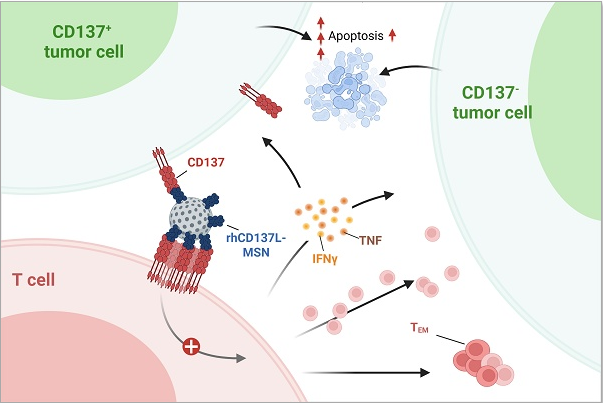
CD137 is a potent T cell co-stimulatory molecule, and CD137 agonists are being evaluated for human cancer immunotherapy. Urelumab and utomilumab are two agonistic anti-CD137 antibodies with the most advanced progress in clinical trials, but they are associated with liver toxicity and low efficacy, respectively. This article describes the development of a novel CD137 agonist and formulation that combines high efficacy with strong safety. Methods: The extracellular domain of recombinant human CD137 ligand (rhCD137L) was conjugated to mesoporous silica nanoparticles (MSNs) with a diameter of approximately 50 nanometers,And its co-stimulatory ability to optimize T cell cytotoxic activity was assessed. Since nasopharyngeal carcinoma (NPC) cells often express CD137, the NPC cell lines C666 and HK-1 (both testing CD137 expression and knockout variants) were used to evaluate the in vitro effects of rhCD137L-MSNs on T cell-mediated tumor cell cytotoxicity. The results were compared with MSNs combined with urelumab (ure-MSNs) or with unbound urelumab.Subsequently, the biodistribution, therapeutic effect, and toxicity of rhCD137L-MSNs were evaluated in a humanized mouse NPC model. Results: rhCD137L-MSNs were more effective than ure-MSNs or non-binding urelumab in inducing in vitro killing of NPC cell lines C666 and HK-1 (which express CD137 and have a deletion phenotype). The clearance efficiency of C666-CD137 and HK1-CD137 cells was higher than that of CD137-deficient cells. In vivo, in the humanized mouse NPC model,Both rhCD137L-MSNs and ure-MSNs inhibit tumor growth, with rhCD137L-MSNs being slightly stronger. This is reflected in the increase of T cell activation markers and the increased infiltration of effector memory CD8 T cells into the tumor. Unlike ure-MSNs, treatment with rhCD137-MSNs does not cause liver damage, making it safer than ure-MSNs. Conclusion: This study identifies an MSN formulation with rhCD137L that is both highly effective and exceptionally safe.
Reference News:
https://www.x-mol.com/paper/1996245486036692992/t?adv