已传文件:photo/1769223242.png
Oral therapeutic nanoparticles offer a non-invasive approach for treating gastrointestinal diseases, but achieving localized and sustained mucosal exposure while avoiding systemic toxicity remains a major challenge. Here, an oral formulation based on sucralfate was developed, combined with therapeutic nanoparticles, which transforms into a paste-like coacervate upon contact with intestinal fluid, uniformly covering the entire gastrointestinal tract within 6 hours and being cleared through feces within 12 hours.Systematic studies have shown that the hydrophobicity of nanoparticles is crucial for stabilizing amino-based nanoparticle formulations, supporting compatibility with various types of nanoparticles. The incorporated nanoparticles are stabilized through strong non-covalent interactions, limiting gastric dissolution and reducing cellular uptake to 0.044% compared to PEGylated nanoparticles. As a representative example, antioxidant cerium oxide nanoparticles were tested in two different models of oxidative stress-related intestinal injury, including immune-mediated colitis and radiation-induced enteropathy.In DSS-induced colitis, our system reduced weight loss from 17.2% to 2.2% and restored colon structure and oxidative stress damage. In radiation-induced enteropathy, our system lowered weight loss from 25.5% to 11.4%, doubled villus length, and significantly enhanced epithelial regeneration. This formulation is also compatible with imaging-capable nanoparticles, demonstrating versatility for both therapeutic and diagnostic applications in gastrointestinal diseases.
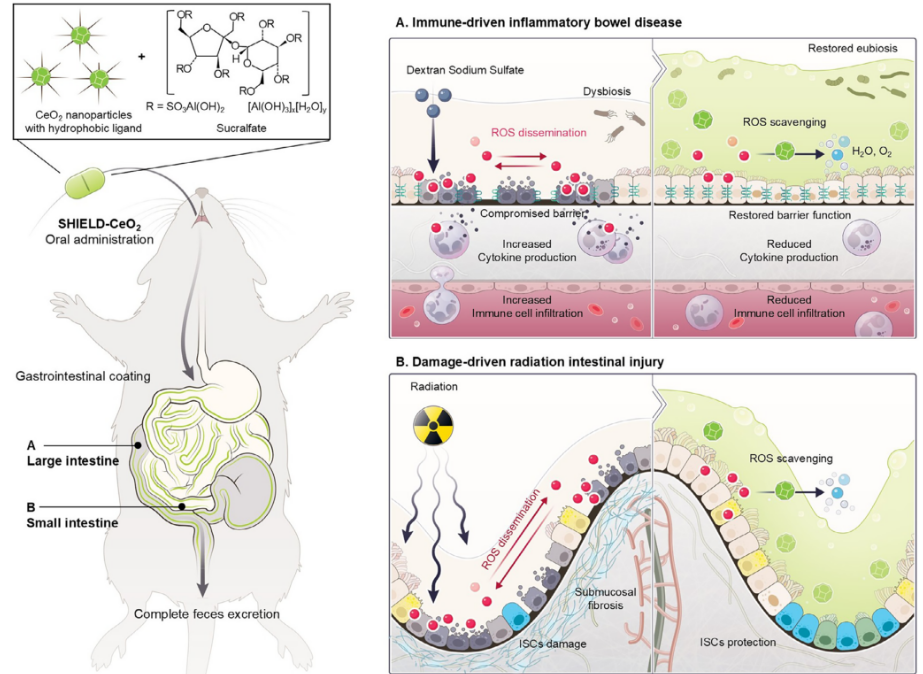
In recent years, oral nanoparticle delivery has provided a non-invasive new approach for the treatment of gastrointestinal diseases. However, achieving local, sustained mucosal coverage while avoiding systemic toxicity remains a significant challenge. Recently, a study published in Advanced Materials proposed an oral nanoparticle delivery system based on sucralfate—SHIELD. This system can rapidly transform into a viscous coacervate in the intestinal environment, uniformly covering the entire gastrointestinal mucosa within 6 hours and being completely excreted through feces after 12 hours.
The system creates a highly adhesive paste-like coating by embedding therapeutic nanoparticles into an acid-treated sucralfate matrix. The research team found that the surface hydrophobicity of the nanoparticles is key to successfully loading them into the system, with nanoparticles using C18 long-chain alkyl ligands achieving more than 99.9% loading efficiency. Once embedded, the nanoparticles remain stably in place through strong non-covalent interactions, effectively preventing leakage in the acidic gastric environment and reducing cellular uptake to 0.044%, far lower than that of conventional polyethylene glycol-modified nanoparticles.
As a representative application, researchers loaded cerium oxide nanoparticles with antioxidant properties into the SHIELD system and validated it in two models of oxidative stress-related intestinal injury: immune-mediated colitis and radiation-induced enteritis. In the DSS-induced colitis model, SHIELD-CeO₂ reduced mouse body weight loss from 17.2% to 2.2%, significantly restoring colon structure and mitigating oxidative stress damage. In the radiation-induced enteropathy model, the system reduced body weight loss from 25.5% to 11.4% and doubled the length of small intestinal villi, significantly promoting epithelial regeneration.
In addition, the platform also demonstrates good compatibility and versatility. Besides cerium oxide, gold nanoparticles, iron oxide nanoparticles, and others can also be successfully loaded while maintaining the physical stability of the system. The SHIELD system loaded with gold nanoparticles shows a significant enhancement effect in gastrointestinal CT imaging, indicating that this platform has potential applications in both therapy and diagnostics.
References:
DOI: 10.1002/adma.202514708