已传文件:photo/1769491065.png
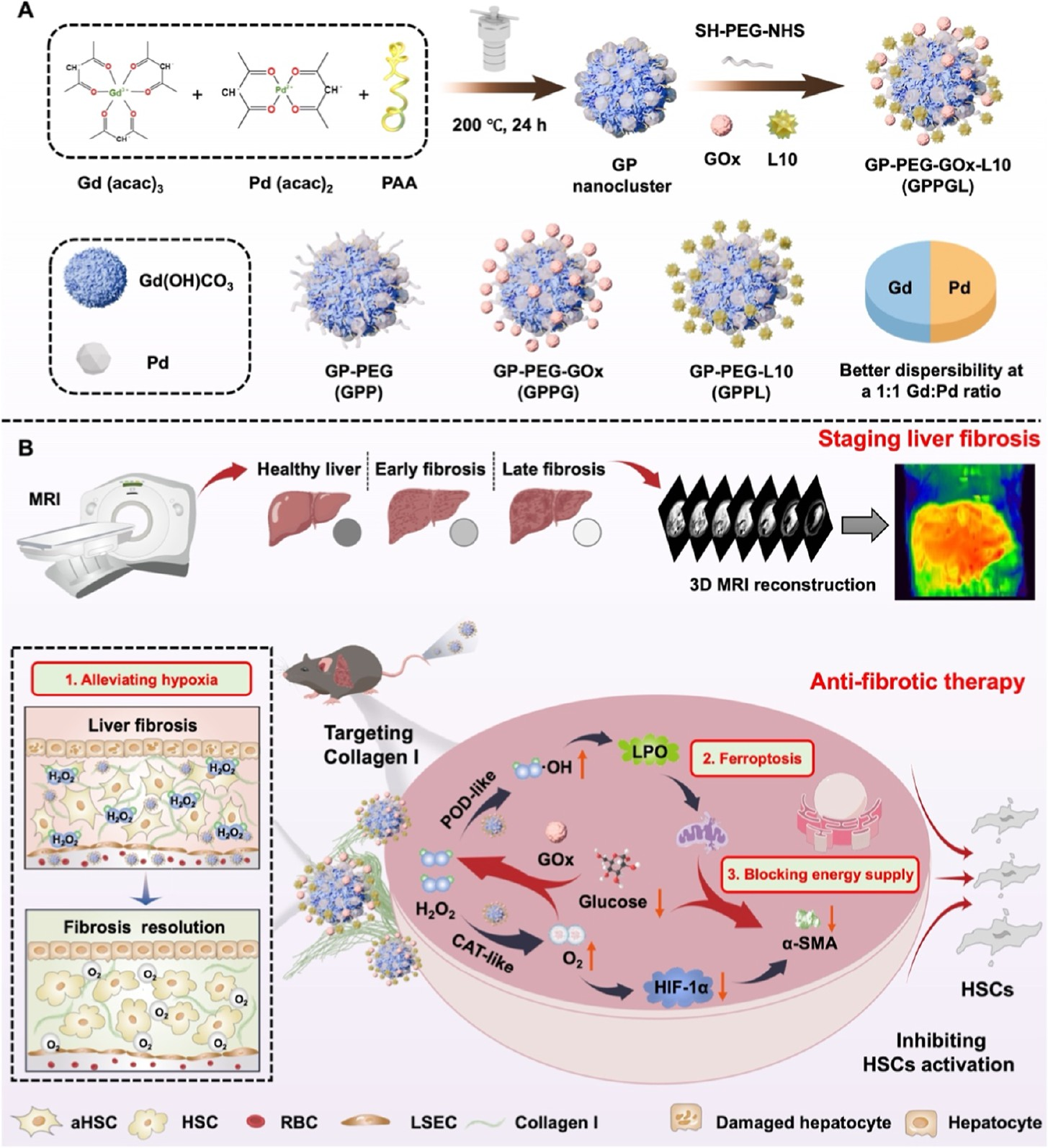
Liver fibrosis is a chronic and progressive liver disease that can lead to irreversible cirrhosis and hepatocellular carcinoma. However, early and accurate diagnosis of liver fibrosis remains a challenge in clinical research. This study developed gadolinium-palladium nanoclusters combined with deoxytaurocholic acid peptide (L10) and glucose oxidase (GOx) transplantation (GPPGL) for precise staging of liver fibrosis and synergistic anti-fibrotic therapy.L10 has a strong affinity for collagen I, which allows this nanoparticle platform to target areas of liver fibrosis and accumulate more effectively in the liver. Therefore, GPPGL has magnetic resonance imaging (MRI) contrast enhancement capabilities, enabling precise grading of different levels of liver fibrosis. Subsequently, 3D reconstruction and histogram feature analysis of MRI images are performed to quantitatively and qualitatively analyze the degree of liver fibrosis. GOx has high glucose consumption, which can cascade to enhance the peroxidase-like activity of the nanoparticle platform.The systemic delivery of GPPGL can synergistically inhibit the activation of hepatic stellate cells, reduce their collagen production, and alleviate liver fibrosis by relieving hypoxia, inducing ferroptosis, and achieving starvation therapy. No significant side effects were observed in histological and hematological examinations. Therefore, GPPGL shows potential for accurately staging liver fibrosis and providing synergistic antifibrotic treatment.

Recently, significant progress has been made in research on the diagnosis and treatment of liver fibrosis. The research team has developed a novel heterogeneous magnetic resonance nanoprobes called GPPGL, which can achieve precise staging and cascade treatment of liver fibrosis, providing new ideas for the early diagnosis and effective intervention of this chronic liver disease.
Liver fibrosis is a common pathological process in the development of various chronic liver diseases. Without timely intervention, it can progress to cirrhosis or even liver cancer. Currently, liver biopsy remains the gold standard for diagnosis, but its invasiveness, sampling errors, and inability to monitor repeatedly drive the scientific community to explore non-invasive and precise alternatives. The GPPGL nano-probe constructed in this study uses gadolinium-palladium nanoclusters as its core,The surface is modified with the decapeptide L10, which has a high affinity for collagen I, and glucose oxidase. L10 can guide the probe to specifically accumulate in fibrotic regions rich in collagen I, achieving targeted delivery. At the same time, the probe has excellent magnetic resonance imaging (MRI) contrast enhancement capabilities, with a longitudinal relaxation rate significantly higher than commonly used clinical contrast agents, enabling clear visualization of differences in fibrosis levels on MRI images.
Reference News:
DOI: 10.1021/acsnano.5c17091