已传文件:photo/1769912431.png
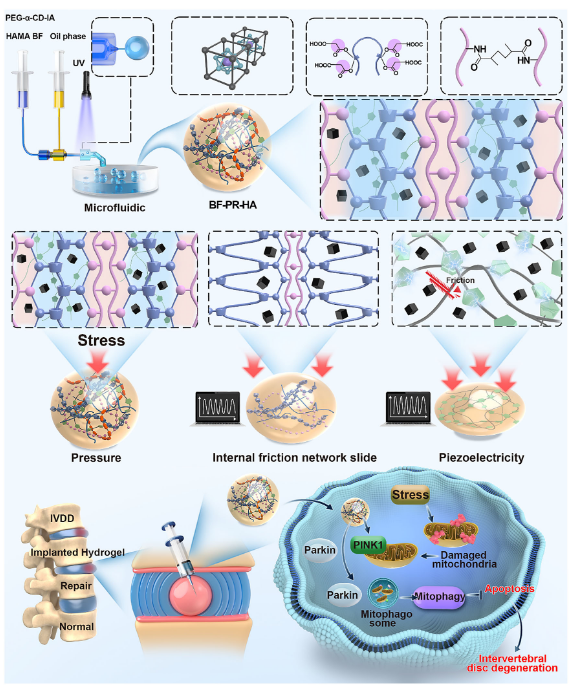
Imbalances in mitochondrial autophagy critically drive cell apoptosis and tissue degeneration, necessitating physiological electrical adaptation to reach the cellular threshold. However, degenerative tissues exhibit a lack of endogenous electrical signals, which interferes with cellular energy transmission. By utilizing supramolecular engineering and microfluidic strategies, we constructed an internal friction network hydrogel microsphere system through the cooperative assembly of piezoelectric barium ferrite nanoparticles (BF) and sliding-ring-functionalized methacrylated hyaluronic acid (HAMA), achieving physiological electrical adaptation in degenerative tissues. BF converts mechanical stimulation into electrical signals, while the stress-dependent internal friction network modulates energy dissipation.Under low stress, the sliding ring movement generates low friction, with electromechanical conversion loss of 61.5 kJ/m³, enhancing electricity generation. Under high stress, straightening of the main chain increases friction to 78.3 kJ/m³, suppressing excessive signals and restoring physiological electrical adaptation. The microspheres generate a stable electric field (95–110 mV/mm) under dynamic loading, activating mitophagy through the PINK1/Parkin pathway, maintaining mitochondrial membrane potential stability (JC-1 ratio increased by 49.2% compared to the OS group), and reducing nucleus pulposus apoptosis by 75%. In vivo experiments showed that microsphere implantation restored the physiological electrical environment, enhanced mitophagy, inhibited cell apoptosis, and slowed the progression of intervertebral disc degeneration, providing new insights into restoring and treating degenerative tissues through electrical adaptation.
For degenerative tissue diseases such as intervertebral disc degeneration, one of the core pathological mechanisms lies in cell apoptosis and energy metabolism disorders caused by an imbalance in mitochondrial autophagy. The loss of endogenous electrical signals in degenerated tissues further exacerbates the decline in cellular function. Recently, a study published in Advanced Materials proposed an innovative intrafriction network piezoelectric hydrogel microsphere system, which provides a new approach for intervening in degenerative changes by restoring the physiological electrical adaptation of tissues.
The research team successfully constructed composite hydrogel microspheres with both stress-responsive and electromechanical conversion functions by utilizing supramolecular engineering and microfluidic technology. The core design lies in the synergistic assembly of bismuth ferrite nanoparticles, which possess excellent piezoelectric properties, with methacrylated hyaluronic acid functionalized with sliding rings. The polyrotaxane formed by the sliding ring structures serves as dynamic crosslinking points, co-forming a unique internal friction network with flexible polymer chains. This network can adaptively regulate energy dissipation based on the magnitude of the applied stress: under low stress, the sliding rings move freely, resulting in low internal friction and minimal mechanical energy loss, which facilitates efficient conversion of mechanical stimuli into electrical signals by the piezoelectric material; under high stress, the polymer backbone is stretched, impeding the movement of the sliding rings, significantly increasing internal friction, thereby dissipating excess mechanical energy, suppressing excessive electrical output, and achieving adaptive regulation of electrical signal output.
References:
DOI: 10.1002/adma.202519152