已传文件:photo/1770081635.png
Peritoneal metastasis of colorectal cancer (PM-CRC) is a major therapeutic challenge in advanced disease, and abnormal tumor vasculature leads to poor prognosis. To overcome the pharmacological limitations of regorafenib (REG), this study developed a dual-receptor targeted nanoplatform (REG@LFHA NPs) that exploits the uniquely overexpressed LRP-1 and CD44 receptors in the colorectal cancer tumor microenvironment. This nanoplatform was designed using nanoprecipitation and electrostatic self-assembly, combining lactoferrin to target LRP-1 and hyaluronic acid to recognize CD44. REG@LFHA NPs exert multifaceted antitumor effects through three coordinated mechanisms: effective suppression of tumor vasculature via VEGF-VEGFR pathway blockade, disrupting blood and oxygen supply to induce tumor necrosis; direct tumor cytotoxicity through REG-mediated apoptosis and cell cycle arrest; and immune microenvironment remodeling through macrophage repolarization from pro-tumor M2 to anti-tumor M1 phenotypes. In PM-CRC models, REG@LFHA NPs significantly enhanced tumor accumulation and therapeutic efficacy compared to free REG. Additionally, the nanoplatform demonstrated significant synergistic effects with oxaliplatin, a first-line chemotherapy agent for PM-CRC, achieving superior therapeutic outcomes through complementary mechanisms. This study not only establishes REG@LFHA NPs as an effective dual-targeted nanomedicine but also highlights its strong potential for clinical translation, especially when combined with standard chemotherapy regimens for the treatment of advanced peritoneal metastatic colorectal cancer.
Colorectal cancer (CRC) is a common malignant tumor worldwide with high incidence and mortality. Approximately 20-25% of patients with advanced CRC develop peritoneal metastasis (PM), leading to a long-term 5-year survival rate of less than 15%, posing a significant clinical treatment challenge. The pathological progression of peritoneal metastasis heavily relies on the formation of an abnormal tumor vascular network. These disordered blood vessels not only supply nutrients for tumor growth but also promote the spread of cancer cells. Therefore, targeting tumor angiogenesis, combined with directly killing tumor cells and reversing the immunosuppressive microenvironment, has become a key strategy against this refractory metastatic tumor. The oral multi-target kinase inhibitor regorafenib (REG) has received considerable attention because it can simultaneously block the VEGF/VEGFR pathway, induce tumor cell apoptosis, and possesses unique immunomodulatory functions. However, its poor water solubility, low bioavailability, and dose-limiting toxicities (such as hand-foot syndrome) severely restrict its clinical effectiveness.
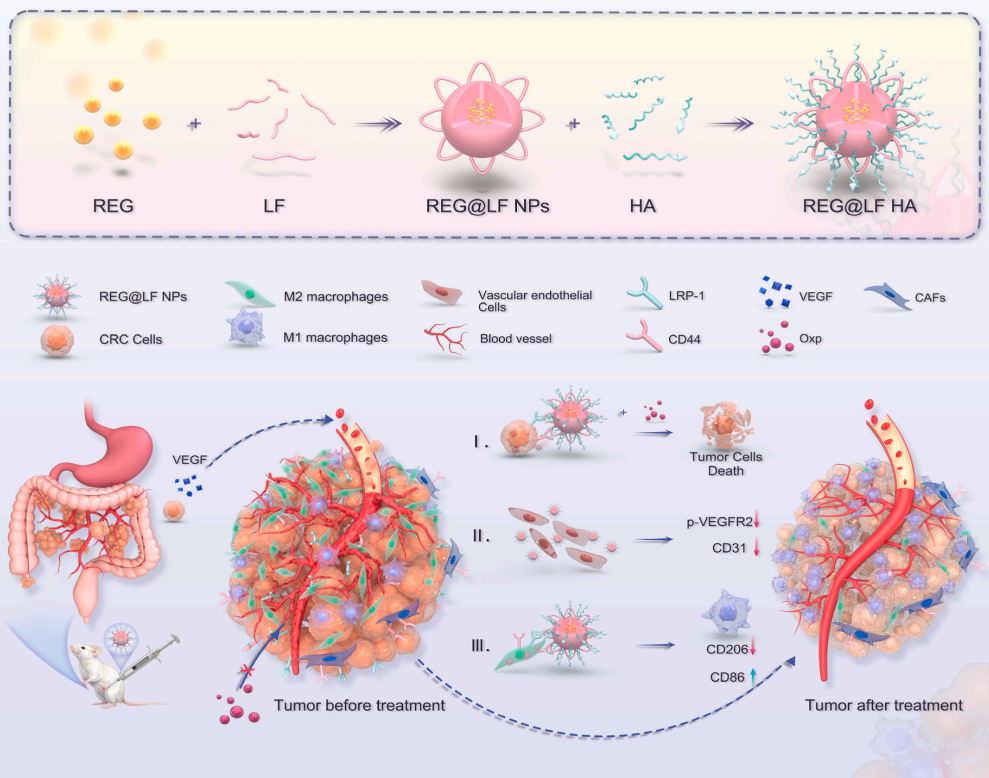
In a PM-CRC mouse model established with CT26-luc cells, REG@LFHA NPs monotherapy showed significantly superior anti-tumor effects compared to free REG, reducing tumor weight and bioluminescence signals by 78.0% and 64.5%, respectively. Macroscopically, tumor tissues appeared characteristically pale, indicating vascular damage and secondary necrosis. Detailed analysis of the tumor microenvironment revealed a comprehensive mechanism: immunofluorescence showed that the pathological vessel density (CD31 positive) in the tumors of the treatment group decreased by 73.6%, while infiltration of CD206-positive M2 macrophages was reduced by 69.4%; flow cytometry further confirmed that the proportion of F4/80⁺CD86⁺ M1 macrophages in tumor tissues increased dramatically by 87.3%. This dual effect of vascular inhibition and immune remodeling collectively led to severe ischemia and hypoxia within the tumor, inducing high expression of HIF-1α and creating a microenvironment unfavorable for tumor growth.
Particularly noteworthy is that this nanoplatform, when combined with the frontline chemotherapy drug oxaliplatin (OxP), produced an outstanding synergistic effect. In vitro experiments showed that the combination induced stronger cell death in both 3D tumor spheroids and 2D cultures, with a combination index (CI) of less than 1, confirming a clear synergistic relationship. Mechanistic studies revealed that REG@LFHA NPs primarily drive G1 phase arrest and apoptosis, while OxP indirectly activates the G1 checkpoint by causing DNA damage. Together, they complement each other in cell cycle regulation, jointly enhancing the G1 phase arrest effect. In vivo, the combination therapy of REG@LFHA NPs and oxaliplatin achieved the strongest antitumor effect, with a tumor inhibition rate of up to 90.3%, and no significant systemic toxicity was observed. Histological morphology of major organs and serum biochemical indicators remained normal.
Reference:
DOI: 10.1016/j.bioactmat.2025.12.015