已传文件:photo/1772675758.png
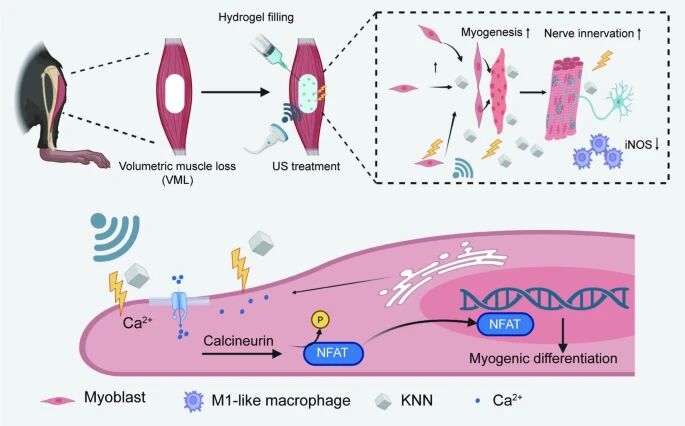
This study investigated novel therapeutic strategies for volumetric muscle loss (VML) and designed an injectable, conductive hydrogel with piezoelectric properties called KOCC hydrogel. Lead-free piezoelectric (K, Na)NbO₃ (KNN) nanoparticles were incorporated into a dynamically crosslinked network composed of oxidized sodium alginate, quaternary ammonium chitosan, and calcium ions, combined with ultrasound stimulation to establish a wireless electrotherapy strategy. This approach does not require implanted electrodes or external wires, can generate controllable local electric fields, and promotes functional improvement in a mouse VML model by coordinating myogenesis, enhancing nerve regeneration, and neuromuscular junction formation, while reducing excessive inflammation and fibrosis. This work provides a novel piezoelectric platform for VML treatment; related literature was published in the Journal of Nanobiotechnology.
Innovative Points
01
Wireless Piezoelectric Platform, Avoiding Invasion
Establish a wireless, ultrasound-responsive piezoelectric therapy platform that does not require implanted electrodes or external wire connections, capable of generating controlled local electric fields. This avoids issues related to invasive procedures and enhances the safety and convenience of treatment.
02
Injectable Hydrogel, Adaptable to Injury
Design a dynamically cross-linked KOCC hydrogel system that integrates lead-free piezoelectric materials with a biocompatible matrix, balancing piezoelectric performance and injectability, enabling precise adaptation to the filling and repair needs of VML injury sites.
03
Synergistic Regulation, Enhancing Repair
Focus on the synergistic regulation of myogenesis and nerve reinnervation while improving the VML injury microenvironment, reducing excessive inflammation and fibrosis, and achieving coordinated repair of muscle structure and function, breaking through the limitations of single repair mechanisms.
Material Development
Material / Material
KOCC hydrogel is composed of lead-free piezoelectric (K, Na) NbO₃ (KNN) nanoparticles, sodium alginate, decyl hydrochloride, and calcium ions. It forms a stable network structure through dynamic cross-linking, possessing both piezoelectric and conductive properties.
Function / Function
Under ultrasonic stimulation, it can generate a controllable local electric field; it is injectable and can adapt to the filling needs of VML injury sites; it can promote myogenic differentiation, enhance nerve regeneration and neuromuscular junction formation, while inhibiting excessive inflammation and fibrosis, providing a suitable microenvironment for muscle repair.
Thought Extension
1. Material Performance Optimization: Further optimize the compositional ratio of KOCC hydrogels to enhance their piezoelectric performance and biocompatibility, while exploring the regulatory patterns of ultrasound parameters (such as intensity and frequency) on electrical signal generation and repair effects to achieve precise improvement in repair outcomes.
2. In-depth Molecular Mechanisms: Conduct in-depth studies on the specific molecular mechanisms through which this piezoelectric platform regulates myogenesis and nerve reinnervation, clarifying the regulatory effects of electrical signals on relevant cellular pathways, and providing solid theoretical support for precise treatment of VML.
3. Application Scenario Expansion: Expand the potential applications of this piezoelectric hydrogel in the repair of other tissue injuries, exploring its adaptability in fields such as nerve injury and cartilage repair, thereby enriching the application scenarios of piezoelectric materials.
Original Source
Journal Name: Journal of Nanobiotechnology
Publication Date: 2026-03-01
DOI: 10.1186/s12951-026-04124-8
Research Team: Yangbao Lyu, Fang Wang, Haihan Gao, Erpeng Yang, Liren Wang, Zaijin Tao, Yang Xiao, Qifu Yang, Yuhan Jiang, Yuming Zhou, Liuqing Yang, Wen Gong, Ke Wang, Fangzhou Yao, Xuanyong Liu, Jiajun Qiu, Xin Ma, Jia Jiang