已传文件:photo/1773121782.png
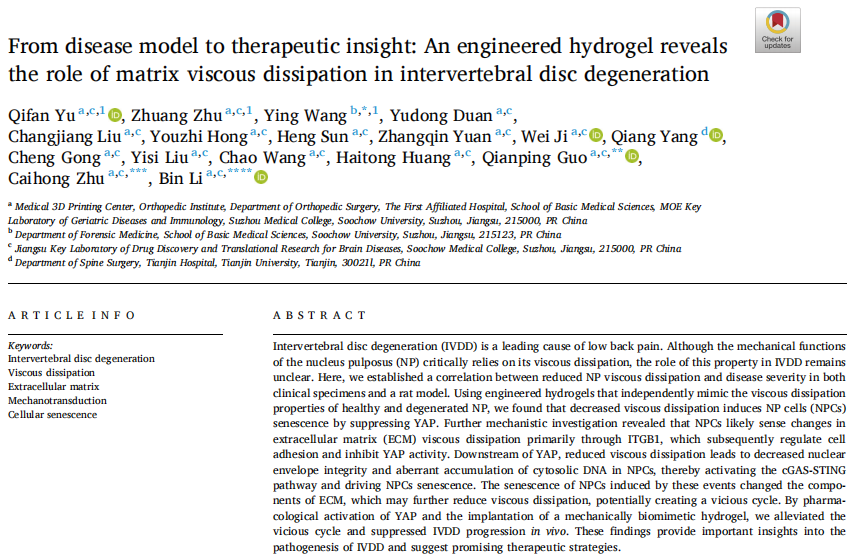
Intervertebral disc degeneration (IVDD) is one of the main causes of lower back pain. Although the mechanical function of the nucleus pulposus (NP) critically depends on its viscoelastic dissipation, the role of this property in IVDD remains unclear. In this study, we established a correlation between reduced NP viscoelastic dissipation and disease severity in both clinical samples and rat models. Using engineered hydrogels that independently mimic the viscoelastic dissipation characteristics of healthy and degenerated NP, we found that reduced viscoelastic dissipation induces NP cell (NPC) senescence by inhibiting YAP. Further mechanistic studies revealed that NPCs may primarily sense changes in extracellular matrix (ECM) viscoelastic dissipation through ITGB1, thereby regulating cell adhesion and inhibiting YAP activity. Downstream of YAP, reduced viscous dissipation leads to a decrease in NPC nuclear membrane integrity, abnormal accumulation of cytoplasmic DNA, activation of the cGAS-STING pathway, and promotion of NPC senescence. NPC senescence induced by these events alters ECM components, potentially further reducing viscoelastic dissipation and forming a vicious cycle. By pharmacologically activating YAP and implanting mechanically biomimetic hydrogels, we alleviated the vicious cycle and inhibited IVDD progression in vivo. These findings provide important insights into the pathogenesis of IVDD and propose promising therapeutic strategies.
Summary
A study published in *Bioactive Materials* revealed the critical role and regulatory mechanisms of the viscoelastic dissipation properties of the extracellular matrix (ECM) in intervertebral disc degeneration (IVDD) by engineering hydrogels to mimic these properties. The research team first confirmed in clinical samples and rat models that the decrease in viscoelastic dissipation capacity of the nucleus pulposus tissue is positively correlated with the severity of IVDD. To explore the pathological significance of this mechanical property change, the team constructed two hydrogels with decoupled mechanical properties, simulating the viscoelastic dissipation levels of normal (V-gel) and degenerated (E-gel) nucleus pulposus. The results showed that even without changing the matrix stiffness, reduced viscoelastic dissipation alone could induce the senescence of nucleus pulposus cells (NPCs): cell spreading area decreased, proliferation capacity declined, senescence-associated β-galactosidase activity increased, accompanied by upregulation of senescence markers such as p16INK4a and γ-H2AX and increased secretion of SASP factors.
References:
DOI: 10.1016/j.bioactmat.2026.02.021
Click to read the original text, and you will be redirected to the original link