已传文件:photo/1792114439.png

Summary:
This study looks into how STING mediates bone remodeling during orthodontic tooth movement in the context of periodontitis. The authors created a rat model combining periodontitis with orthodontic tooth movement, and in vitro, they used periodontal ligament fibroblasts exposed to inflammatory stimuli and compressive stress, testing STING with activators, inhibitors, and gene knockdown. The results showed that STING activation is linked to ER stress, pro-inflammatory responses, apoptosis, and inhibition of bone formation, and it speeds up bone resorption. Anxa2 was identified as a new STING-interacting factor involved in NF-κB-related inflammatory signaling. Inhibiting STING could reduce these responses, suggesting that the STING-Anxa2-NF-κB functional connection plays a role in bone remodeling during orthodontics in periodontitis.
Research Background
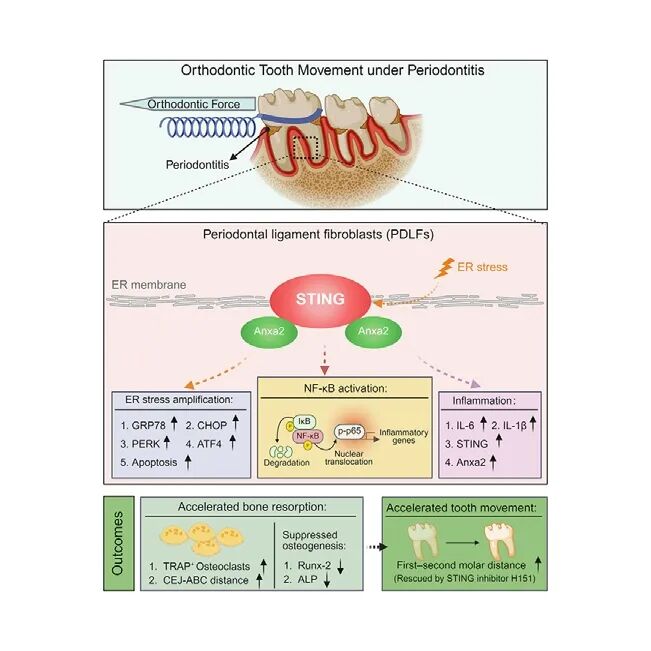
Orthodontic tooth movement under healthy conditions is a mechanically induced sterile inflammatory process, whereas in periodontitis, it is combined with bacteria-driven inflammation, creating a more complex microenvironment that worsens bone resorption on the compression side. Periodontal ligament fibroblasts are the most abundant and mechanically sensitive cells in the periodontal ligament, connecting the tooth to the alveolar bone and participating in inflammation and bone remodeling. STING is a cytoplasmic DNA sensor located on the endoplasmic reticulum membrane that can activate the interferon and NF-κB pathways, involved in sterile inflammation and immune responses. Previous studies suggest that STING is related to periodontitis bone resorption and mechanical forces, but its role in periodontitis combined with orthodontic tooth movement is still unclear.
Results
STING activation can increase IL-1β and IL-6, decrease Runx-2, and inhibit bone formation. In rats with periodontitis combined with orthodontic tooth movement, STING, IL-1β, and IL-6 were upregulated on the compression side, Runx-2 was downregulated, alveolar bone loss worsened, and H151 could partially reverse these effects. Under mechanical inflammatory stimulation, STING activation was accompanied by increased ER stress markers, apoptosis, altered mechanical responses, and inhibited bone formation. Anxa2 was identified as a STING interacting factor, and knocking it down could mimic the effects of STING inhibition, reducing ER stress, inflammation, apoptosis, and mechanical responses, while also decreasing P65 phosphorylation and nuclear translocation. STING
Original Source:
Journal of Advanced Research
Pub Date: 2026-07-17
DOI: 10.1016/j.jare.2026.07.038
Yuqin Jin, Jiangyan Ren, Baochao Li, Jialing Li, Xuanxuan Yu, Yanyi Wang, Shumin He, Chao Liu, Liang Ding, Huang Li
We focus on custom functional materials in the field of nanomedicine. Based on your experimental needs, we can develop biofunctional nanomaterials, adjusting material structure, particle size, and surface modification, and provide full characterization testing. The plan can be repeatedly optimized with full technical support throughout, supporting research projects in targeted delivery, bioimaging, nanodiagnostics, and therapy. Feel free to provide your requirements, and we’ll evaluate customized solutions.
Engineer Zhang: 17715390137
Engineer Chen: 18914047343