已传文件:photo/1793069684.png

Summary:
Chronic osteomyelitis requires eliminating pathogens and restoring the bone-forming microenvironment, but these two often get out of sync. Repeated debridement and long-term antibiotics rarely prevent recurrence, as Staphylococcus aureus biofilms, intracellular infections, and invasion of the osteocyte network make it persist. Ongoing infection disrupts the early antibacterial inflammation, inflammation resolution, vascularization, and bone formation timing of bone immunity. JAK2-STAT3 links infection, macrophage dysfunction, and bone repair, with a two-way effect depending on the environment. Current immunotherapies mostly rely on drug delivery, but the damaged blood supply in infected bone limits penetration. Electrical stimulation can regulate immunity and regeneration, but traditional devices need an external power source; direct current triboelectric nanogenerators can convert low-frequency mechanical movement into directed pulse DC, providing an engineering basis for local, on-demand, repeatable, drug-free electrical stimulation.
01
Research Background
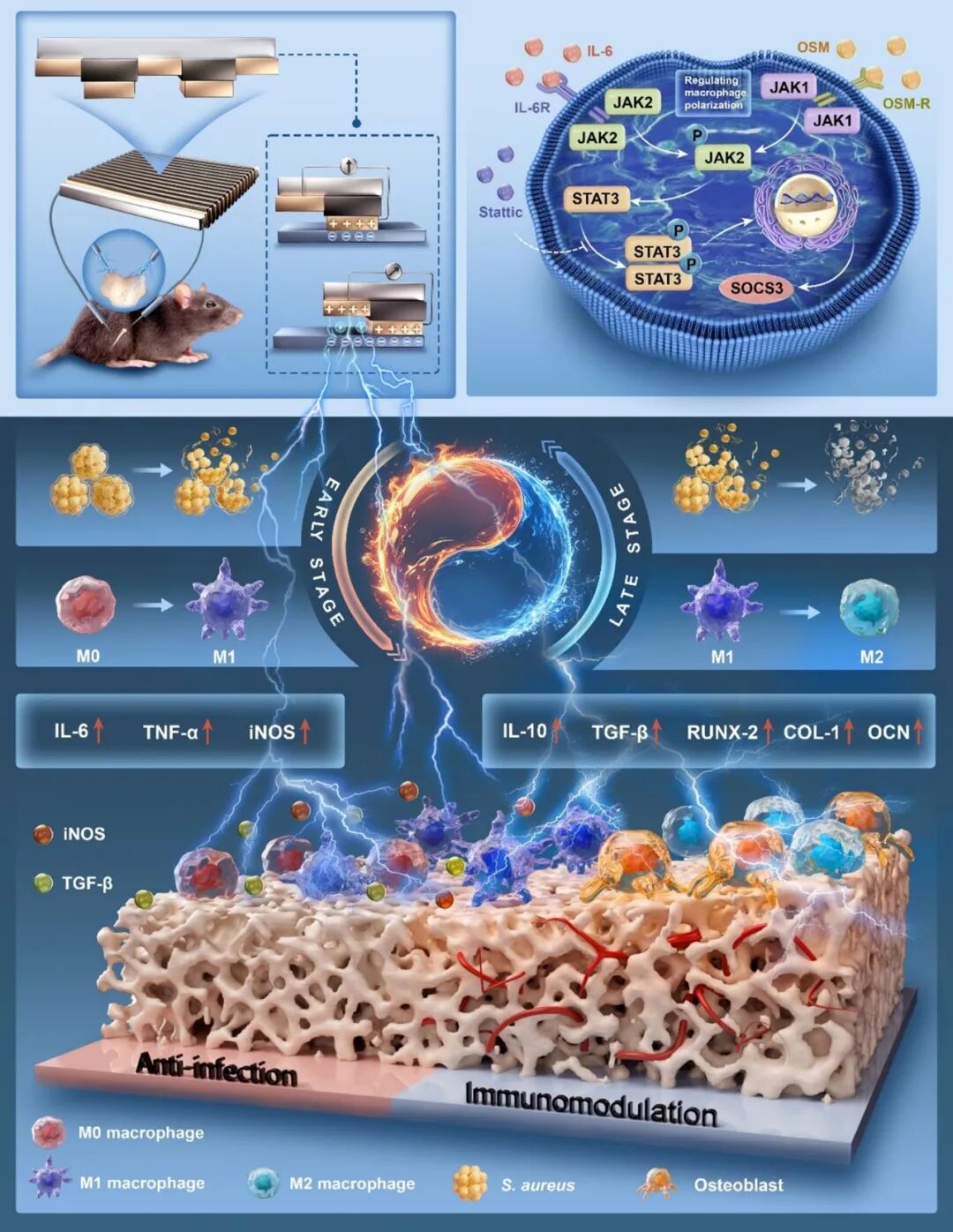
Chronic osteomyelitis requires clearing the pathogens and restoring the bone-forming microenvironment, but the two often don’t go hand in hand. Repeated debridement and long-term antibiotics hardly prevent recurrence, while Staphylococcus aureus biofilms, intracellular infection, and invasion of the bone cell network make things persist. Ongoing infection disrupts the early antibacterial inflammation, inflammation resolution, vascularization, and bone formation timing in bone immunity. JAK2-STAT3 links infection, macrophage dysfunction, and bone repair, and it behaves differently depending on the environment. Current immunotherapy mostly relies on drug delivery, but poor blood supply in infected bone limits penetration. Electrical stimulation can regulate immunity and regeneration, but traditional devices depend on external power; direct current triboelectric nanogenerators can convert low-frequency mechanical motion into directed pulsed DC, providing an engineering basis for local, on-demand, and repeatable drug-free electrical stimulation.
02
Main Content
The study proposes a staged electrotherapy driven by a DC triboelectric nanogenerator, using fixed optimized stimulation conditions to see if it induces different biological responses over short- and long-term periods. The authors don’t just view it as an antibacterial or bone-growth stimulator, but as a drug-free triboelectric platform that combines immediate local antibacterial effects with time-coordinated bone immune regulation and bone repair. The work systematically evaluates in vitro and in vivo performance, and explores how the infected bone marrow microenvironment is regulated, focusing on whether JAK2-STAT3 is involved in the shift from early antibacterial immune activation to later tissue repair.
03
Research Design
We designed a sliding mode DC friction nanogenerator to generate pulsed DC through electrostatic breakdown. In vitro, we compared different currents and durations to evaluate macrophage compatibility, osteogenesis of pre-osteoblasts, Staphylococcus aureus planktonic bacteria, and biofilm formation. Mechanistically, we performed RNA sequencing, KEGG/GSEA, and WB on chronic osteomyelitis and control tibial bone marrow; in macrophages, we combined IF, WB, ELISA, and qPCR, and used Stattic inhibition and STAT3 siRNA knockdown. For the animal study, we used a mouse tibial osteomyelitis model with groups including control, Stattic, electrical stimulation, and electrical stimulation + Stattic, setting short-term and long-term endpoints to assess blood routine, immunofluorescence, bacterial plating, flow cytometry, histology, ELISA, micro-CT, and major organs.
04
Results
The DC friction nanogenerator outputs stable pulsed direct current. Under optimized conditions, it shows good cell compatibility and promotes osteogenesis, while inhibiting the growth and biofilm formation of Staphylococcus aureus in a parameter-dependent manner. Chronic osteomyelitis bone marrow sequencing showed bone immune imbalance, weakened JAK2-STAT3 signaling, and increased SOCS3. Electrical stimulation activated macrophage JAK2-STAT3, reduced SOCS3, promoted pro-inflammatory/antibacterial phenotypes, ROS production, and antibacterial genes; Stattic and STAT3 knockdown weakened these effects. Short-term in vivo, it induced STAT3-dependent antibacterial immune activation, enhanced T cell response, reduced bacterial load, without causing sustained inflammation. Long-term, inflammation and chemotactic signals were reduced, JAK2-STAT3 activity decreased, inflammation subsided, collagen remodeled, osteogenic markers and bone structure improved, with no obvious abnormalities in major organs.
Original Source:
Journal of Nanobiotechnology
Pub Date: 2026-09-25
DOI: 10.1186/s12951-026-05112-8
Yunchang Zhao, Haimei Li, Junwei Su, Yize Wu, Zhiwei Wang, Jianghan Xia, Xinyi Tan, Zheng Wang, Hao Zhang, Yuchen Song, Ying Yuan, Peng Jiang, Aixi Yu