已传文件:photo/1793239584.png

Summary:
Lower back pain is linked to endplate sclerosis, and aging-like macrophages accumulate in the hardened endplates, promoting pathological angiogenesis and bone formation coupling via IL-10/STAT3. The study developed PLGA nanospheres coated with macrophage membranes and loaded with ABT-263 and Fe3O4 (MM@MS@ABT), which can target degenerated endplates through both magnetic guidance and the inflammatory microenvironment. These nanospheres help clear aging-like macrophages, reduce IL-10 and CD31/Emcn-driven angiogenesis, and relieve endplate sclerosis, providing experimental evidence for back pain associated with endplate hardening.
01
Research Background
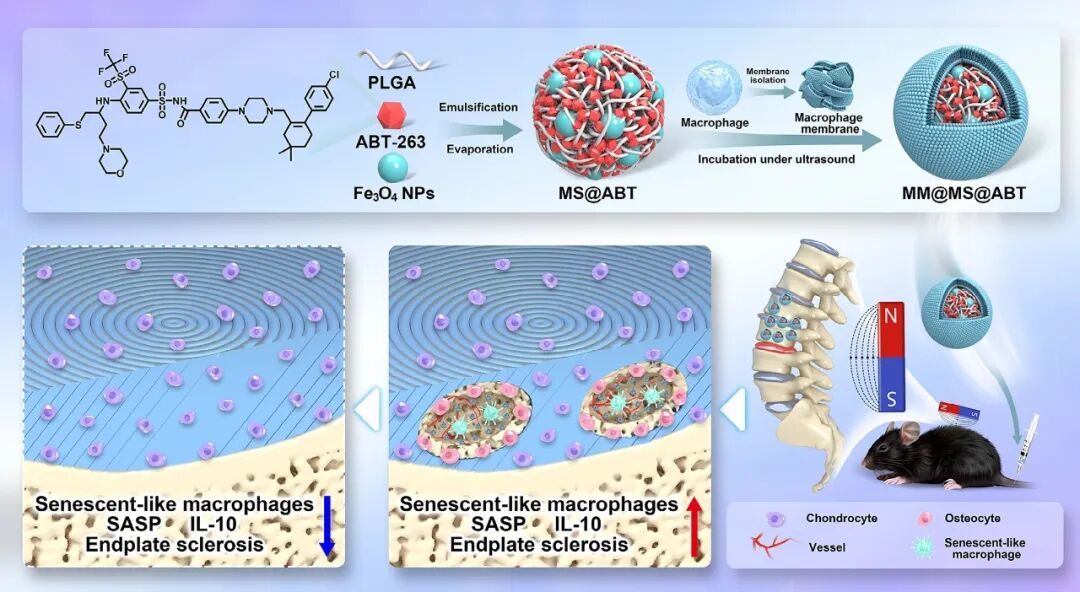 Low back pain is common and disabling. Current conservative and surgical strategies mostly target the symptoms, lacking interventions for the pathology of endplate degeneration. Early signs of lumbar instability and aging can induce endplate sclerosis. Senescent-like macrophages secrete IL-10, which upregulates VEGFA, PDGFB, and MMP2 via STAT3, triggering angiogenesis-osteogenesis coupling and causing pain. Systemic administration of senolytic drugs can easily lead to off-target effects and adverse reactions, so the drugs need to be delivered precisely to the sclerotic endplate while minimizing systemic exposure.
02
Main Content
The study focuses on the role of senescent-like macrophages in endplate sclerosis and develops a PLGA nanodelivery system co-loaded with macrophage membrane biomimetic, magnetic Fe3O4, and ABT-263. This system uses the macrophage membrane to actively target inflammatory sites and magnetism for passive accumulation, releasing a senolytic drug locally in degenerated endplates to inhibit senescent-like macrophages and their SASP, block IL-10–mediated angiogenesis-osteogenesis coupling, and thus alleviate endplate sclerosis.
03
Research Design
Prepare MM@MS@ABT and characterize its morphology, particle size, zeta potential, composition, magnetic response, drug release, membrane protein retention, and biocompatibility. In vitro, use H2O2 to induce macrophage senescence, and assess uptake, SA-β-Gal, P16/P53/γH2AX, SASP genes, IL-10, and endothelial tube formation. In animals, establish a lumbar instability model with groups including PBS, PLGA@ABT, MM@MS, MM@MS@ABT, and a sham surgery group; administer drugs via tail vein and apply a local magnetic field, followed by in vivo/ex vivo imaging and local drug quantification. Evaluate the endplate using micro-CT, histology, immunofluorescence, immunohistochemistry, and safety indicators.
04
Results
The nanospheres have a bilayer membrane structure and retain macrophage membrane markers, showing magnetic responsiveness and sustained-release properties, with good biocompatibility. The dual-targeting system accumulates in degenerated lumbar regions, achieving higher local drug concentrations. In vivo, it reduces endplate SA-β-Gal cells and F4/80 with P16, P53, and γH2AX double-positive cells, lowers senescence-associated secretory genes and IL-10, decreases CD31 Emcn vessels, p-STAT3, and Osx/Ocn positive cells, and improves endplate porosity and pathological scores. In vitro, it inhibits markers of senescent macrophages and IL-10 secretion, and weakens their conditioned media-driven promotion of endothelial tube formation; no obvious pathological abnormalities were observed in major organs.
05
Further Thoughts
This study places aging-like macrophages at the core of the immune mechanism of endplate sclerosis. Combining membrane biomimicry with magnetic targeting can improve local delivery selectivity and reduce systemic exposure. Future work needs to clarify the anti-inflammatory role of the macrophage membrane itself, other IL-10 sources in the endplate, and the applicability of different aging markers, optimize membrane protein retention, magnetic guidance parameters, and dosing schedules, assess long-term safety and tissue homeostasis after clearing senescent cells, and potentially explore combinations with other senescent cell interventions or bone immune regulation strategies.
Original Source:
Journal of Advanced Research
Pub Date: 2026-10-01
DOI: 10.1016/j.jare.2026.01.054
Weiping Su, Chenhao Shi, Yixiao Pan, Boyan Ma, Yueke Sun, Mingzhe Fan, Lantian Zhao, Yuanyang Zhu, Xianglong Zhuo, Shiqing Feng, Shuangfei Ni
We provide custom functional nanomedicine materials. We adjust material structure, particle size and surface modification as requested, with complete characterization and ongoing technical communication. Our solutions fit targeted delivery, bioimaging and nanotheranostics research. Submit your requirements for evaluation.
Mr. Zhang: +86 17715390137
Mr. Chen: +86 18914047343