已传文件:photo/1794206941.png
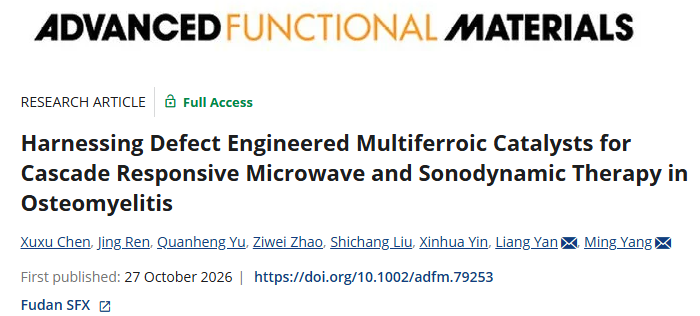
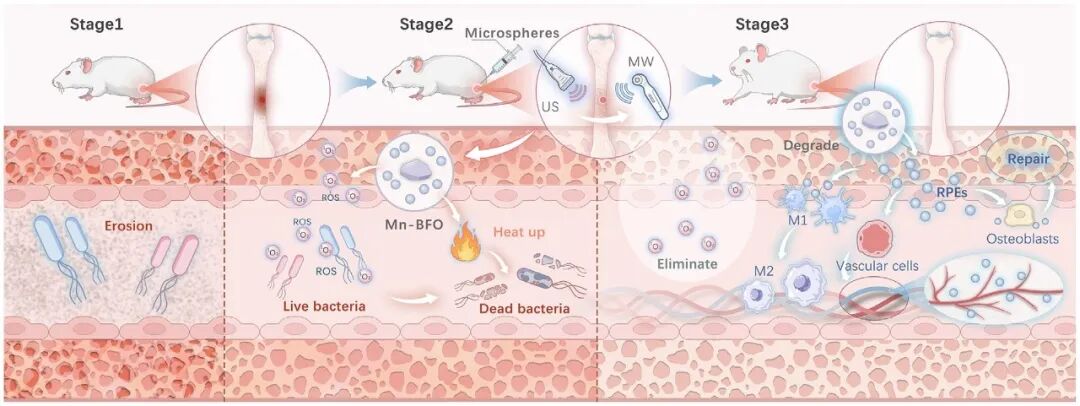
In this study, a defect‑engineered multiferroic catalytic platform was constructed, in which manganese‑doped bismuth ferrite nanocatalysts and RP‑derived extracellular vesicles were co‑loaded into injectable hydrogel microspheres. Sequential microwave and ultrasound stimulation triggers a thermo‑piezocatalytic cascade to generate localized heat and reactive oxygen species, achieving antibacterial activity, immunomodulation and bone regeneration for chronic osteomyelitis.
01
Research Background
 Chronic osteomyelitis is characterized by deep biofilms and bony structural barriers that hinder the penetration of antibiotics and immune cells. Monomodal microwave hyperthermia suffers from limited spatial precision, while standalone ultrasound‑triggered piezocatalysis faces rapid carrier recombination and insufficient energy coupling. Therefore, a multi‑physical‑field coupled platform is required to coordinate bactericidal action and tissue regeneration.
02 Main Content
Mn doping induces defect dipoles to modulate the electronic structure of bismuth ferrite, suppress leakage current, and boost dielectric loss and piezoelectric response. Microwave irradiation generates localized heat to lower the catalytic energy barrier; ultrasound facilitates piezoelectric charge separation and reactive oxygen species production, synergistically eradicating deep biofilms. Degradation of the hydrogel releases RP‑EVs to promote M2 macrophage polarization and osteogenesis. Theoretical calculations are performed to analyze band structures, work functions, adsorption energies and d‑p hybridization.
03 Study Design
BFO and Mn‑BFO were synthesized and characterized for morphology, crystal phase, elemental distribution, XPS, ESR, microwave absorption and piezoelectric performance. RP‑EVs were isolated and subjected to multi‑omics analysis. RP/Mn‑BFO hydrogel microspheres were fabricated. In vitro evaluations included antibacterial and anti‑biofilm activities, cytocompatibility, cell migration and osteogenic capacity. A rat tibial osteomyelitis model was established, followed by micro‑CT, histological staining, immunofluorescence, transcriptome sequencing and macrophage polarization analysis.
04 Results
Mn doping preserves the perovskite structure and introduces defect dipoles, which enhance microwave dielectric loss and piezoelectric response. Dual‑field stimulation elevates ROS production, strengthens antibacterial and anti‑biofilm effects, and triggers bacterial membrane disruption and protein leakage. The materials exhibit favorable cytocompatibility and upregulate osteogenic markers and mineralization. In vivo studies demonstrate alleviated infection and bone destruction, improved trabecular architecture, enhanced M2 polarization and osteogenic protein expression, and suppressed NF‑κB‑associated inflammatory pathways. Hemolysis assays confirm satisfactory hemocompatibility.
05 Outlook
Further investigations are required to clarify the types of Mn‑induced defects, quantify the correlation between dual‑field energy coupling and ROS generation, and distinguish the individual contributions of thermal effects, piezocatalysis and immunomodulation. Long‑term release, biodistribution and biosafety of Bi/Mn ions should be evaluated. The degradation profile of hydrogels and the release kinetics of extracellular vesicles need optimization, and validation in more sophisticated bone infection models is warranted.
Source:
Advanced Functional Materials
Published: 28 October 2026
DOI:10.1002/adfm.79253
Xuxu Chen, Jing Ren, Quanheng Yu, Ziwei Zhao, Shichang Liu, Xinhua Yin, Liang Yan, Ming Yang
We specialize in custom nano-medical functional materials. We conduct targeted development to tailor structure, particle size and surface modification for your experiments. Full characterization, iterative optimization and technical support are available for targeted delivery, bioimaging and nanomedicine studies. Send your evaluation plans to us.
Engineer Zhang: 17715390137
Engineer Chen: 18914047343