已传文件:photo/1794881287.png
 Frontiers in Nanomedicine
Laccase is an eco-friendly catalyst whose only catalytic byproduct is water, yet its application potential in biomedical detection remains underexplored. Herein, a ligand engineering strategy was adopted to synthesize manganese-cysteine nanoflowers (Mn-Cys NF) with laccase-like activity via a one-pot method. The nanoflowers employ manganese (Mn), which possesses multiple valence states, as the catalytic center and cysteine (Cys) as the ligand. Spectroscopic characterizations confirm that Cys modulates the electronic structure of Mn, and theoretical calculations verify enhanced substrate adsorption and reduced reaction energy barrier. The specific activity of Mn-Cys NF is approximately 3.56 times that of natural laccase, and it exhibits outstanding stability against variations in pH, temperature, ionic strength and organic solvents. Using this high-performance nanozyme, we constructed a CRISPR/Cas12a electrochemical biosensor based on a DNA triangular prism interface. In this sensor, target-triggered catalytic hairpin assembly (CHA)-DNAzyme cascade reactions regulate Cas12a cleavage to achieve signal-on detection. The biosensor enables quantitative detection of hepatocellular carcinoma (HCC) biomarkers alpha-fetoprotein (AFP) and microRNA-122 (miRNA-122), with limits of detection as low as 4.47 fg/mL and 6.21 aM, respectively. Moreover, it can effectively distinguish HCC patients from healthy individuals in clinical serum samples. This work provides a ligand engineering strategy for designing high-performance laccase-mimicking nanozymes and extends the application scope of laccase nanozymes from environmental remediation to biomedical sensing.

This study was published in ACS Nano under the title “Ligand-Engineered Mn-Cysteine as a Potent Laccase Mimic for CRISPR/Cas12a Electrochemical Biosensing of Hepatocellular Carcinoma Biomarkers”.
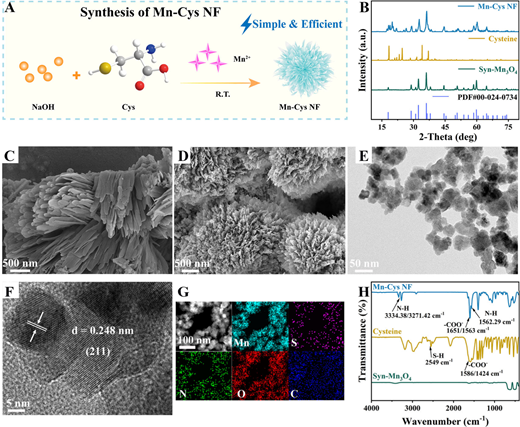
Figure 1
Synthesis, crystal structure, morphology, elemental mapping and surface functional group characterization of Mn-Cys NF. (A) Schematic illustration of the one-pot synthesis route of Mn-Cys NF. (B) XRD pattern. SEM images of Syn-Mn₃O₄ (C) and Mn-Cys NF (D). (E) TEM image of Mn-Cys NF. (F) HRTEM image of Mn-Cys NF. (G) Elemental mapping of Mn-Cys NF: C (blue), N (green), S (purple), O (red), and Mn (cyan). (H) FT‑IR spectrum of Mn-Cys NF.
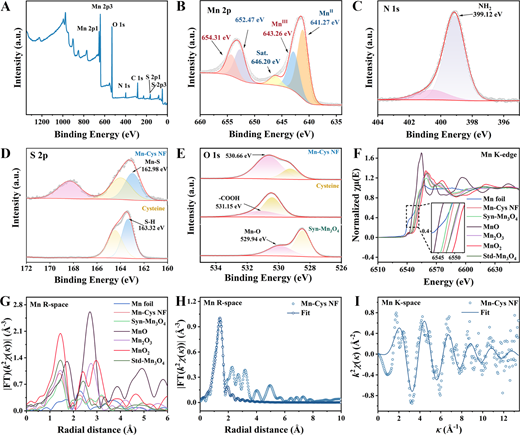
Figure 2
Chemical states and local coordination structure of Mn-Cys NF. (A) Survey XPS spectrum of Mn-Cys NF. High-resolution XPS spectra: (B) Mn 2p, (C) N 1s, (D) S 2p and (E) O 1s. (F) Mn K-edge XANES spectra of Mn-Cys NF and reference samples. (G) Fourier-transformed EXAFS spectra in R-space for Mn-Cys NF and reference samples. (H–I) EXAFS fitting curves of Mn-Cys NF.
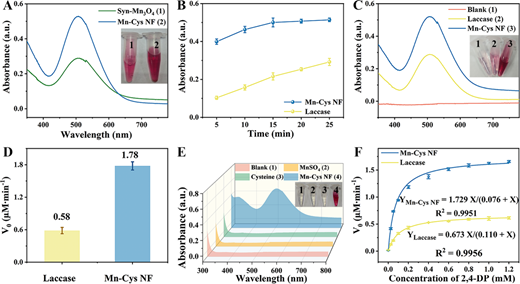
Figure 3
Comparison of catalytic activity and kinetics among Mn-Cys NF, Syn-Mn₃O₄, natural laccase and precursors. (A) UV‑vis spectra of reaction mixtures catalyzed by Syn-Mn₃O₄ and Mn-Cys NF, respectively (Inset: corresponding color photographs). (B) Time-dependent absorbance changes at 510 nm within 20 min. (C) UV‑vis spectra of supernatants after centrifugation. (D) Initial reaction rates (V₀) of natural laccase and Mn-Cys NF. (E) Catalytic performance of the nanozyme and its synthetic precursors. (F) Michaelis‑Menten kinetic fitting curves for 2,4-DP oxidation catalyzed by Mn-Cys NF and natural laccase.
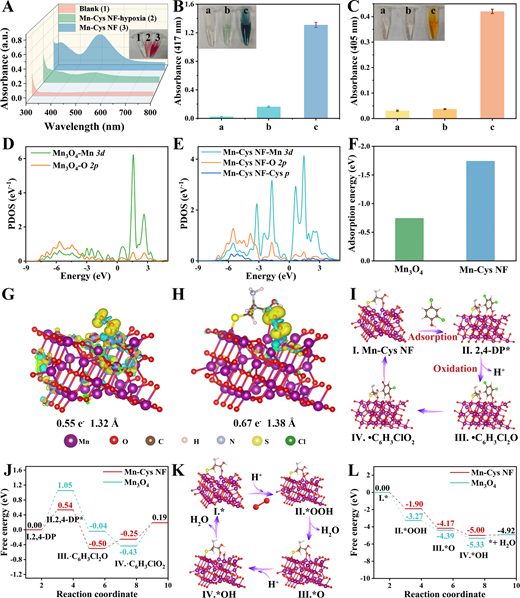
Figure 4
Experimental validation and theoretical interpretation of the catalytic mechanism of Mn-Cys NF. (A) Catalytic performance of Mn-Cys NF under normoxic and hypoxic conditions. (B) ABTS/HRP-based oxidative colorimetric assay for hydrogen peroxide detection: a: Mn-Cys NF + 2,4-DP; b: Mn-Cys NF + 2,4-DP + ABTS + HRP; c: Mn-Cys NF + 2,4-DP + ABTS + HRP + H₂O₂. (C) Hydrogen peroxide detection using Ti(SO₄)₂ colorimetric method: a: Mn-Cys NF + 2,4-DP; b: Mn-Cys NF + 2,4-DP + Ti(SO₄)₂; c: Mn-Cys NF + 2,4-DP + Ti(SO₄)₂ + H₂O₂. (D) PDOS of Mn (3d) and Cys (p) orbitals before Cys coordination. (E) PDOS of Mn (3d) and Cys (p) orbitals after Cys coordination. (F) Comparison of O₂ adsorption energies on Mn₃O₄ and Mn-Cys NF. Differential charge density analysis for O₂ adsorption on Mn₃O₄ (G) and Mn-Cys NF (H). (I) Proposed catalytic pathway for 2,4-DP oxidation on Mn-Cys NF. (J) Calculated free-energy profiles for 2,4-DP oxidation on Mn₃O₄ and Mn-Cys NF. (K) Proposed reaction pathway for O₂ reduction to H₂O on Mn-Cys NF. (L) Free-energy curve for O₂ reduction to H₂O on Mn-Cys NF.
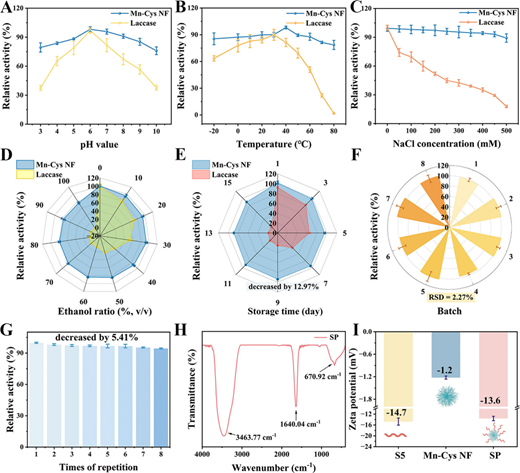
Figure 5
Stability and reusability of Mn-Cys NF, together with characterization of the sensitized probe. Catalytic stability of Mn-Cys NF and natural laccase under different treatment conditions: (A) pH, (B) temperature, (C) ionic strength, (D) organic solvents and (E) storage time. (F) Batch-to-batch reproducibility and (G) reusability of Mn-Cys NF. (H) FT‑IR spectrum of SP. (I) Zeta potential comparison among S5, Mn-Cys NF and SP.
Summary
Laccase produces only water as a by‑product, yet the poor stability of natural enzymes restricts their applications in bioassays. Herein, we adopt a ligand‑engineering strategy to fabricate manganese‑cysteine nanoflowers via one‑pot coordination of manganese ions with cysteine. Cysteine modulates the electronic structure of manganese, enhancing substrate adsorption and lowering the reaction energy barrier. This nanozyme exhibits 3.56 times higher specific activity than natural laccase and greatly improved tolerance toward harsh conditions. Coupled with a CRISPR/Cas12a electrochemical sensor, signal‑on detection is realized through target‑triggered cascade reactions. The limits of detection for hepatocellular carcinoma biomarkers AFP and miRNA‑122 reach 4.47 fg/mL and 6.21 aM, respectively, and the sensor can effectively discriminate clinical serum samples from HCC patients and healthy controls.
This work extends the application of laccase‑mimicking nanozymes from environmental catalysis to biomedical sensing and validates the feasibility of ligand engineering for boosting the performance of enzyme mimics. In future studies, cysteine can be substituted with other sulfur‑containing ligands to further optimize catalytic selectivity. The CRISPR sensing module is versatile; replacing the recognition sequence enables detection of other tumor biomarkers or pathogen nucleic acids. The excellent stability of the nanozyme favors the fabrication of test strips or portable electrodes for point‑of‑care testing. Moreover, the dual‑target detection capability of this system offers a convenient strategy for combined multi‑marker diagnosis.
Reference:
DOI: 10.1021/acsnano.6c07904