已传文件:photo/1795743431.png
 Biomedical Materials Frontier
Biomechanical energy is abundant yet irregular and low-grade, posing a major challenge to wearable electronics. Current energy-harvesting approaches are largely limited to charging capacitors via physical storage and cannot accomplish the full chemical charging cycle of practical batteries. To bridge this gap, we propose a closed-loop strategy that integrates an optimized triboelectric nanogenerator, a dedicated lithium-ion battery charging management system, and fiber lithium-ion batteries (FLIBs). This system achieves a 22.7-fold increase in root-mean-square current and an 800-fold reduction in optimal load resistance. Consequently, the charging rate is enhanced by 38.8-fold, enabling, for the first time, complete electrochemical charging cycles of 20 cm and 50 cm FLIBs within 2.37 ± 0.10 h and 6.06 ± 0.11 h, respectively. A self-powered backpack system demonstrates practical feasibility through real-time positioning and outdoor data transmission, marking a decisive advance for wearable devices from energy harvesting toward full energy autonomy.

This study was published in Advanced Materials under the title “Closed-Loop Wearable Energy Management: From Biomechanical Energy Harvesting to Full-Cycle Battery Charging”.
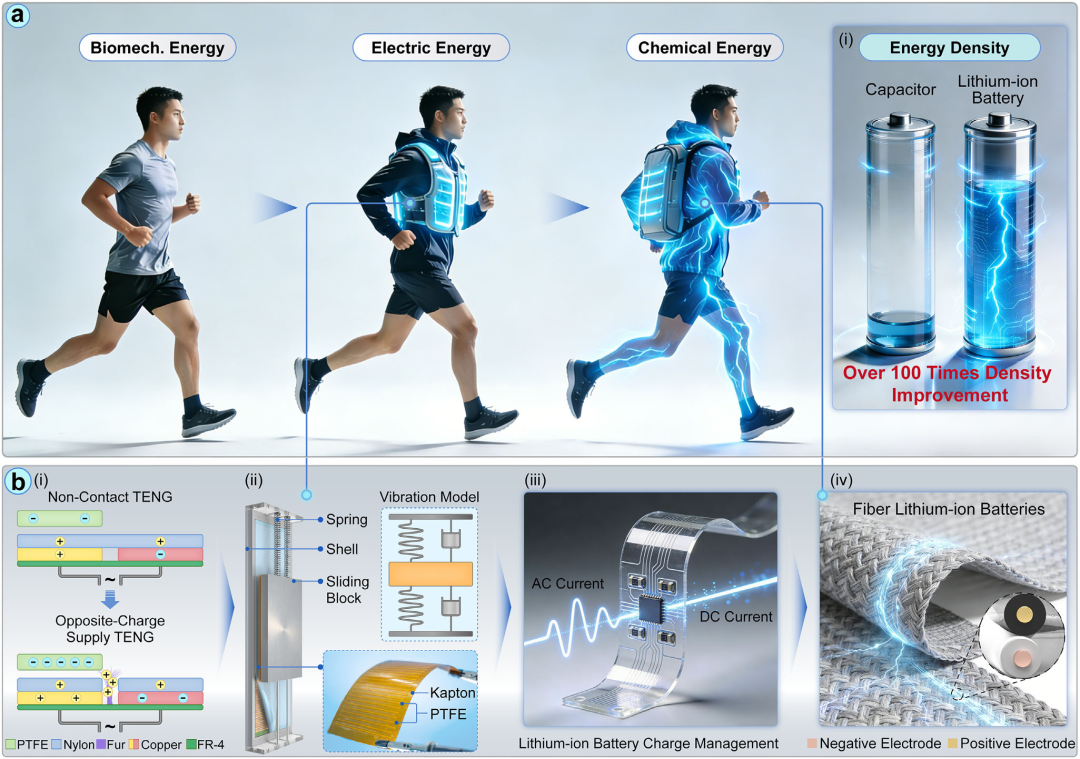
Figure 1
Structure and working mechanism of the self-powered backpack system for closed-loop biomechanical energy management.
(a) Schematic illustration of the closed-loop wearable energy management system. Inset (i) compares the energy density of capacitors and lithium-ion batteries, illustrating the necessity of battery-level energy storage units for practical wearable devices.
(b) Overview of the closed-loop energy management strategy. Insets (i) and (ii) show the triboelectric nanogenerator (TENG) used to harvest energy from irregular human motion, including its vibration model and charge compensation principle. Inset (iii) depicts the lithium-ion battery charging management system (LBCMS), which regulates the pulsed electric energy output from the TENG to charge the battery. Inset (iv) presents fiber lithium-ion batteries (FLIBs), which serve as high-energy-density energy storage units to form the complete closed loop. The model images in Figure 1a, Figure 1b-iii and Figure 1b-iv were generated by ChatGPT. After obtaining the original image files, the researchers performed manual secondary editing. All content was reviewed by the author team to guarantee accuracy.
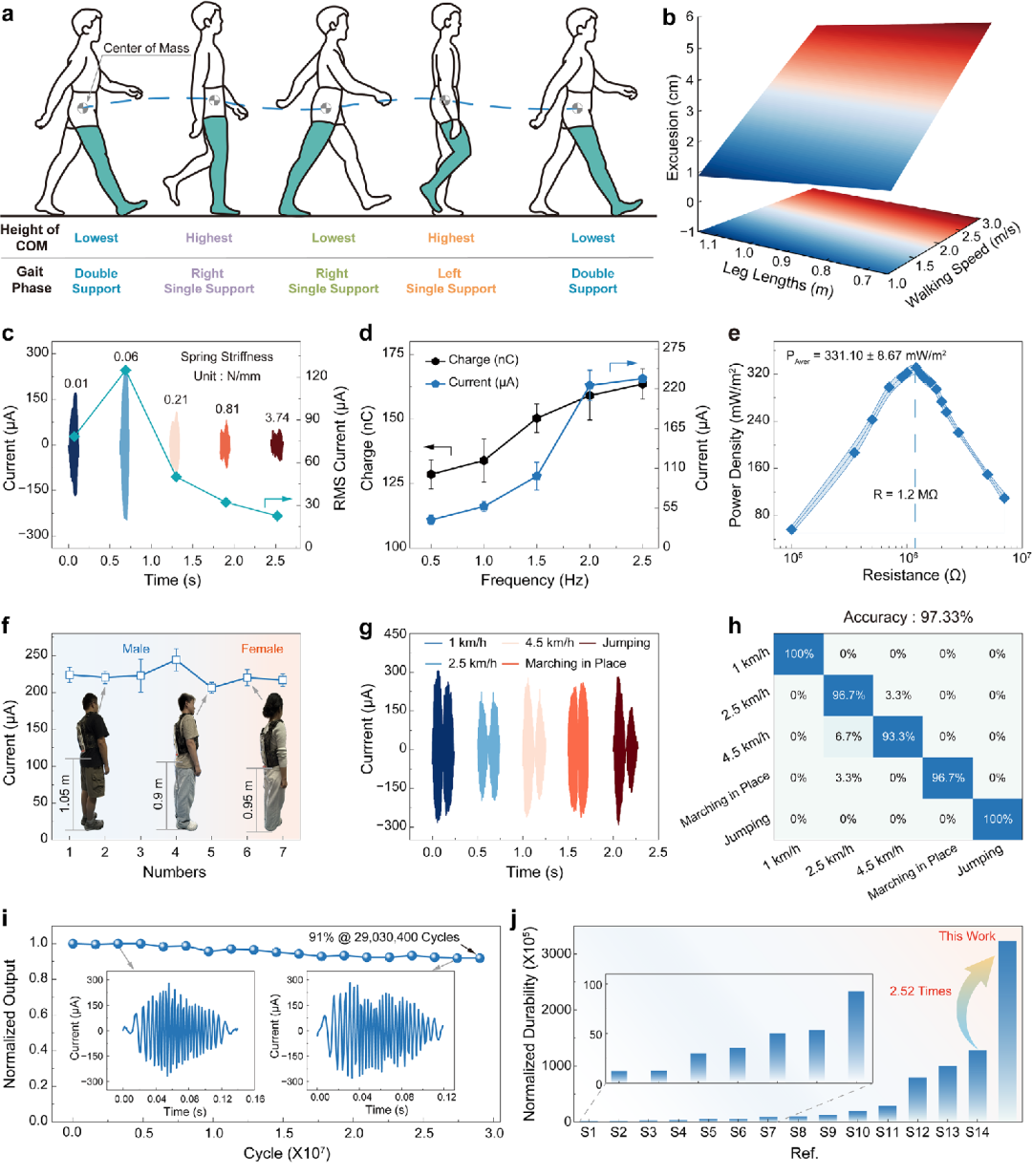
Figure 2
Optimization and performance characterization of biomechanically driven triboelectric nanogenerator (TENG).
(a) Gait analysis illustrating vertical vibration of the center of mass.
(b) Dependence of center-of-mass displacement on leg length and walking speed.
(c) Effects of different spring stiffness values on output current performance.
(d) Frequency-dependent electrical output characteristics of the TENG. Data are presented as mean ± standard deviation (SD) of three independent samples.
(e) Average power density delivered to external load resistors at an excitation frequency of 2 Hz. Data are presented as mean ± standard deviation (SD) of three independent samples.
(f) Output current during in-place stepping under different leg-length conditions. Data are presented as mean ± standard deviation (SD) of three independent samples.
(g) Output current under different motion postures.
(h) Confusion matrix corresponding to different motion postures.
(i) Comparison of material wear of the TENG after continuous testing for more than 20 million cycles.
(j) Normalized durability comparison of various low-wear TENGs (see Table S4 for references).
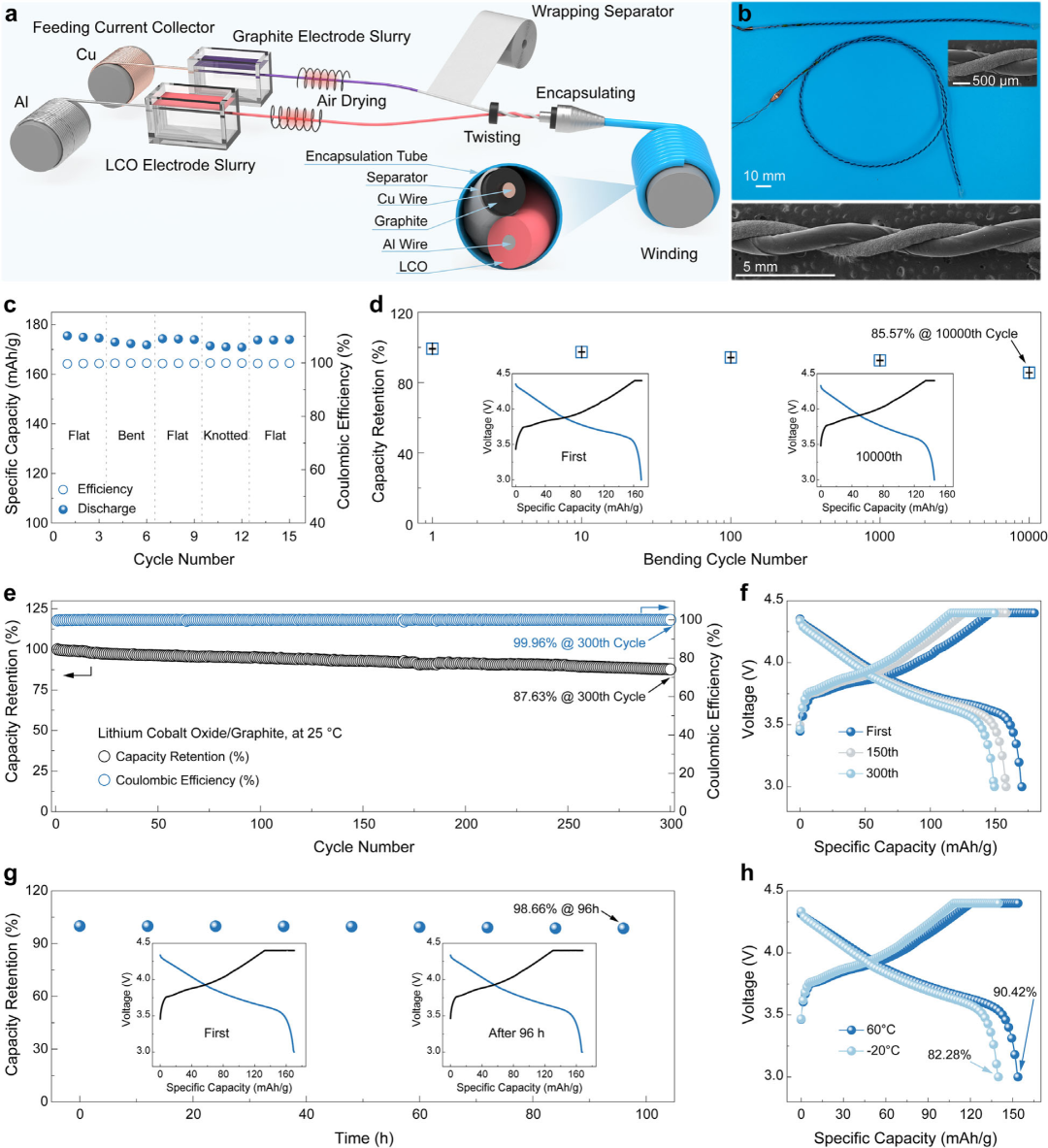
Figure 3
Electrochemical and mechanical properties of fiber lithium-ion batteries (FLIBs).
(a) Schematic illustration of the continuous manufacturing process for scalable fabrication of FLIBs.
(b) Digital photograph and scanning electron microscopy (SEM) image of FLIBs.
(c) Capacity retention and Coulombic efficiency of FLIBs under different tensile strains.
(d) Capacity retention under cyclic bending, showing that the battery retains more than 80% of its capacity after 10,000 bending cycles. Data are presented as mean ± standard deviation of three independent samples. Inset: charge–discharge profiles at the 1st and 10,000th bending cycles.
(e) Cycling performance and Coulombic efficiency of FLIBs after 300 consecutive charge–discharge cycles.
(f) Charge–discharge profiles at the 1st, 150th and 300th cycles.
(g) Capacity retention of FLIBs after immersion in artificial sweat (pH 6.5) for 96 h. Inset: charge–discharge profiles of the pristine state and after bending test following 96 h of immersion.
(h) Capacity retention of FLIBs within the temperature range from −20 °C to 60 °C.
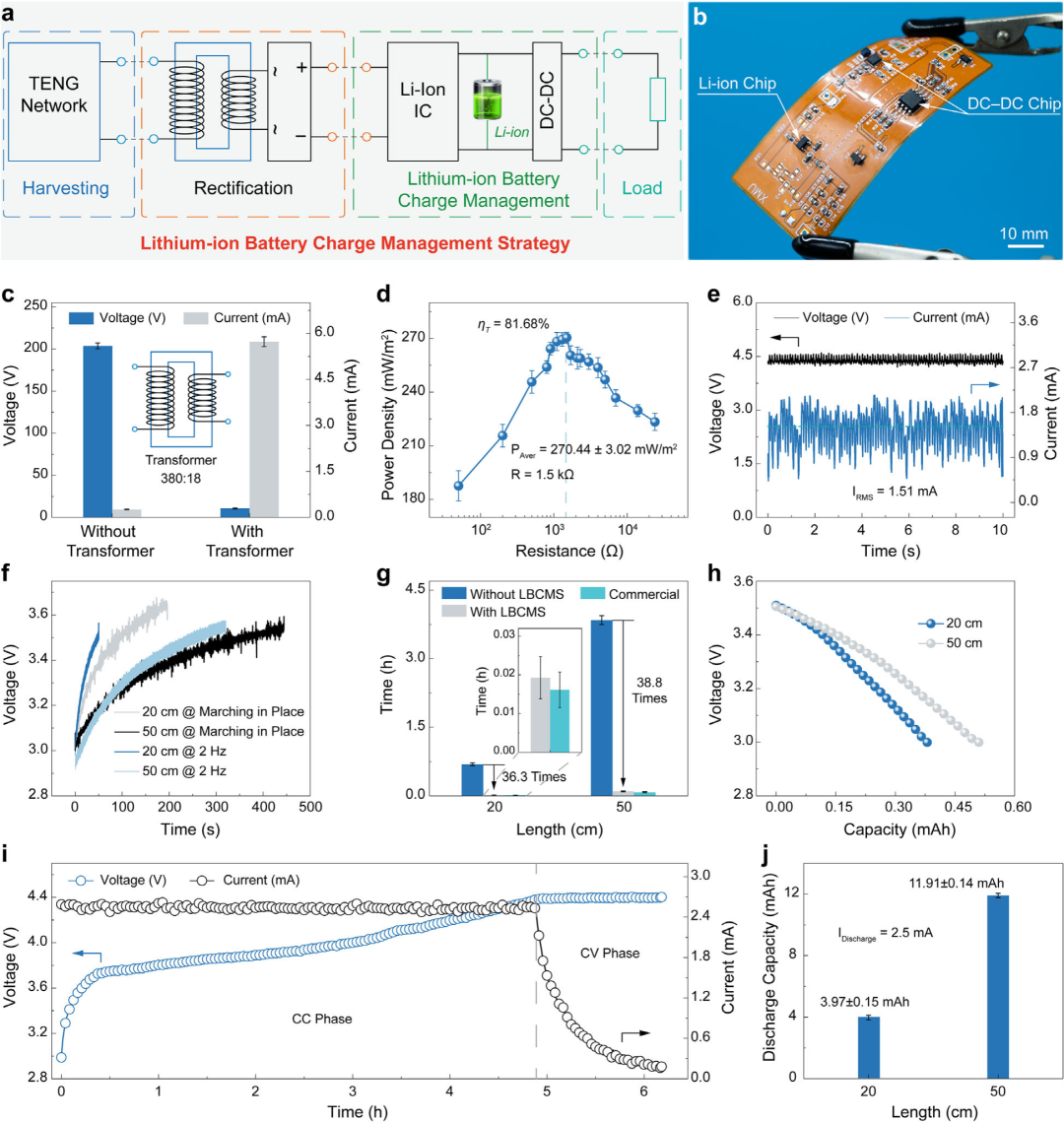
Figure 4
Design and performance of the lithium-ion battery charging management system (LBCMS).
(a) Circuit schematic of the LBCMS.
(b) Digital photograph of the flexible charging management module.
(c) Comparison of output voltage and output current of the triboelectric nanogenerator (TENG) with and without a transformer. Data are presented as mean ± standard deviation of three independent samples.
(d) Average power density of the TENG integrated with a transformer unit at an excitation frequency of 2 Hz. Data are presented as mean ± standard deviation of three independent samples.
(e) Output characteristics of the LBCMS driven by a single TENG.
(f) Charging voltage profiles of 20 cm and 50 cm flexible fiber lithium-ion batteries (FLIBs) under linear motor (2 Hz) and wearable human walking conditions, respectively.
(g) Comparison of charging duration (3.0–3.5 V) among TENG with LBCMS, TENG without LBCMS, and a commercial battery test system. Data are presented as mean ± standard deviation of three independent samples.
(h) Discharge voltage–capacity profiles of FLIBs of different lengths within the voltage range of 3.0–3.5 V.
(i) Complete charging voltage and current evolution curves of the 50 cm FLIB.
(j) Dependence of discharge capacity on battery length for FLIBs at a discharge current of 2.5 mA. Data are presented as mean ± standard deviation of three independent samples.
Summary
Human biomechanical energy is irregular and low-quality. Previously, harvested energy could only be stored physically in capacitors, making it difficult to complete the full chemical charging cycle for practical batteries. The authors resolve the mismatch between energy generation and storage through systematic integration. A closed loop is constructed by combining a triboelectric nanogenerator, a charging management circuit and fiber lithium-ion batteries. This design reduces the load resistance by 800-fold and increases the root-mean-square current by 22.7-fold. Accordingly, the charging rate is improved by 38.8-fold. For the first time, 20 cm and 50 cm batteries can be fully charged within approximately 2.4 h and 6.1 h, respectively. A self-powered backpack is further demonstrated to realize outdoor real-time positioning and data transmission.
The most enlightening highlight of this work is that it breaks the limitation of capacitor-only energy storage for biomechanical harvesting. Instead, circuit management enables direct coupling with high-specific-energy chemical batteries. In follow-up research, this resistance-reduction and current-amplification strategy can be extended to commercial batteries of various specifications and other scenarios featuring low-frequency, irregular biomechanical energy. Meanwhile, fiber batteries feature excellent bending resistance, sweat tolerance and weavability for textile integration. Combined with the inherent gait-recognition capability of triboelectric technology, the current backpack positioning function can be further expanded to wearable health monitoring and maintenance-free field sensing systems.
References:
DOI:10.1002/adma.75016
We specialize in the customized development of functional nanomedicine materials. We tailor materials according to experimental requirements, with controllable structure, particle size and surface modification. Full characterization services are provided. Solutions can be iteratively optimized with continuous technical support throughout the cooperation. Our work supports research projects including targeted delivery, bioimaging, nanotheranostics and more. Feel free to share your specifications for solution evaluation.
Mr. Zhang: +86 17715390137
Mr. Chen: +86 18914047343