

 Academic Frontier
Biomaterials | Gradient-Driven Self-Electrophoretic Nanoparticles for Deep Penetration in Acidic Tumor Microenvironments to Enhance Antitumor Therapy
QQ Academic Group: 1092348845
Detailed
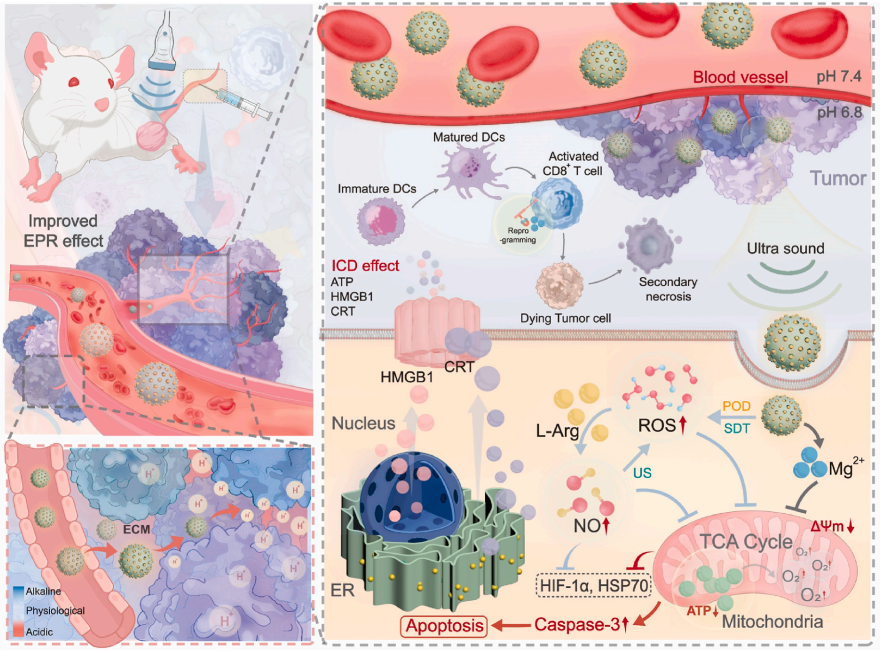
Nanomedicines have difficulty effectively penetrating the tumor core and achieving effective killing of tumor stem cells, which is an important factor leading to tumor recurrence, metastasis, and drug resistance. Strategies based on the tumor microenvironment provide new perspectives and approaches to address the challenges associated with deep tumor therapy. Here, we designed novel MgF2@L-Arg nanoparticles (ML NPs) by integrating basic L-arginine into MgF2. Under the endogenous acid gradient within the tumor,ML NPs selectively protonate their proximal amines, resulting in spatial charge asymmetry. This promotes the continuous diffusion and penetration of ML NPs into deep tumor tissues, achieving a penetration distance of up to 197 μm. In addition, besides playing a synergistic role in sonodynamic therapy (SDT) and gas therapy, ML NPs can also reduce the expression of hypoxia-inducible factor 1-alpha (HIF-1α) and heat shock protein 70 (HSP 70) in tumor cells, induce immunogenic cell death, and bind to the co-stimulatory molecule LFA-1 on the surface of tumor cells.This enhances the specific cytotoxicity of CD8 T cells. This mechanism significantly improves the immune response against cancer cells and effectively inhibits tumor metastasis. Our study proposes a feasible new strategy for nanoparticles to penetrate tumors and achieve effective deep tumor therapy, demonstrating the great potential of such materials in enhancing antitumor efficacy.
Reference News:
DOI: 10.1016/j.biomaterials.2025.123398
- Previous: Journal of Controlled
- Next: Bioactive Materials|离子


