

 Academic Frontier
Advanced Functional Materials | Carbon Dot-Based Nanomaterials as Potent Antifungal Agents
QQ Academic Group: 1092348845
Detailed
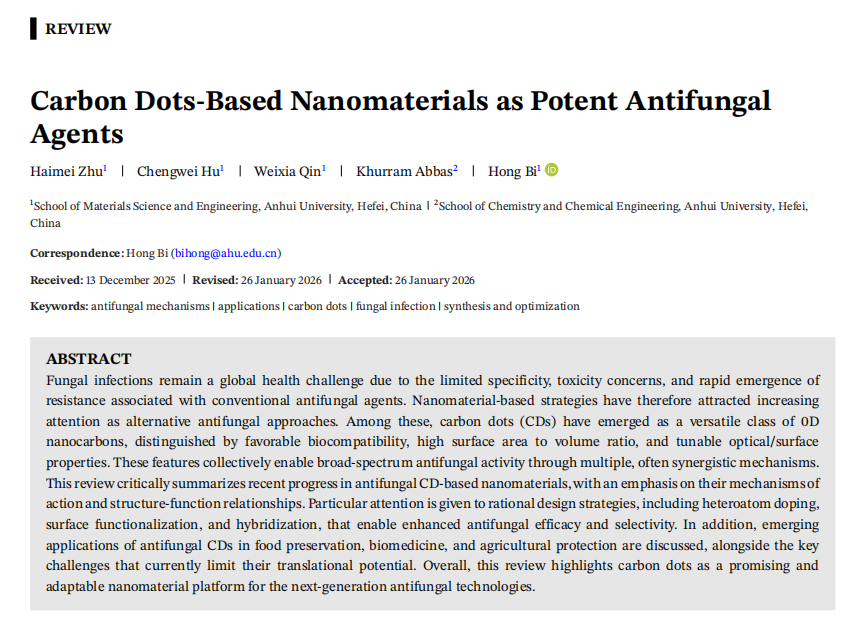
Due to the limited specificity, serious toxicity issues, and rapid emergence of resistance associated with traditional antifungal drugs, fungal infections remain a global health challenge. Therefore, strategies based on nanomaterials have attracted increasing attention as alternative antifungal approaches. Among them, carbon dots (CDs), as a class of multifunctional 0D carbon nanomaterials, have emerged, characterized by good biocompatibility, high surface-to-volume ratio, and tunable optical/surface properties. These features collectively enable broad-spectrum antifungal activity through multiple, often synergistic mechanisms. This review critically summarizes the latest advances in antifungal CD-based nanomaterials, focusing on their mechanisms of action and structure-function relationships. Special attention is given to rational design strategies, including heteroatom doping, surface functionalization, and hybridization, to enhance antifungal efficacy and selectivity. In addition, the review discusses emerging applications of antifungal CDs in food preservation, biomedicine, and agricultural protection, as well as key challenges currently limiting their translational potential. Overall, this review highlights carbon dots as a promising and adaptable nanomaterial platform for next-generation antifungal technologies.
- Previous: IF:20.3 Biophysical Si
- Next: Bioactive Materials|离子


