已传文件:photo/1770283452.png
Large bone defects pose significant challenges to the field of reconstructive medicine. Clinically, autologous and allogeneic bone grafts are commonly used, but they have limitations in donor availability, associated complications, and immune responses. Although tissue-engineered bone offers an alternative, it is difficult to replicate the complex biological functions of native bone, resulting in limited repair outcomes. The periosteum is a key factor in regulating bone regeneration, and its unique bilayer structure is essential for maintaining bone integrity and the repair process. Large bone defects can cause periosteal damage, thereby weakening its regenerative capacity, highlighting the urgent need for new bone regeneration strategies.
Main Content
The review systematically explores the structural composition and biological functions of the periosteum; provides a detailed introduction to the design concept and application scenarios of periosteum organoids; analyzes the potential integration possibilities between periosteum organoids and bone organoids; and focuses on summarizing recent advances in periosteum organoids in novel regenerative medicine and bone repair-related research, while offering prospects for future development in this field.
Research Design
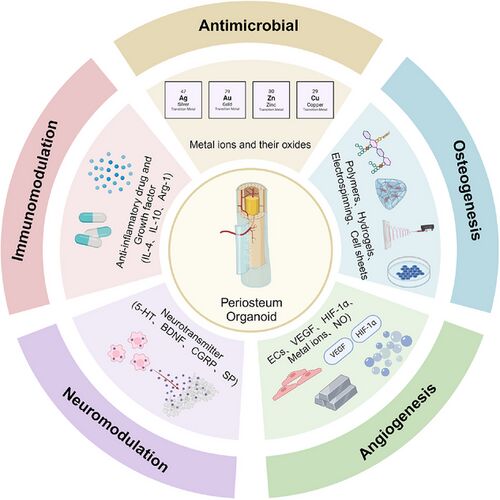
Based on the critical role of the periosteum in bone regeneration and the challenges posed by large-scale defects, periosteum organoids were developed using novel organoid technology. This design integrates various natural or synthetic materials with bio-derived factors, endowing the periosteum organoids with essential biological functions required for bone regeneration, including antibacterial properties, immune modulation, neural regulation, angiogenesis, and osteogenic-related efficacy, in order to optimize bone regeneration.
Results
The development of periosteum-like organoids provides a new technical approach for addressing the challenge of repairing large bone defects. After integrating various materials and biological factors, they possess the core biological functions required for bone regeneration. Related studies have made progress in the design optimization of periosteum-like organoids, functional validation, and their potential for synergy with other organoids, providing important references for research in the field of bone regeneration.
Future Directions
In the future, the material composition and combination of biological factors in periosteum-like organoids can be further optimized to enhance functional synergy; the integration mechanisms between periosteum-like organoids and bone organoids, as well as other related biological structures, can be explored to construct systems that more closely mimic the native bone regeneration microenvironment; at the same time, research on the adaptability of periosteum-like organoids to different types of bone defects can be expanded, providing more diversified technical support for bone regeneration research.
Original Source:
1. Journal: ACS Nano
2. Pub Date: 2025-12-08
3. DOI: 10.1002/exp.202402984
4. Authors: Shuyue Hao, Fuxiao Wang, Jingtao Huang, Zhidao Xia, James T. Triffitt, Chenjie Xu, Long Bai, Jiacan Su