已传文件:photo/1772675758.png
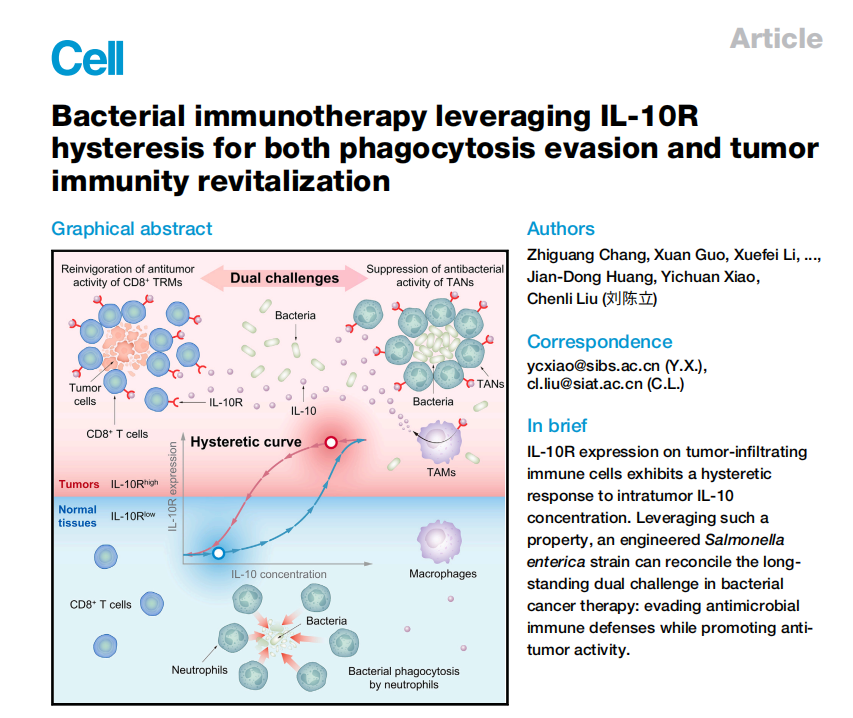
Bacterial immunotherapy has promising anti-cancer potential. However, to unleash its power, it is necessary to understand the mechanisms by which bacteria can both evade antimicrobial immune defenses and stimulate anti-tumor immune responses in the tumor microenvironment. Here, by utilizing an engineered Salmonella enterica strain with this dual capability, we reveal a potentially unique mechanism. Specifically, the delayed nonlinear expression of the interleukin-10 receptor (IL-10R) drives tumor-infiltrating immune cells into a tumor-specific IL-10R^hi state.Bacteria exploit this to enhance tumor-associated macrophages that produce IL-10, avoid phagocytosis by tumor-associated neutrophils, while simultaneously expanding and stimulating exhausted tumor-resident CD8 T cells. This effective combination can eliminate tumors, prevent recurrence, and suppress metastasis of multiple tumor types. Analysis of human samples suggests that a high IL-10R state may be a common feature across human tumor types. Our study reveals an unresolved mechanism of the dual challenge faced by bacterial immunotherapy in solid tumors and provides a framework for intratumoral immune modulation.
Summary
A study published in March 2025 in Cell revealed a new mechanism of bacterial immunotherapy for solid tumors based on IL-10R hysteresis effects. The research team engineered a strain of Salmonella Typhimurium to create the engineered strain DB1, which can specifically proliferate within tumors. This strain, by carrying oxygen-suppressible growth regulatory elements and the lysin O gene, is cleared in normal tissues but continuously expands within tumors. The study found that DB1 can induce tumor-associated macrophages (TAMs) within tumors to secrete large amounts of IL-10, which in turn activates tumor-infiltrating CD8 T cells through the IL-10/IL-10R/STAT3 positive feedback pathway, particularly the exhausted PD-1 TIM-3 tissue-resident memory-like T cells (TRM-like), significantly enhancing their antitumor activity. At the same time, IL-10 also helps the bacteria evade host immune clearance by inhibiting the chemotaxis and phagocytic functions of tumor-associated neutrophils (TANs), thereby creating a tumor microenvironment where immune suppression and immune activation coexist.
Summary :
A March 2025 Cell study reveals a novel bacterial immunotherapy mechanism for solid tumors based on IL-10R hysteresis. Researchers engineered Salmonella typhimurium into a strain (DB1) that selectively proliferates in tumors by incorporating oxygen-repressible growth regulators and lysozyme O genes, ensuring clearance in normal tissues but sustained expansion in tumors. DB1 induces tumor-associated macrophages (TAMs) to secrete IL-10, which activates exhausted CD8+ T cells (especially PD-1+TIM-3+ TRM-like cells) via the IL-10/IL-10R/STAT3 positive feedback loop, enhancing anti-tumor immunity. Simultaneously, IL-10 suppresses tumor-associated neutrophils (TANs), helping bacteria evade immune clearance and creating a dual microenvironment of immune suppression and activation.
Mechanistically, IL-10R exhibits "hysteresis"—cells maintain high IL-10R expression even after IL-10 levels drop, observed in CD8+ T cells, TAMs, and TANs, dependent on STAT3 binding to the IL-10R promoter. This establishes an "immune memory-like" state, providing a therapeutic window. The findings, validated in human tumors, suggest broad cross-species and cross-tumor relevance. The study unifies the dual challenge of bacterial immunotherapy (evading antimicrobial immunity while activating anti-tumor responses) and offers new insights for IL-10-based immunotherapies.
References:
DOI: 10.1016/j.cell.2025.02.002