已传文件:photo/1793589737.png
 This study was published in Nature Communications under the title “Slow-water strategy for fracture-resistant hydrogels”.
Water within hydrogels is often overlooked or considered detrimental to their mechanical performance owing to the plasticizing effect of water, which weakens interchain interactions and accelerates crack propagation. Herein, we propose a slow-water strategy to enhance the fracture resistance of hydrogels. By converting free water into slowly migrating intermediate water, we suppress excessive chain mobility by reducing the free volume surrounding polymer chains, thereby strengthening interchain interactions and markedly extending the load-transfer length. Notably, even with a polymer content of only 13% and without additional network design, these hydrogels achieve an order-of-magnitude improvement in fracture toughness and fatigue threshold merely through medium engineering. Such reinforcing effects are verified to be predominantly governed by intermediate water. This strategy is versatile, offers insights into the roles of intermediate water in biological systems, and opens an innovative avenue for toughening biomimetic materials under complex stress conditions.
Quick Look at Literature
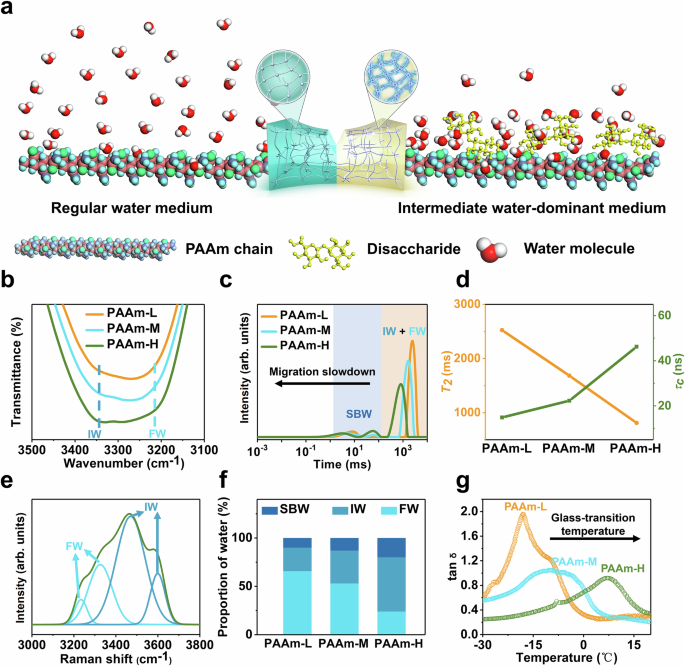
Figure 1
a Schematic illustration of the slow-water strategy enabled by strong hydrogen bonding and hydration interactions.
b ATR‑IR spectra showing the variation of −OH stretching peaks.
c Low-field NMR curves of PAAm-L, PAAm-M and PAAm-H hydrogels (herein, PAAm-L, PAAm-M and PAAm-H refer to PAAm hydrogels with low, medium and high intermediate water concentrations, respectively).
d Relaxation time (T_2) and correlation time ( au_c) of the hydrogels.
e Raman spectra with deconvoluted peaks representing intermediate water (IW) and free water (FW) in the PAAm-H hydrogel.
f Contents of strongly bound water (SBW), intermediate water (IW) and free water (FW) in PAAm-L, PAAm-M and PAAm-H hydrogels.
g Temperature sweep from −30 °C to 20 °C for the three hydrogels using a dynamic mechanical analyzer (DMA). The curves show the loss factor as a function of temperature, and the peak position of the loss factor corresponds to the temperature range of the glass transition of the material.
PAAm: polyacrylamide; PAAm-L, PAAm-M and PAAm-H represent PAAm hydrogels with low, medium and high intermediate water content, respectively. ATR‑IR: attenuated total reflection infrared spectroscopy; FW: free water; IW: intermediate water; SBW: strongly bound water; (T_2): proton spin–spin relaxation time; ( au_c): correlation time; tan (delta): loss factor.
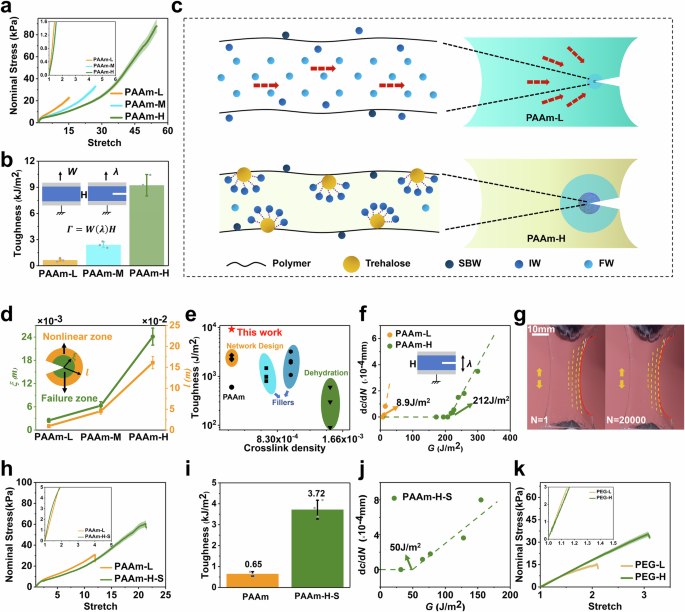
Figure 2
a Stress–stretch curves of PAAm-L, PAAm-M and PAAm-H hydrogels.
b Fracture toughness of the three hydrogels. Γ denotes fracture toughness, W(λ) is the strain energy density at stretch λ, and H is the initial specimen height.
c Conversion of free water into intermediate water reduces the free volume surrounding polymer chains and suppresses excessive chain mobility.
d Nonlinear elastic length and dissipation length of PAAm-L, PAAm-M and PAAm-H hydrogels. l and (xi) denote the nonlinear elastic length and dissipation length, respectively.
e Comparison of the slow-water strategy with network design strategy, filler reinforcement strategy and dehydration strategy.
f Relationship between cyclic crack growth rate (mathrm{d}c/mathrm{d}N) and applied energy release rate G for PAAm-L and PAAm-H hydrogels. G represents the applied energy release rate, and (mathrm{d}c/mathrm{d}N) is the crack growth rate per loading cycle.
g Single-edge notch test of the PAAm-H hydrogel under cyclic loading (maximum stretch = 6). N denotes the number of loading cycles.
h–k Verification of the universality and effectiveness of the slow-water strategy for enhancing the mechanical performance of hydrogels.
h Stress–stretch curves of sucrose-modified PAAm networks
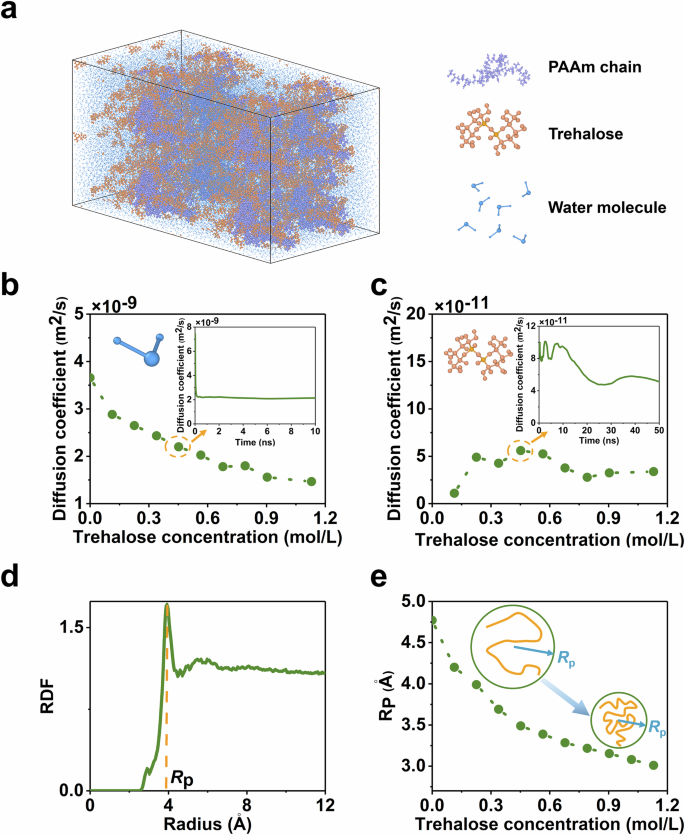
Figure 3
a Molecular dynamics model consisting of mixed polyacrylamide chains, trehalose molecules and water molecules.
b Diffusion coefficient of water molecules as a function of trehalose concentration, with steady-state values adopted. The inset illustrates the method for selecting steady-state values using 0.45 M as an example.
c Diffusion coefficient of trehalose molecules as a function of trehalose concentration, with steady-state values adopted. The inset shows the steady-state mobility at the corresponding trehalose concentration during simulation, taking 0.45 M as an example.
d Radial distribution function (RDF) of polymer chains containing 20 trehalose molecules.
e Radius of free motion space (R_ ext{p}) of chains varying with the number of trehalose molecules. Two circles show schematics of polymer chains with different (R_ ext{p}) values.
RDF: radial distribution function; (R_ ext{p}): radius of the free motion space of polymer chains.
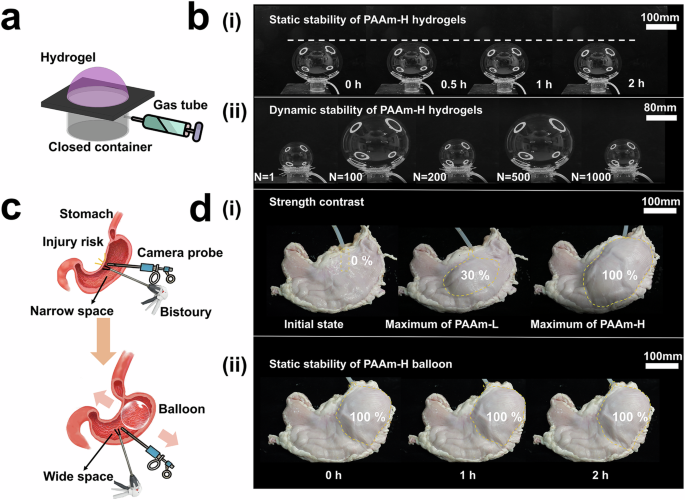
Figure 4
a Schematic of the hydrogel stress-testing setup.
b Stability tests of the PAAm-H hydrogel under biaxial stress. (i) Static stability test under biaxial stress for the PAAm-H hydrogel with a constant horizontal stretch of 4. (ii) Dynamic stability test under biaxial stress for the PAAm-H hydrogel with a maximum horizontal stretch of 4.
c Schematic of an ex vivo tissue-like soft-support model based on hydrogel balloons.
d Device-level deformation and stability demonstration of hydrogel balloons in a porcine stomach model. (i) Comparison of the supporting capacity between PAAm-L and PAAm-H hydrogel balloons. (ii) Short-term static and cyclic deformation stability of the PAAm-H hydrogel balloon in the porcine stomach model.
Reference Information
Nature Communications (IF 18.1)
Pub Date: 2026-08-25
DOI: 10.1038/s41467-026-76816-6
We specialize in custom nano-medical functional materials. We conduct targeted development to tailor structure, particle size and surface modification for your experiments. Full characterization, iterative optimization and technical support are available for targeted delivery, bioimaging and nanomedicine studies. Send your evaluation plans to us.
Engineer Zhang: 17715390137
Engineer Chen: 18914047343