已传文件:photo/1793755111.png
 Aberrant interactions between mitochondria-associated endoplasmic reticulum (ER) and mitochondria-associated ER membranes (MAMs) trigger oxidative stress, calcium dysregulation, pyroptosis and ferroptosis in nucleus pulposus cells, accelerating intervertebral disc degeneration (IVDD). Nanozymes that mimic antioxidant enzymes and remodel the oxidative stress microenvironment hold great promise for IVDD therapy, yet their therapeutic efficacy is hampered by inferior enzyme-mimicking activity and poor MAM targeting capability. Herein, we report a spatially confined pyrolysis strategy to fabricate N/O co-doped hollow bamboo-shaped porous carbon nanotubes embedded with atomic-layer Janus MnSe diatoms. Functionalization with the MAM-targeting protein GRP75 and σ1R regulatory protein yields GC-MnSeDA/BCNT, an integrated nanozyme platform for precise IVDD intervention. The hollow BCNT framework exposes atomically dispersed MnSe sites. Meanwhile, the MnSeN₅O Janus active center optimizes the local electronic structure of Mn via Se-mediated p–d orbital hybridization, facilitating electron transfer and lowering reaction energy barriers, and thereby boosting SOD-, CAT- and GPx-like activities. This platform exhibits favorable biosafety and potent multi-enzyme antioxidant activity, enabling efficient ROS scavenging and lipid peroxidation suppression. Notably, it restores the integrity of MAMs and mitochondrial function, maintains Ca²⁺ homeostasis, and blocks NLRP3-mediated pyroptosis and ferroptosis, thereby retarding IVDD progression. This work offers an efficient, safe and precise strategy for the treatment of degenerative and inflammatory disorders.

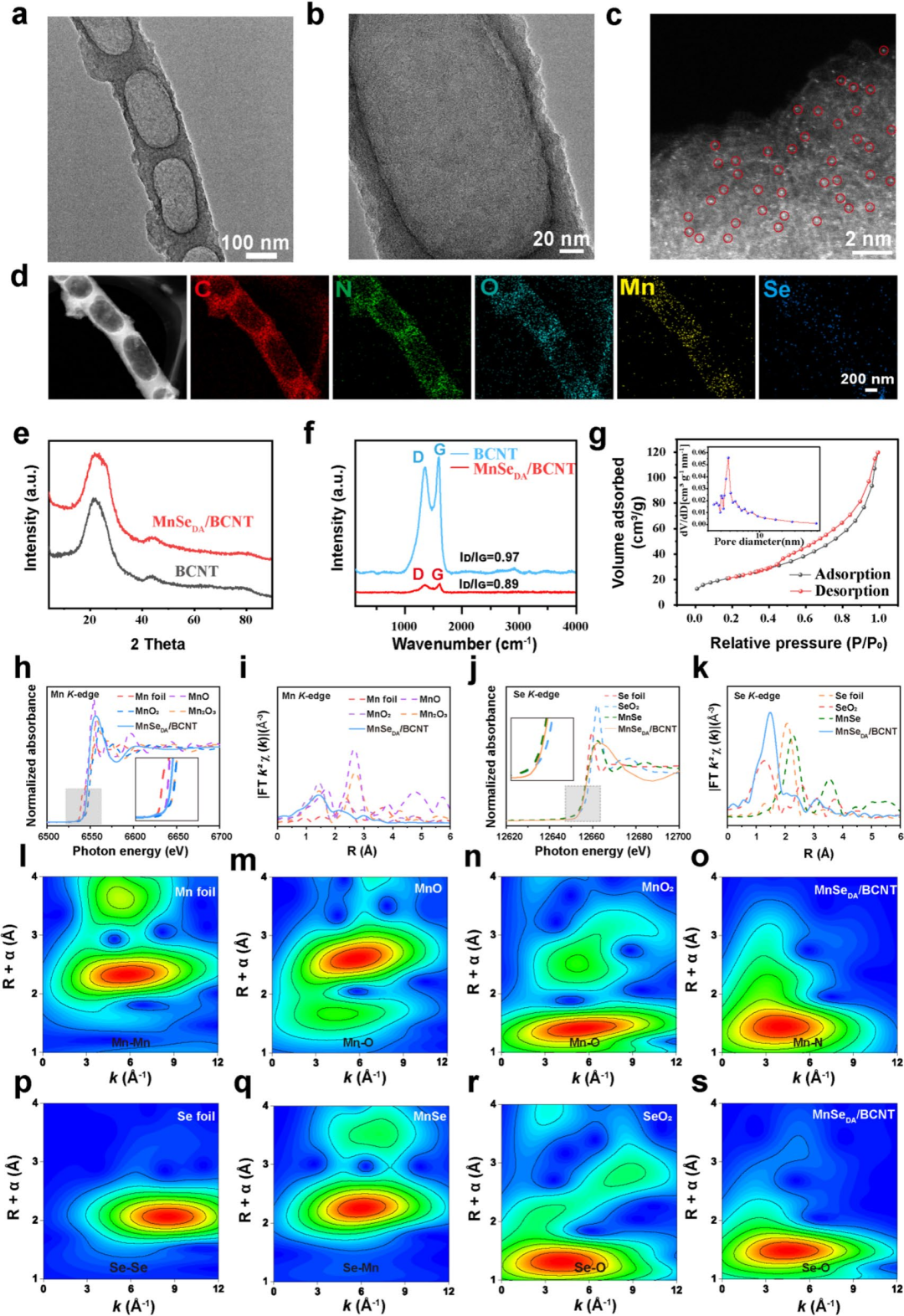
Figure 2
Structural and functional characterization of the MnSeDA/BCNT nanozyme. (a) TEM image of MnSeDA/BCNT, scale bar: 100 nm. (b) TEM images of MnSeDA/BCNT at different magnifications, scale bar: 20 nm. (c) Aberration-corrected high-angle annular dark-field scanning TEM (AC-HAADF-STEM) image of MnSeDA/BCNT, scale bar: 2 nm. (d) Elemental mapping of MnSeDA/BCNT showing C, N, O, Mn and Se, scale bar: 200 nm. (e) XRD patterns of BCNT and MnSeDA/BCNT. (f) Raman spectra of BCNT and MnSeDA/BCNT. (g) N₂ adsorption–desorption isotherm and pore size distribution (inset) of MnSeDA/BCNT. (h) Mn K-edge XANES spectra of different samples. (i) Fourier-transformed EXAFS functions of k²-weighted χ(k) for different samples. (j) Se K-edge XANES spectra of different samples. (k) Fourier-transformed EXAFS functions of k²-weighted χ(k) for different samples. (l–o) WT images at the Mn K-edge for Mn foil (l), manganese oxide (m), MnO₂ (n) and MnSeDA/BCNT (o). (p–s) WT images at the Se K-edge for Se foil (p), MnSe (q), SeO₂ (r) and MnSeDA/BCNT (s).
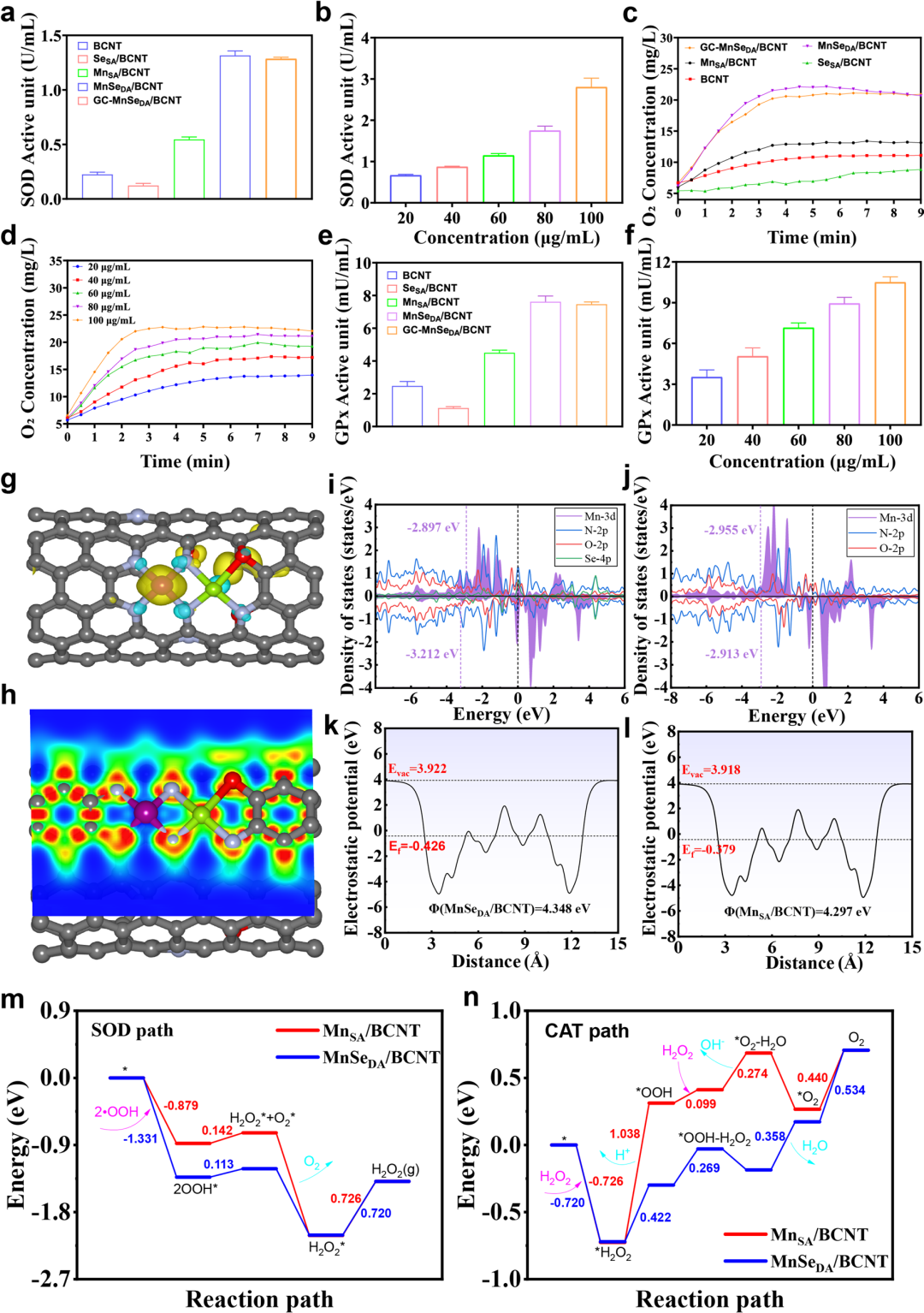 Figure 3
Enzymatic activity and DFT calculations of the MnSeDA/BCNT nanozyme. (a) SOD activities of BCNT, SeSA/BCNT, MnSA/BCNT, MnSeDA/BCNT and GC-MnSeDA/BCNT at the identical concentration. (b) SOD activity of MnSeDA/BCNT at different concentrations. (c) Evaluation of hydrogen peroxide decomposition by BCNT, SeSA/BCNT, MnSA/BCNT, MnSeDA/BCNT and GC-MnSeDA/BCNT nanozymes at the identical concentration. (d) Evaluation of hydrogen peroxide decomposition by MnSeDA/BCNT nanozyme at different concentrations. (e) GPx activities of BCNT, SeSA/BCNT, MnSA/BCNT, MnSeDA/BCNT and GC-MnSeDA/BCNT at the identical concentration. (f) GPx activity of MnSeDA/BCNT at different concentrations. (g) Spin density distribution of MnSeDA/BCNT. (h) Electron localization function (ELF) plot of MnSeDA/BCNT. (i–j) Calculated density of states (DOS) and d-band centers of MnSeDA/BCNT and MnSA/BCNT. (k–l) Calculated work functions of MnSA/BCNT and MnSeDA/BCNT. (m–n) Calculated energy profiles for the SOD and CAT reaction pathways on MnSA/BCNT and MnSeDA/BCNT.
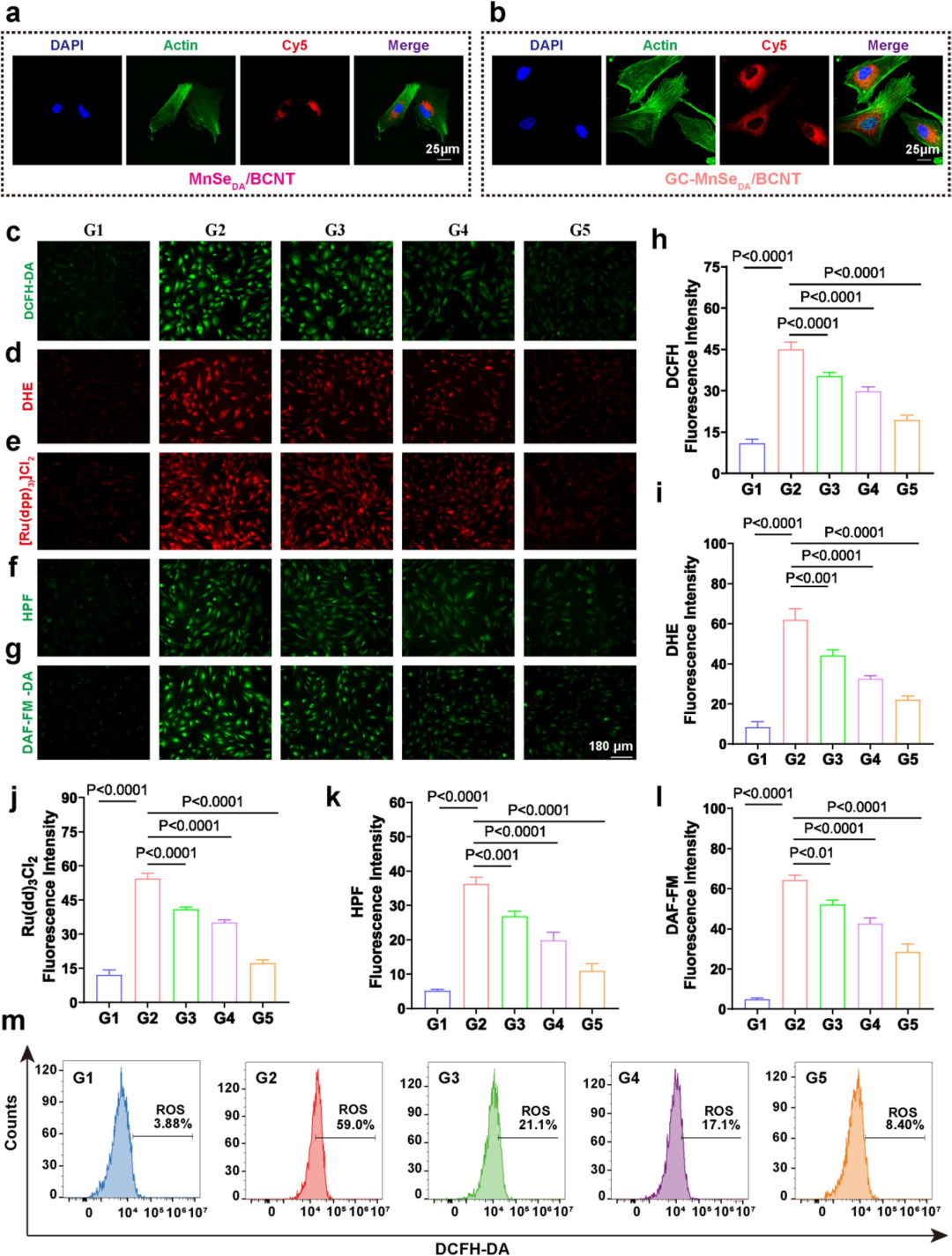 Figure 4
Cellular uptake and free radical scavenging capacity of the GC-MnSeDA/BCNT nanozyme. (a–b) Confocal fluorescence images of NPCs incubated with Cy5-labeled MnSeDA/BCNT and GC-MnSeDA/BCNT nanozymes for 12 h. Scale bar: 25 μm. (c–l) Confocal images and quantitative analysis of intracellular fluorescence intensity in NPCs stained with (c, h) DCFH-DA, (d, i) DHE, (e, j) [Ru(dpp)₃]Cl₂, (f, k) HPF, and (g, l) DAF-FM DA under different treatments. Scale bar: 180 μm. (m) Flow cytometric analysis of intracellular ROS in DCFH-DA-stained NPCs after different treatments. Notes: G1: control group, G2: TBHP, G3: MnSeDA/BCNT + TBHP, G4: G-MnSeDA/BCNT + TBHP, G5: GC-MnSeDA/BCNT + TBHP. Data are presented as mean ± SD (n = 3).
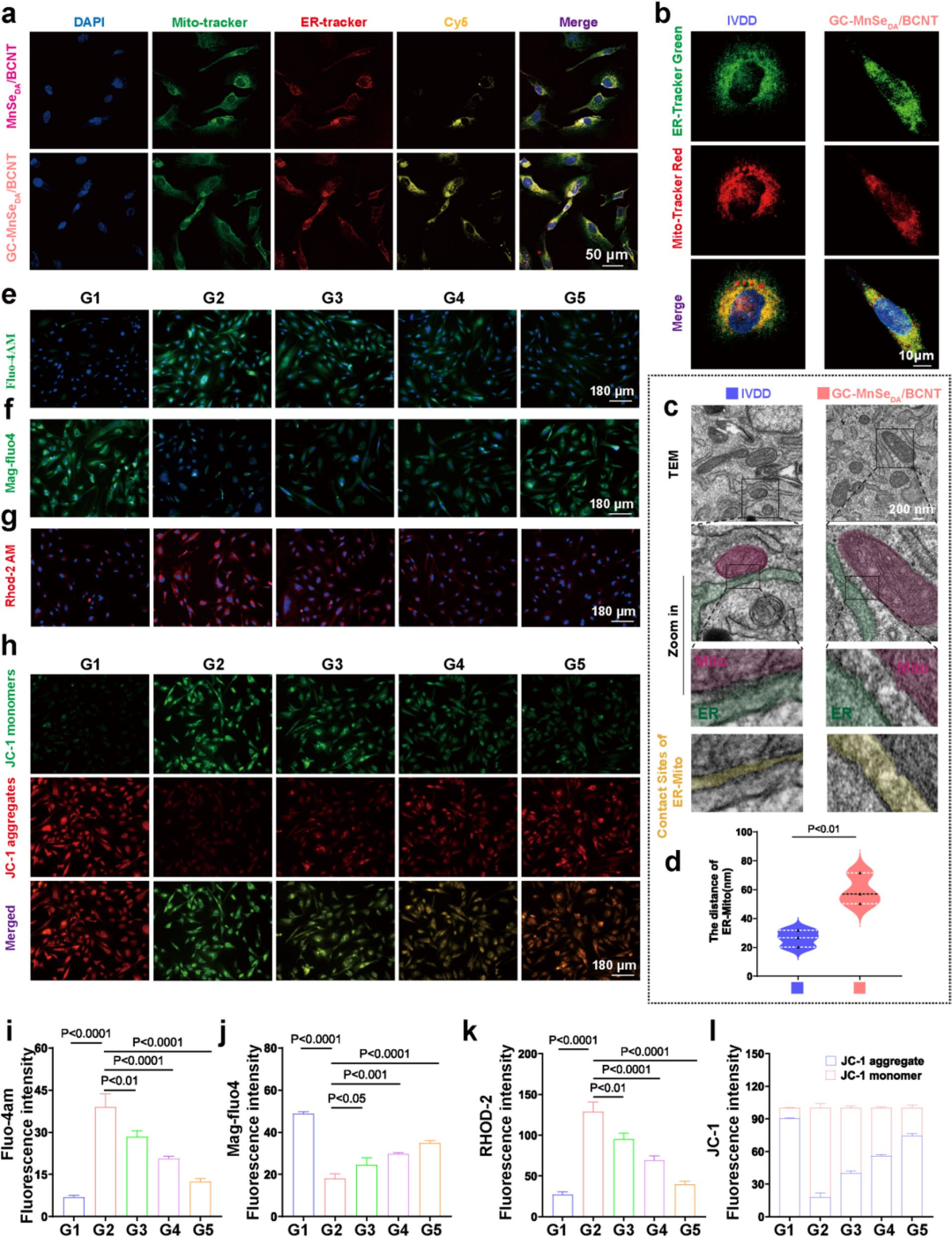
Figure 5
GC-MnSeDA/BCNT targets and remodels MAMs in TBHP-injured NPCs. (a) Confocal images of MnSeDA/BCNT and GC-MnSeDA/BCNT showing DAPI, MitoTracker Green, ER-Tracker Red and Cy5-labeled nanozymes. Scale bar: 50 μm. (b) Confocal images of NPCs stained with MitoTracker Green and ER-Tracker Red after IVDD (TBHP) and GC-MnSeDA/BCNT treatment. Scale bar: 10 μm. (c) Ultrastructure of NPCs. Magnified views present pseudocolored images, in which the endoplasmic reticulum is highlighted in green, mitochondria in red, and ER–mitochondria contact sites in yellow. Scale bar: 200 nm. (d) Quantification of ER–mitochondria distance in the IVDD group and GC-MnSeDA/BCNT group. (e–l) Confocal images and quantitative analysis of intracellular fluorescence intensity in NPCs stained with (e, i) Fluo-4 AM, (f, j) Mag-Fluo-4, (g, k) Rhod-2 AM, and (h, l) JC-1 under different treatments. Scale bar: 180 μm. Notes: G1: control group, G2: TBHP group, G3: MnSeDA/BCNT + TBHP group, G4: G-MnSeDA/BCNT + TBHP group, G5: GC-MnSeDA/BCNT + TBHP group. Data are presented as mean ± SD (n = 3).
Summary
Aberrant MAMs disrupt oxidative stress and calcium homeostasis in nucleus pulposus cells, trigger pyroptosis and ferroptosis, and drive IVDD progression. Current nanozymes suffer from unsatisfactory catalytic activity and poor MAM-targeting ability. Herein, N/O co-doped hollow bamboo-shaped porous carbon nanotubes embedded with atomic-layer Janus MnSe diatoms are fabricated via spatially confined pyrolysis, followed by functionalization with GRP75 and σ1R to obtain GC-MnSeDA/BCNT. The hollow tubular structure exposes MnSe active sites. The MnSeN₅O Janus center tunes the electronic configuration of Mn through Se-mediated p–d orbital hybridization, reduces reaction energy barriers, and boosts SOD-, CAT- and GPx-like activities.
GC-MnSeDA/BCNT exhibits favorable biosafety and robust multi-enzyme antioxidant performance, enabling ROS scavenging and lipid peroxidation suppression. Importantly, it repairs MAMs and mitochondrial function, stabilizes Ca²⁺ homeostasis, and inhibits NLRP3-mediated pyroptosis and ferroptosis, thereby retarding IVDD development. This platform integrates MAM targeting and atomic-level Janus active centers, which improves nanozyme therapeutic outcomes and offers an efficient, safe and precise intervention strategy for degenerative and inflammatory diseases.
References:
DOI:10.1186/s12951-026-05151-1
We specialize in custom nano-medical functional materials. We conduct targeted development to tailor structure, particle size and surface modification for your experiments. Full characterization, iterative optimization and technical support are available for targeted delivery, bioimaging and nanomedicine studies. Send your evaluation plans to us.
Engineer Zhang: 17715390137
Engineer Chen: 18914047343