已传文件:photo/1794446207.png
 Integrating advanced conductive materials into microbial electrosynthesis systems constitutes a powerful paradigm that merges abiotic functionalities with biological specificity to drive the sustainable conversion of organic waste and carbon dioxide into value-added chemicals. Tuning the bio–abiotic hybrid interface within biohybrids is essential for elevating surface microbial abundance, boosting electron injection, and improving electrosynthetic productivity. In this work, a maleimide-functionalized conjugated polymer (p(mNDI-gT2)) was employed to construct a robust covalent biointerface through an in situ click reaction with the thiol groups of cytochromes from Shewanella oneidensis, which doubled bacterial adhesion. Moreover, intimate contact and binding interactions substantially lowered interfacial resistance and strengthened electron injection. As a direct consequence of this optimized architecture, the system delivered a 23-fold enhancement in electron transfer and a 6-fold improvement in electrochemical reduction relative to bare S. oneidensis. Additionally, it considerably outperformed the noncovalent group, with a 2-fold increase in total charge output and a 2-fold higher fumarate yield. Molecular docking simulations and proteomic analyses collectively demonstrated that p(mNDI-gT2) not only facilitates efficient charge transfer but also predominantly upregulates the expression of key respiratory and biointerface protein complexes. Fundamentally, this covalent bio–abiotic interface outperforms conventional bulk adsorption approaches, shifting the paradigm from straightforward microbial coating toward molecular-level interface engineering.
This study was published in Advanced Materials under the title “Maleimide-Functionalized Conjugated Polymers Enable Covalent Biotic–Abiotic Integration to Boost Microbial Electrosynthesis”.
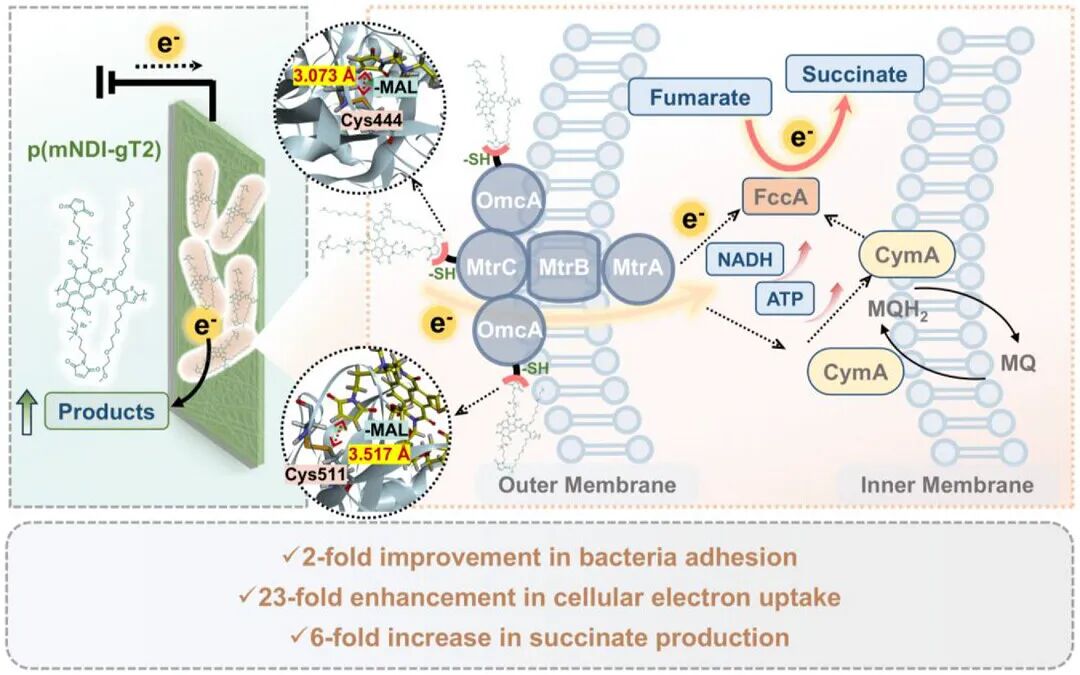
Figure 1
Schematic illustration of the model for efficient bioelectron uptake realized via covalent integration at the biotic–abiotic interface based on the p(mNDI-gT2)/S. oneidensis biohybrid system.
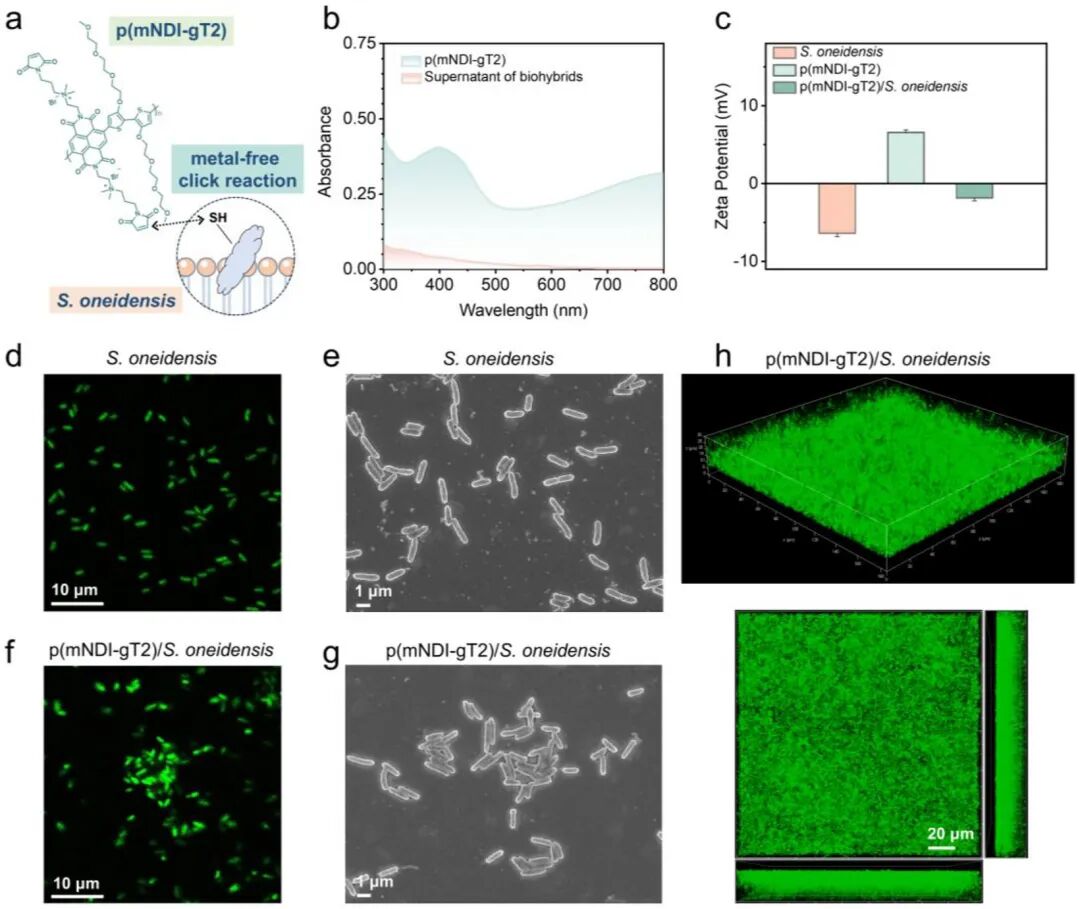 Figure 2
Construction and characterization of the p(mNDI-gT2)/S. oneidensis biohybrid system. (a) Schematic illustration of the p(mNDI-gT2)/S. oneidensis biohybrid model. This biohybrid was constructed by incorporating p(mNDI-gT2) (20 μm) into electroactive S. oneidensis. (b) UV–vis absorption spectra of the aqueous p(mNDI-gT2) solution (green) and the supernatant of the p(mNDI-gT2)/S. oneidensis biohybrid after centrifugation (orange-red). (c) Surface potential of aqueous p(mNDI-gT2), bare S. oneidensis suspension, and the p(mNDI-gT2)/S. oneidensis biohybrid system in M9 minimal medium (n = 3, mean ± SD). CLSM images of (d) bare S. oneidensis and (f) the p(mNDI-gT2)/S. oneidensis biohybrid stained with the standard LIVE/DEAD BacLight bacterial viability kit in M9 minimal medium. SEM images of (e) bare S. oneidensis and (g) the p(mNDI-gT2)/S. oneidensis biohybrid. (h) 3D confocal fluorescence image of the biofilm formed by the p(mNDI-gT2)/S. oneidensis biohybrid after 24 h of incubation in Luria Bertani (LB) medium. [p(mNDI-gT2)] = 20 μM.
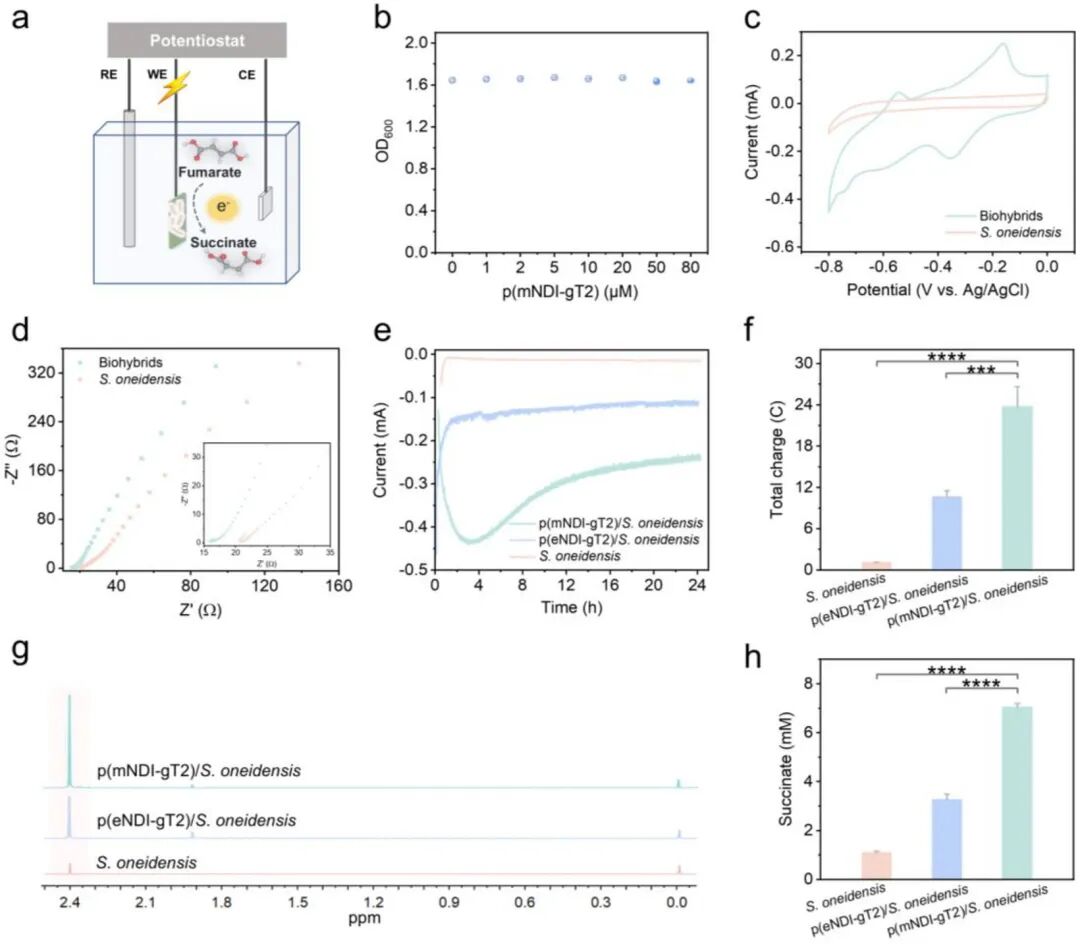 Figure 3
Construction and electrobiological activity of the p(mNDI-gT2)/S. oneidensis biohybrid system. (a) Schematic illustration showing how the p(mNDI-gT2)/S. oneidensis biohybrid facilitates improved electron uptake during bioelectron reduction. (b) Microbial interaction and biocompatibility of S. oneidensis incubated with p(mNDI-gT2) (0−80 μM) in LB medium over 10 h (n = 3, mean ± SD). (c) Cyclic voltammetry (CV) recorded from 0 V to −0.80 V at a scan rate of 5 mV s⁻¹. (d) Nyquist plots (the inset shows the magnified low-impedance region). (e) Chronoamperometry (CA) curves collected over 24 h at 30 °C for the bioelectrosynthesis of succinate from fumarate at a bias of −0.70 V under anaerobic conditions (n ≥ 1 independent biological replicates). (g) ¹H NMR spectra and (h) succinate yields of the p(mNDI-gT2)/S. oneidensis biohybrid under anaerobic conditions, with bare S. oneidensis and the p(eNDI-gT2)/S. oneidensis biohybrid as control groups.
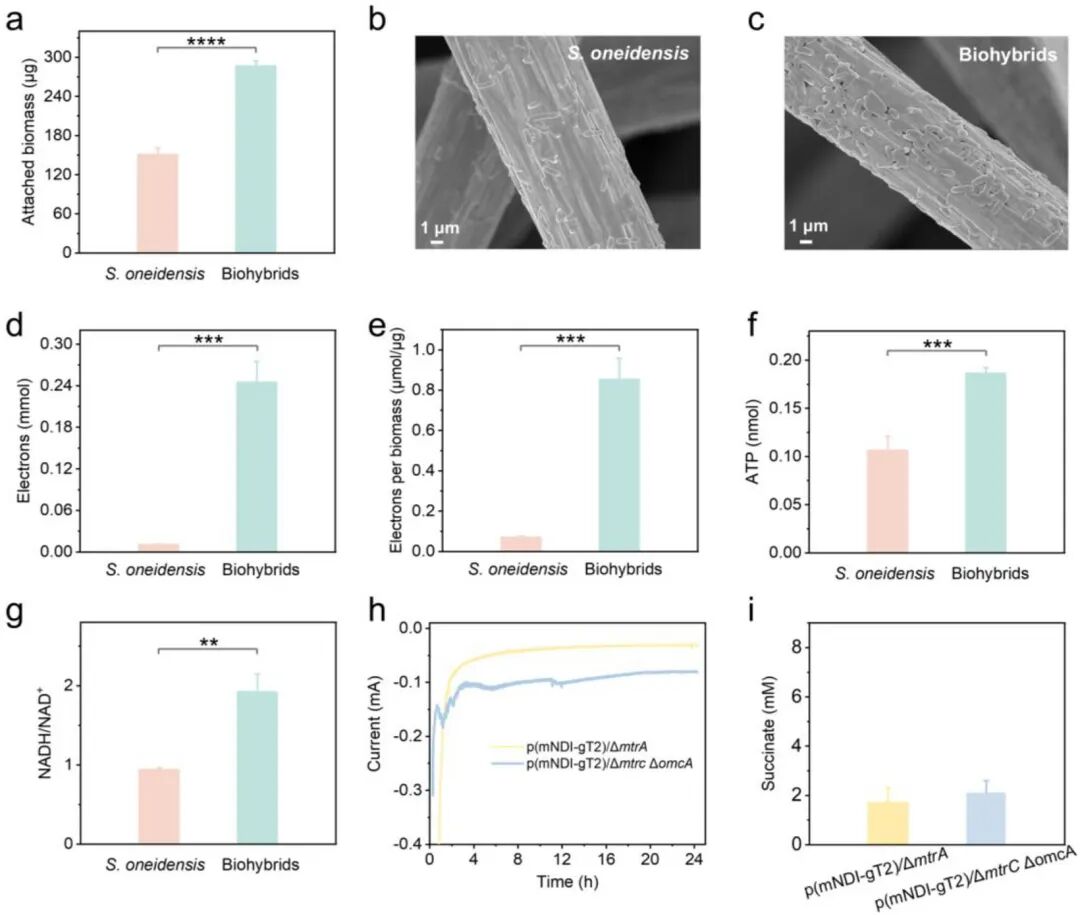
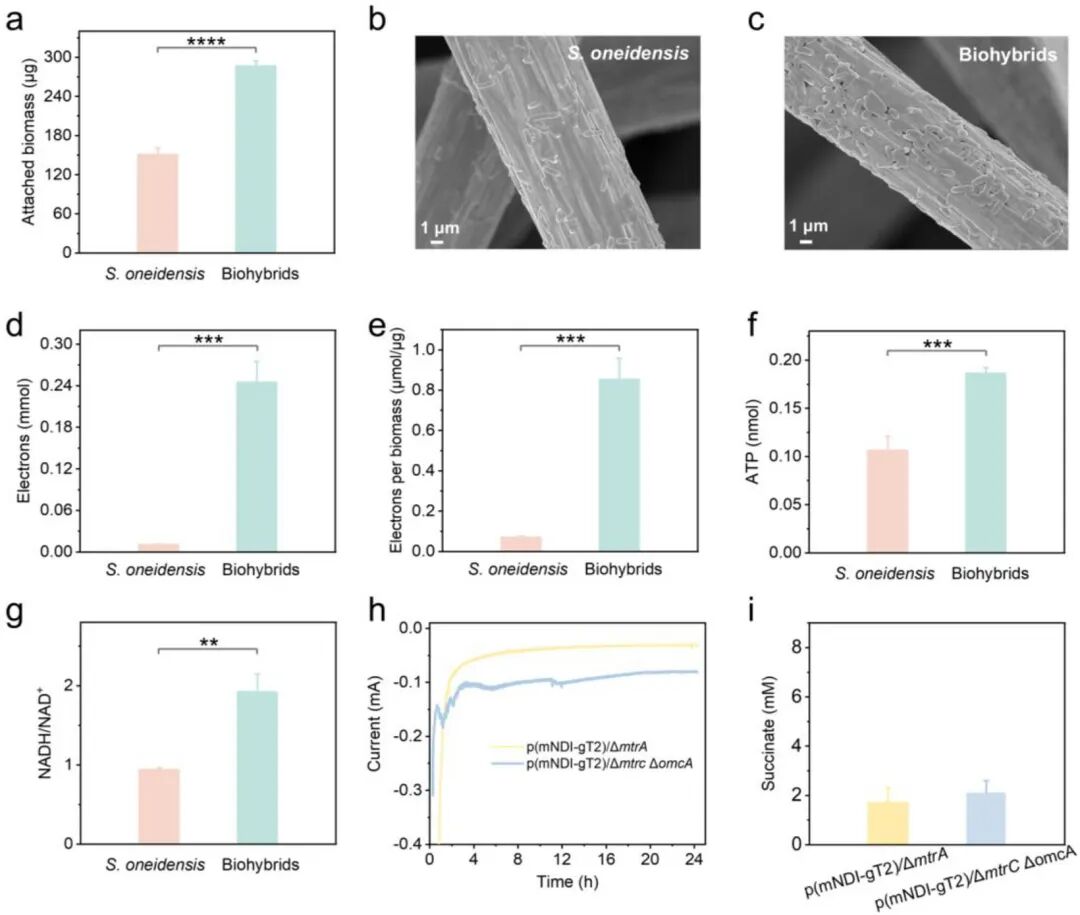 Figure 4
Performance and proposed mechanism of the p(mNDI-gT2)/S. oneidensis biohybrid system. (a) Quantification of attached biomass adsorbed on the p(mNDI-gT2)/S. oneidensis biohybrid electrode, with the bare S. oneidensis electrode as the control (n = 3, mean ± SD). Representative scanning electron microscopy images of (b) the bare S. oneidensis electrode and (c) the p(mNDI-gT2)/S. oneidensis biohybrid electrode after 24 h of CA operation. (d) Total cathodic electrons and (e) electrons normalized to biomass over 24 h for the bare S. oneidensis electrode and the p(mNDI-gT2)/S. oneidensis biohybrid electrode (n = 3, mean ± SD). (f) ATP levels and (g) NADH/NAD⁺ ratios of the bare S. oneidensis electrode and the p(mNDI-gT2)/S. oneidensis biohybrid.
Summary
Aiming at the challenges of weak adhesion, high interfacial resistance and insufficient electron injection at biotic–abiotic interfaces, this work adopts maleimide-functionalized conjugated polymer p(mNDI-gT2) to perform in situ click reaction with thiol groups of cytochromes from Shewanella oneidensis, so as to construct a covalent biointerface. The covalent interface doubles bacterial adhesion, reduces interfacial resistance and facilitates electron injection, achieving a 23-fold enhancement in electron transfer and a 6-fold improvement in electrochemical reduction, which is markedly superior to the noncovalent group. Fundamentally, this strategy advances conventional bulk adsorption and microbial coating toward molecular-level interface engineering.
Molecular docking and proteomic analyses reveal that such an interface not only improves charge transfer, but also upregulates key respiratory and biointerface protein complexes, establishing a closed correlation between macroscopic performance and microscopic protein expression. Future work can be extended to other electroactive microorganisms and conductive material systems. Further efforts will be devoted to interfacial selectivity, long-term stability, biocompatibility and scalable fabrication. The regulatory effects of covalent linkage on respiratory chain assembly and product selectivity will also be dissected, providing transferable design principles for microbial electrosynthesis interfaces.
References:
DOI: 10.1002/adma.75571
We specialize in custom development of functional nanomedical materials. We can tailor materials according to experimental requirements, tuning structure, particle size and surface modification, with a full suite of characterization services. The research scheme supports iterative optimization and continuous technical communication. Our services support research projects including targeted delivery, bioimaging, nanotheranostics and more. Feel free to send your specifications for scheme evaluation.
Engineer Zhang: +86 17715390137
Engineer Chen: +86 18914047343