已传文件:photo/1794532818.png
 Biomedical Materials Frontier
Miniature wireless magnetic robots (MWMRs) hold great potential for minimally invasive interventions. Real-time tracking of MWMRs is critical for precise in vivo navigation yet remains challenging. Tracking MWMRs via their emitted magnetic signals represents a viable solution; however, this approach is limited to centimeter-scale robots, as miniaturization makes it increasingly difficult to isolate the faint signals of MWMRs from strong interference induced by driving fields. Herein, we report an artificial intelligence (AI)-driven tracking system to address these challenges, enabling the precise localization of millimeter-scale MWMRs in the presence of driving fields. Our strategy integrates sensor array design with a transformer architecture to accurately model and filter interference. A spatiotemporal transformer is subsequently adopted to decode the extracted MWMR signals into corresponding three-dimensional coordinates within a short time window. The system has been validated in multiple in vitro and in vivo experiments, demonstrating its suitability for closed-loop navigation of MWMRs in unshielded clinical environments.

This study was published in Science Robotics under the title “AI-driven actuation-compatible tracking for closed-loop navigation of miniature robots in vivo”.
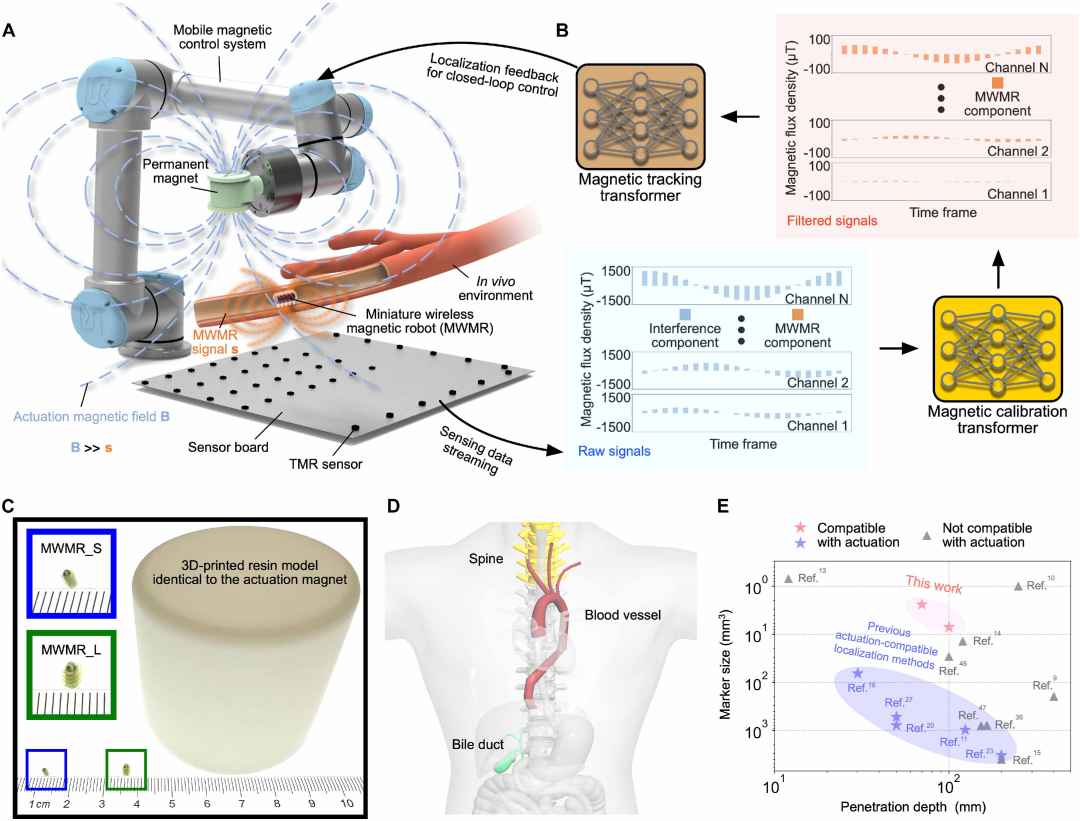
Figure 1
Overview of the AI-driven tracking system based on multi-magnetic-field monitoring. (A) Schematic illustration of an MWMR navigated in vivo by a mobile magnetic control system, with real-time localization feedback provided by our tracking system. (B) Simplified workflow for recovering the 3D position of the MWMR using the proposed AI-based method. The magnetic calibration transformer extracts the MWMR component from raw sensing data, and the MTT exploits spatiotemporal correlations within the extracted MWMR signals to predict its three-dimensional position. (C) Size comparison between the MWMR and the permanent magnet used to generate the actuation field. (D) Potential application scenarios of the proposed tracking method. (E) Comparison of our method with existing wireless localization studies.
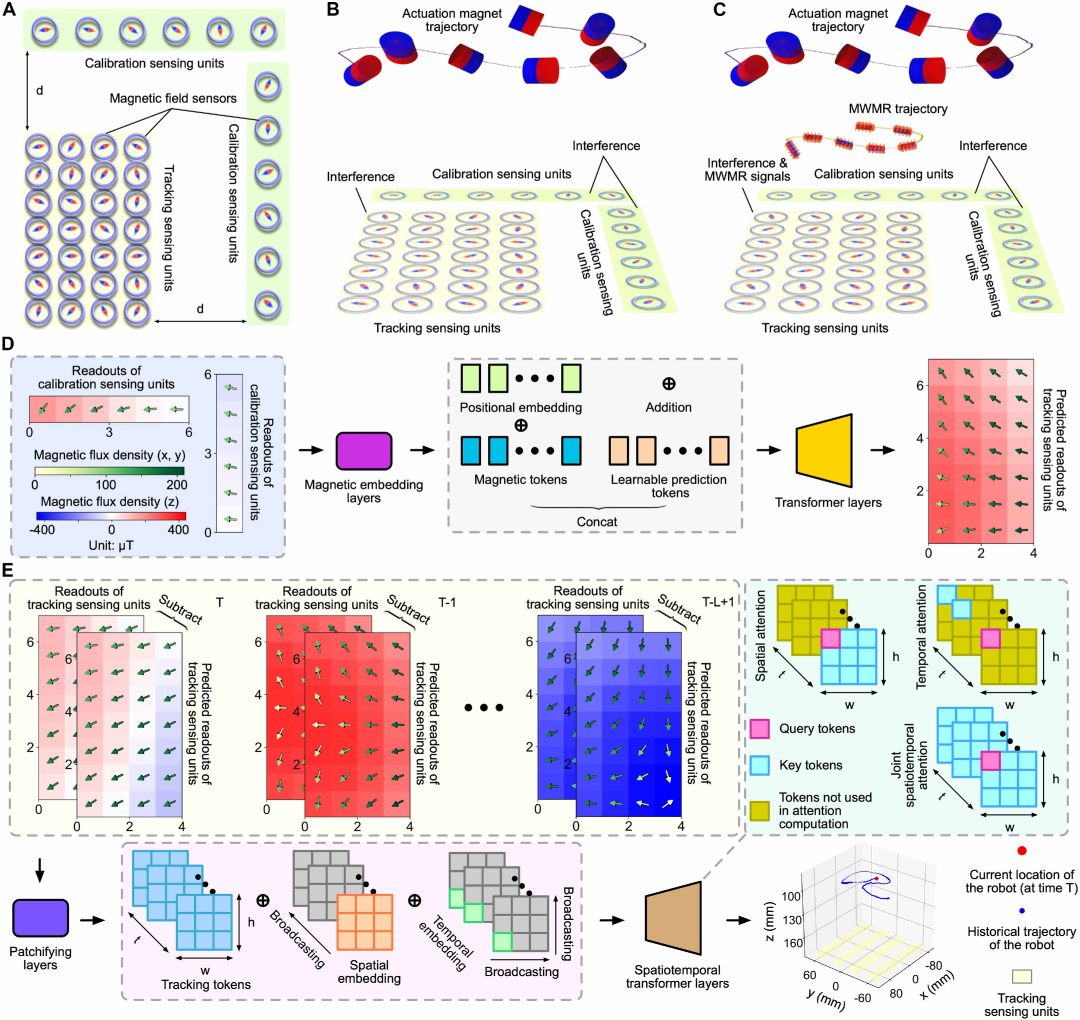
Figure 2
The sensing components of the tracking platform and the AI-based data interpretation method were designed. (A) Schematic showing the layout of the TMR sensor array. (B) Random actuation fields are generated in the absence of the MWMR to collect calibration data for MCT training. (C) The MWMR is navigated along different trajectories within the operating space using actuation fields to acquire tracking data required for MTT training. (D) Schematic of the MCT, which takes readings from calibrated sensing units as input and predicts interference components in the tracking readings of the sensing units. (E) Schematic of the MTT, which takes the time series of estimated MWMR signals from tracking sensing units as input and outputs three-dimensional coordinates representing the corresponding MWMR positions.
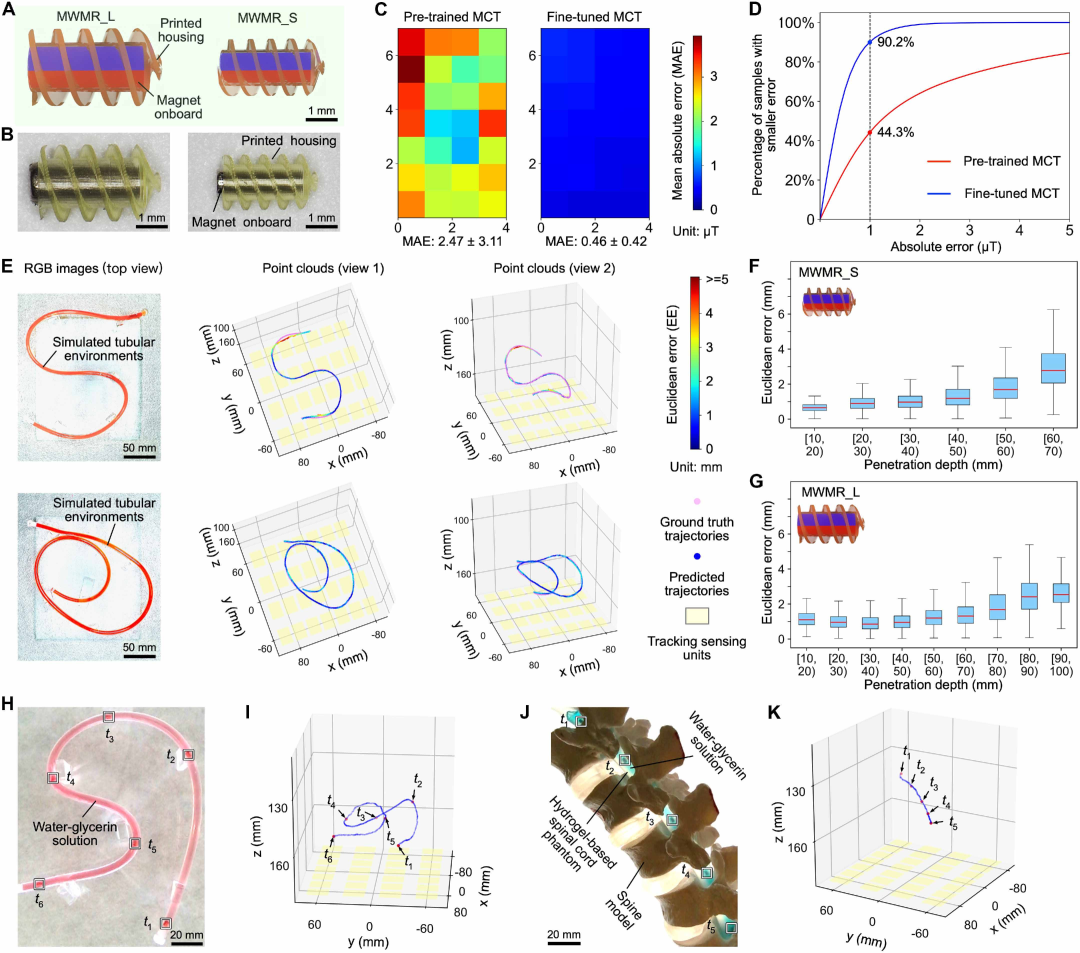
Figure 3
In vitro evaluation of tracking and navigation performance. (A) Schematic diagrams showing the structures of MWMR_S and MWMR_L. (B) Microscopic images of MWMR_S and MWMR_L. (C) MAEs of pre-trained and fine-tuned MCT for predicting the readings of tracking sensing units. (D) Absolute error distributions of pre-trained and fine-tuned MCT. (E) Tracking results of MWMR_S in two simulated tubular environments. (F and G) Error distributions of MWMR_S and MWMR_L at different penetration depths.
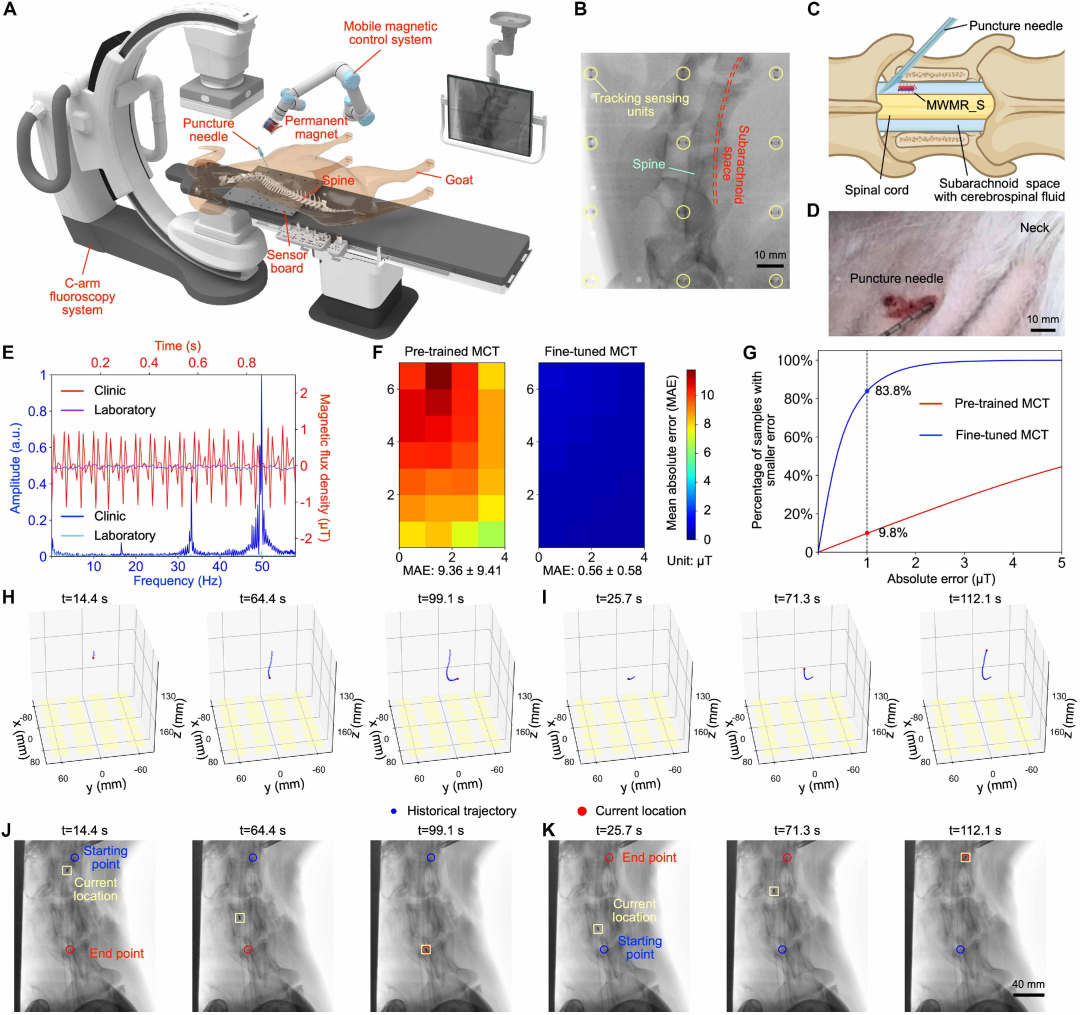
Figure 4
In vivo navigation in the subarachnoid space of the spine in a goat model. (A) Schematic of the experimental setup, including a mobile magnetic control system for generating the actuation field, a sensor board for recording magnetic signals, and a C-arm fluoroscopy system for capturing X-ray images as reference. (B) Preoperative X-ray scan showing the position of the goat spine relative to the sensor board. (C) Schematic illustrating the introduction of MWMR_S into the subarachnoid space via a custom titanium puncture needle. (D) Photograph showing the puncture site on the goat’s neck.
Summary
This study targets a core bottleneck of miniature magnetically controlled robots: the faint intrinsic signals of millimeter-scale robots are completely overwhelmed by strong external driving magnetic fields, restricting conventional localization methods to centimeter-scale robots. The research team adopted a synergistic "hardware + algorithm" strategy to address this challenge. First, a sensor array combined with Transformer architecture was designed to accurately model and filter intense magnetic background interference. A spatiotemporal Transformer was then implemented to capture signal evolution within a short time window and directly reconstruct three-dimensional coordinates. Ultimately, closed-loop in vivo navigation of millimeter-scale robots was realized in an unshielded realistic environment.
This two-stage framework of "AI denoising plus spatiotemporal feature decoding" essentially solves the problem of weak signal extraction under extremely low signal-to-noise ratios. For our own research projects, this strategy can serve as a valuable reference for weak fluorescence/photoacoustic signal tracking in deep tissues and biosensing detection in complex physiological environments. Instead of solely relying on hardware upgrades or complicated conventional physical equations, researchers can first acquire environmental background noise baselines via rational spatial arrangement of sensors, and then leverage deep learning to capture time-series correlations, efficiently breaking the detection limit.
Reference:
DOI:10.1126/scirobotics.aee0592
We specialize in custom development of functional nanomedical materials. We tailor materials according to experimental requirements, regulating material structure, particle size and surface modification. Full characterization services are provided, and solutions can be iteratively optimized with continuous technical support throughout the project. Our services support research projects including targeted delivery, bioimaging and nanotheranostics. Feel free to share your specifications for solution evaluation.
Engineer Zhang: 17715390137
Engineer Chen: 18914047343