已传文件:photo/1794795234.png
 The emergence of multidrug-resistant (MDR) bacterial infections has become a critical global health concern, driving an urgent demand for innovative therapeutic strategies beyond conventional antibiotics. In this study, a novel drug platform was developed using peptone-containing poly(N-vinyl-2-pyrrolidone)-stabilized silver nanoparticles (PVP-AgNPs) to improve antibacterial efficacy and biocompatibility. AgNPs were synthesized via chemical reduction of silver nitrate with sodium borohydride, where PVP served as a stabilizer and capping agent. Peptone, a cationic antibacterial peptide, was subsequently incorporated to leverage its strong affinity for bacterial membranes and synergistic bactericidal effects. The resulting nanoparticles were spherical, with an average diameter of 70.96±0.27 nm, a PDI of 0.25±0.002, and a zeta potential of +10.4±0.15 mV. The peptone loading efficiency reached 66.2%±3.2%, demonstrating excellent colloidal stability and successful drug incorporation. In vitro antibacterial assays revealed that the minimum inhibitory concentration decreased by 2–4-fold compared with bare PVP–AgNPs and free peptone. Disk diffusion assays confirmed markedly enhanced activity against both Gram-positive (Staphylococcus aureus) and Gram-negative bacteria (Escherichia coli, Pseudomonas aeruginosa). Furthermore, in vivo evaluation using a mouse wound infection model achieved efficient bacterial clearance, accelerated wound closure, and improved tissue regeneration. These findings indicate that peptone-enriched PVP-AgNPs exhibit multimodal antibacterial activity and improved cytocompatibility, with the potential to circumvent resistance mechanisms. Overall, this work presents a promising therapeutic strategy for managing MDR infections and promoting wound healing, which holds great significance for future biomedical applications.
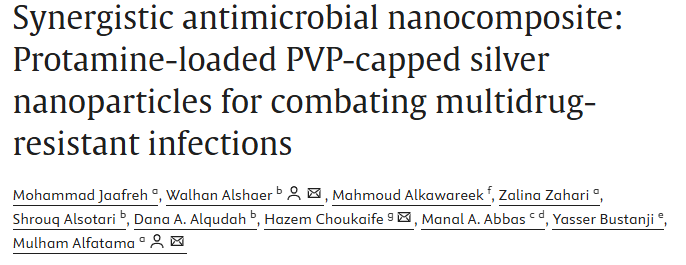
This study was published in the Asian Journal of Pharmaceutical Sciences under the title “Synergistic antimicrobial nanocomposite: Protamine-loaded PVP-capped silver nanoparticles for combating multidrug-resistant infections”.
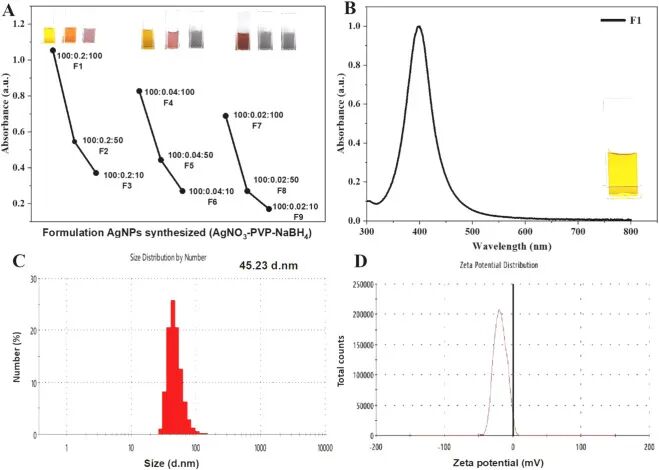
Figure 1
UV–Vis spectra and characterization of PVP–AgNPs prepared with different concentrations of NaBH₄ and PVP (AgNO₃ fixed at 100 mM): (A) shifts and intensity variations of the SPR peak; (B) UV–Vis spectrum of the optimized formulation (F1); (C) particle size distribution of F1; (D) zeta potential of F1.
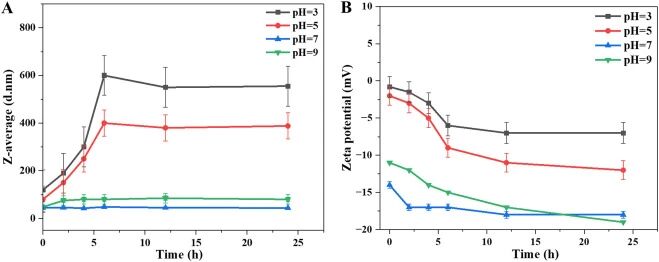
Figure 2
Effects of pH on the physicochemical properties of PVP–AgNPs. (A) Z-average hydrodynamic diameter (d, nm) and (B) zeta potential at different pH values.
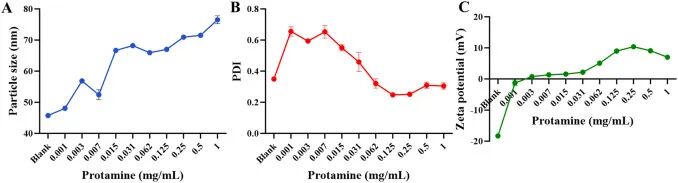
Figure 3
Effects of protamine concentration on (A) particle size, (B) polydispersity index (PDI), (C) loading efficiency and (D) zeta potential of protamine-loaded PVP–AgNPs.
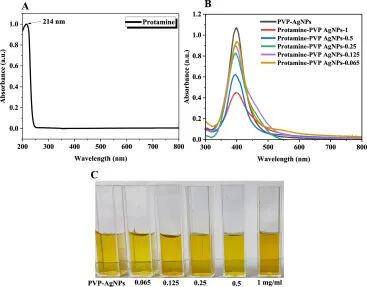
Figure 4
(A) UV–Vis spectrum of free protamine, and (B) UV–Vis spectra of protamine-loaded PVP–AgNPs at different protamine concentrations and bare PVP–AgNPs; (C) corresponding photographs of AgNPs solutions at the designated protamine concentration.
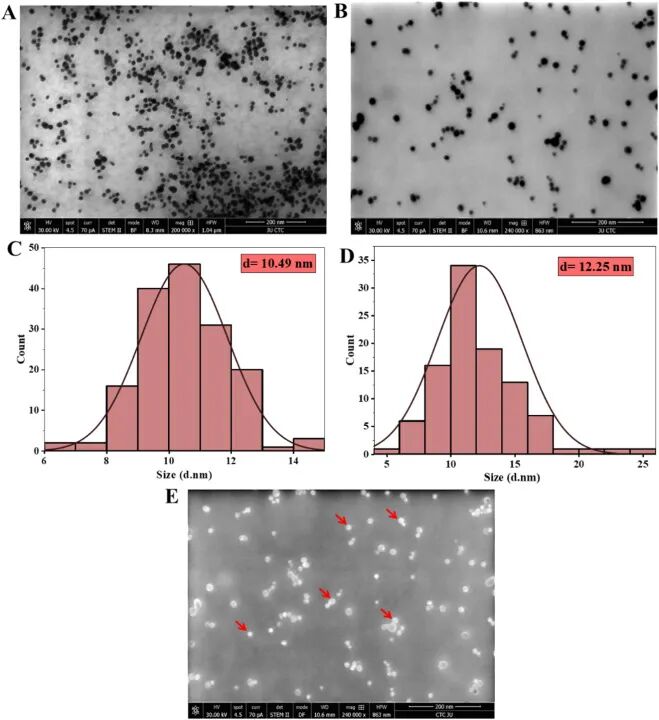
Figure 5
Transmission electron microscopy (TEM) images of (A) PVP–AgNPs and (B) protamine-loaded PVP–AgNPs (scale bar: 200 nm); (C) particle size distribution of bare PVP–AgNPs and (D) protamine-loaded PVP–AgNPs (>100 particles); (E) dual-staining image showing the surface morphology of protamine-loaded PVP–AgNPs, with arrows indicating the adsorbed protamine layer (scale bar: 200 nm).
Summary
Infections caused by multidrug-resistant bacteria drive the demand for alternative therapeutic approaches beyond conventional antibiotics. Herein, silver nanoparticles were combined with the cationic antimicrobial peptide protamine using PVP as a stabilizer to construct a composite antibacterial system. Silver nanoparticles exert broad-spectrum bactericidal activity, while protamine disrupts bacterial membranes via electrostatic interactions. The combination synergistically improves membrane penetration and bactericidal efficacy. In vitro assays demonstrate that the minimum inhibitory concentrations of this composite against both Gram-positive and Gram-negative bacteria are 2–4-fold lower than those of individual components. In a mouse wound infection model, the material efficiently eradicates bacteria, accelerates wound healing and exhibits favorable histocompatibility.
This strategy validates the feasibility of combining inorganic nanomaterial-mediated sterilization and peptide-induced membrane perturbation to combat drug-resistant bacteria. In future work, tuning protamine density and silver particle size may enable targeted treatment of clinical strains with distinct resistance profiles. Its suitability for local administration supports applications in wound treatment, implant coating and postoperative infection prophylaxis, thereby reducing systemic antibiotic consumption. Moreover, this platform can be loaded with other antibacterial agents to achieve combined multi-modal action and slow the emergence of new resistance. The in vivo pro-healing effect suggests that silver and protamine may also participate in immunomodulation in addition to their bactericidal effects. Further investigation into their integrated performance in chronically infected wounds is warranted.
Reference:
DOI: 10.1016/j.ajps.2026.101160
We specialize in custom functional materials for nanomedicine. We can tailor biofunctional nanomaterials according to your experimental requirements with controllable structure, particle size and surface modification, alongside a full range of characterization services. Iterative optimization and continuous technical support are provided to facilitate research projects involving targeted delivery, bioimaging and nanotheranostics. Please share your specification requirements for a customized evaluation.
Mr. Zhang: +86 17715390137
Mr. Chen: +86 18914047343