已传文件:photo/1794963562.png
 Literature Background

This study was published in Advanced Functional Materials under the title “Tough and Skin-Free Porous Polyelectrolyte Complex Hydrogels via Salt-Induced Aqueous Phase Separation”.
Frontiers in Bionanomaterials
Polyelectrolyte complex (PEC) hydrogels fabricated via eco‑friendly aqueous phase separation (APS) can exhibit porous structures suitable for tissue engineering, drug delivery and flexible bioelectronics. The microstructures and mechanical properties of PEC hydrogels can be tuned by adjusting the processing parameters of salt‑induced APS. Using poly(sodium 4‑styrenesulfonate) and poly(diallyldimethylammonium chloride) as a model system, this study clarifies the critical role of counterion exchange rate in governing the microstructural features of PEC hydrogel networks. By systematically varying polymer concentration and coagulation bath composition, a direct correlation is established between counterion exchange rate and the resulting microstructure. Fast counterion exchange triggers instantaneous phase separation, generating a skin layer and large pores. In contrast, slow counterion exchange enables more uniform phase separation, facilitating the formation of dense PEC networks with homogeneous pores and improved mechanical performance. Additives introduced into the coagulation bath further yield uniformly porous PEC networks, producing physical hydrogels with outstanding toughness (>10 MJ·m⁻³) and stretchability (>1000%). The PEC hydrogels are compatible with advanced processing strategies including extrusion‑based 3D (bio)printing for fabricating homogeneously porous scaffolds. Polypyrrole can be deposited onto skin‑free PEC networks via oxidative chemical vapor deposition to obtain conductive hydrogels for flexible bioelectronics. These findings highlight the significance of coagulation bath composition for designing PEC hydrogels with tough, robust and tailorable properties.
Quick Look at the Literature
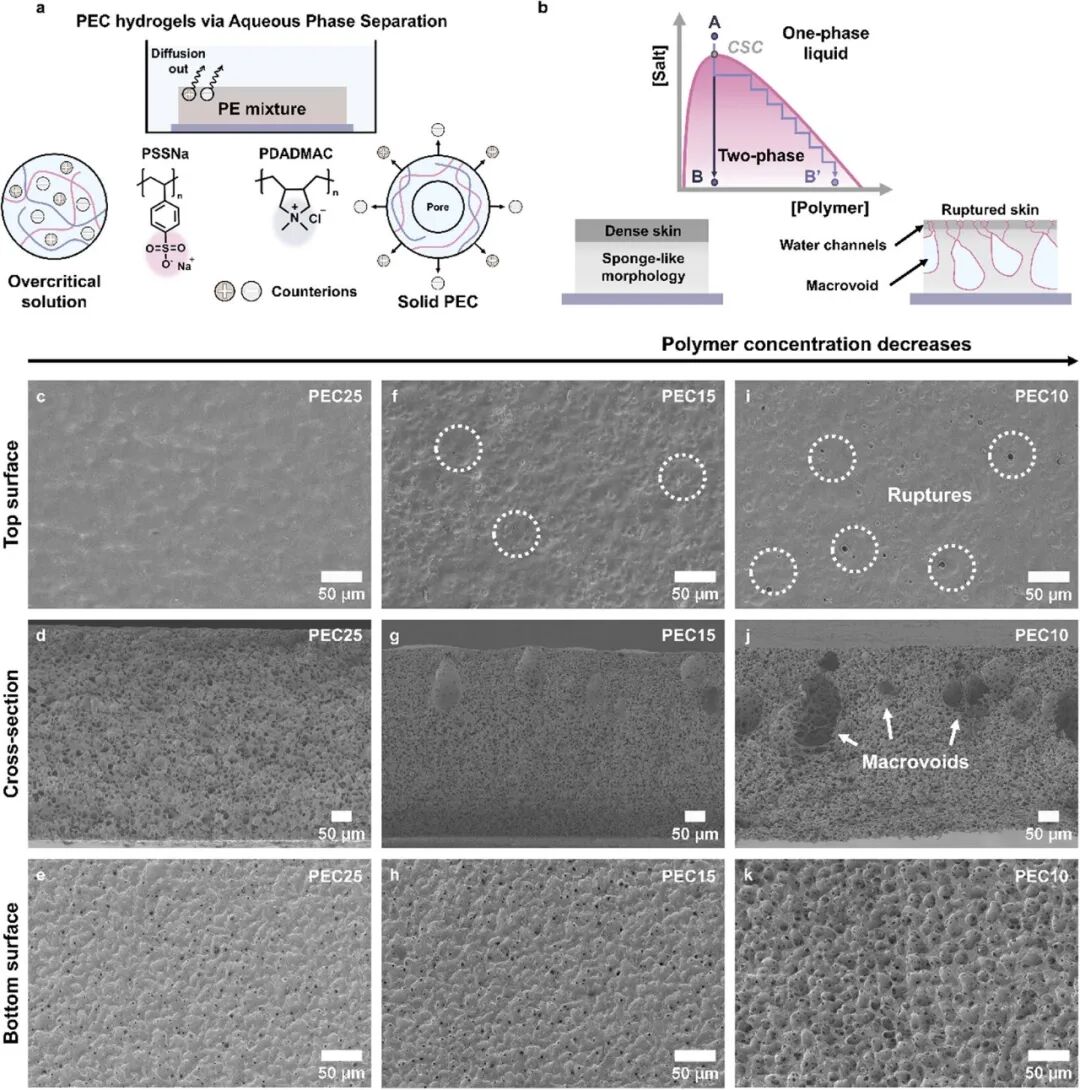
Figure 1
Microstructural characteristics of polyelectrolyte complex (PEC) hydrogels. (a) Schematic illustration of the aqueous phase separation (APS) process used to fabricate PEC hydrogels. (b) Schematic of the polymer–salt phase diagram and coagulation pathway during APS. Representative scanning electron microscopy (SEM) images showing the top-surface, cross-sectional and bottom-surface morphologies of PEC hydrogels prepared from casting solutions with total polymer concentrations of (c–e) 25 wt.%, (f–h) 15 wt.% and (i–k) 10 wt.%.
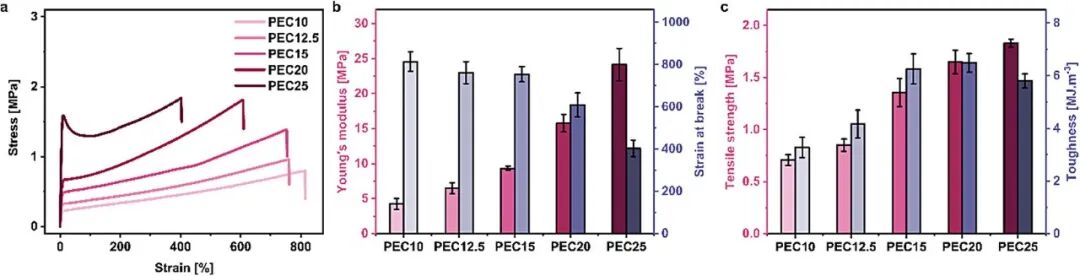
Figure 2
Mechanical performance of polyelectrolyte complex (PEC) hydrogels with increasing total polymer concentration. (a) Representative uniaxial tensile stress–strain curves of PEC hydrogels fabricated from casting solutions with total polymer concentrations ranging from 10 to 25 wt.%, and the corresponding (b) Young’s modulus and fracture strain, as well as (c) tensile strength and toughness. Data are presented as mean ± standard deviation (n = 5 independent samples).
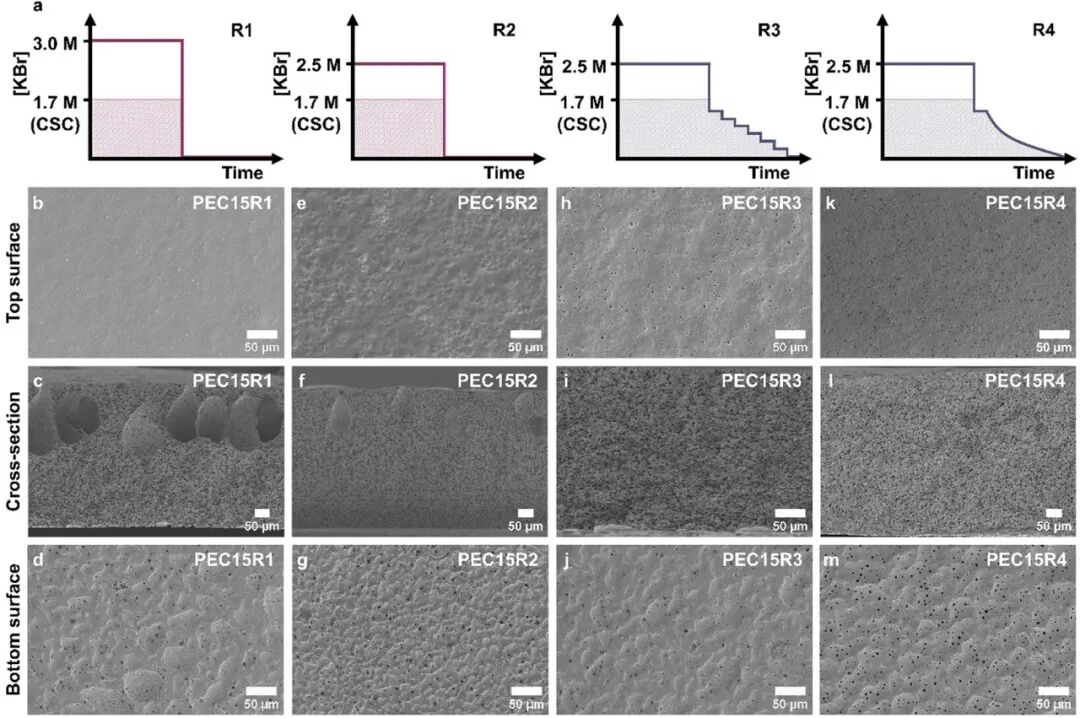
Figure 3
Effects of tuning coagulation bath salinity on the microstructural characteristics of polyelectrolyte complex (PEC) hydrogels. (a) Schematic illustration of the counterion exchange rates adopted during APS. Representative scanning electron microscopy (SEM) images showing the top-surface, cross-sectional and bottom-surface morphologies of PEC hydrogels formed by (b–d) direct immersion of the PE casting solution in 3.0 M KBr, (e–g) immersion in a 2.5 M KBr coagulation bath in deionized water (0 KBr), (h–j) stepwise reduction, and (k–m) quasi-continuous reduction of coagulation bath salinity from 2.5 M to 1.2 M and finally to 0 M KBr.
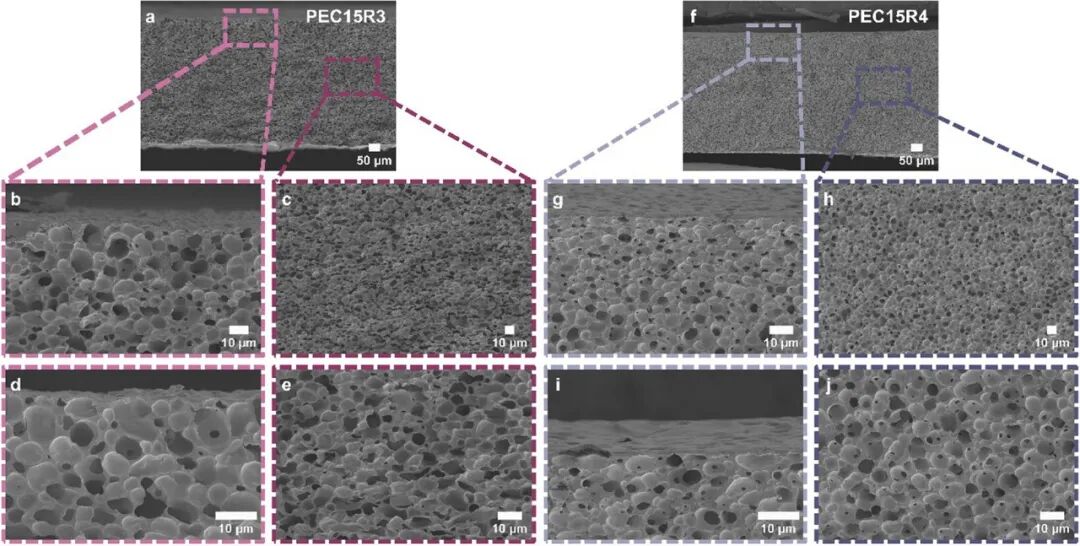
Figure 4
Microstructural characteristics of polyelectrolyte complex (PEC) hydrogels fabricated by tuning coagulation bath salinity. Representative scanning electron microscopy (SEM) images of cross-sections of PEC hydrogels prepared by adding salt to the coagulation bath during aqueous phase separation (APS), followed by (a–e) stepwise reduction (PEC15R3) and (f–j) quasi-continuous reduction (PEC15R4) of coagulation bath salinity.
Reference Information
Advanced Functional Materials (IF: 19.9)
Publication Date: August 4, 2026
DOI: 10.1002/adfm.77451
We specialize in custom functional materials for nanomedicine. We can develop biofunctional nanomaterials tailored to your experimental requirements, with controllable structure, particle size and surface modification. A full suite of characterization tests is available. Formulations can be iteratively optimized with continuous technical support to assist research projects including targeted delivery, bioimaging and nanotheranostics. Feel free to share your specifications for custom scheme evaluation.
Engineer Zhang: 17715390137
Engineer Chen: 18914047343