已传文件:photo/1795055987.png


This study was published in Advanced Functional Materials under the title “Hydration‐Triggered Electronic Skin for Integrated Biomechanical and Non‐Invasive Plasmonic Biochemical Sensing”.
Frontiers in Biomedical
Materials
Wearable electronic skins that overcome sweat interference and utilize sweat biomarkers are critical for clinical-grade monitoring. Herein, we report a hydration-triggered whole-body electronic skin (HTWB-E-Skin) constructed from a biocompatible composite of nanofibrous silk fibroin and silver nanowires (Ag NWs). The elegance of this design lies in its structurally simple, multifunctional architecture that employs a hydration-triggered mechanism to synergistically boost biomechanical and biochemical sensing. On one hand, the hydration-induced conformational transition of silk, validated by theoretical and experimental investigations, enables rapid sweat absorption (<10 s), outstanding water retention capacity (>600% mass gain), and stable adhesion on moist skin. On the other hand, silk-fibroin-embedded Ag NWs simultaneously realize motion-robust electrocardiogram (ECG) monitoring and generate plasmonic hotspots for surface-enhanced Raman spectroscopy (SERS). Via passive capillary action, trace sweat is automatically guided to the sensing region for label-free, real-time and continuous metabolic kinetic analysis of clinically relevant biomarkers such as uric acid and urea at ultralow concentrations, facilitating personalized nutrition and health management. This platform integrates a portable 12-lead cloud-based ECG module, supporting motion-adaptive ECG recording, voice recognition and whole-body motion sensing. It outperforms commercial electrodes and offers a practical methodology for long-term personalized health monitoring and point-of-care diagnosis.
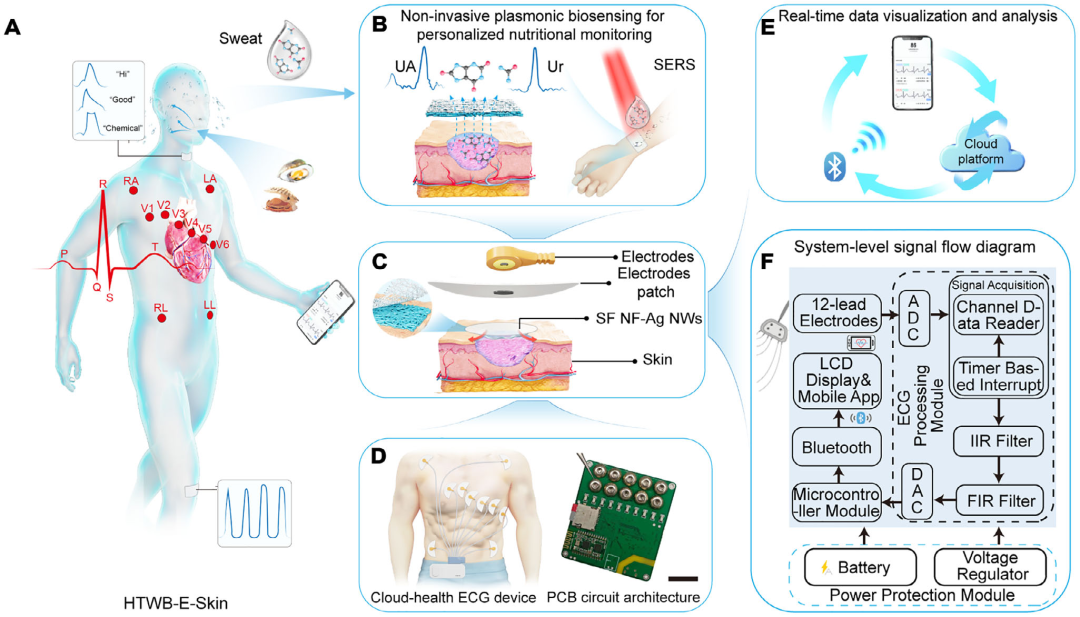
Figure 1
HTWB-E-Skin platform for multimodal biomechanical and plasmonic biochemical sensing. (A) Schematic illustration of HTWB-E-Skin, which enables motion-adaptive 12-lead electrophysiological (ECG) monitoring, voice recognition, whole-body motion sensing, and non-invasive surface-enhanced Raman spectroscopy (SERS) analysis of clinically relevant sweat biomarkers such as uric acid (UA) and urea. (B) Schematic of non-invasive plasmonic biosensing for personalized monitoring of sweat metabolic biomarkers (urea and uric acid). The upward blue dashed arrows indicate the diffusion direction of biomarkers in sweat. (C) Cross-sectional schematic of the motion-adaptive ECG electronic device, including electrodes, electrode patches and HTWB-E-Skin (i.e., the SF NF-Ag NW layer). Hydration-triggered liquid transport within the silk fibroin network allows HTWB-E-Skin to adhere tightly to the skin surface; red arrows denote the trend of skin conformability. (D) Schematic layout of cloud-enabled health ECG electrodes (left) and photograph of the assembled PCB and signal-processing components (right).
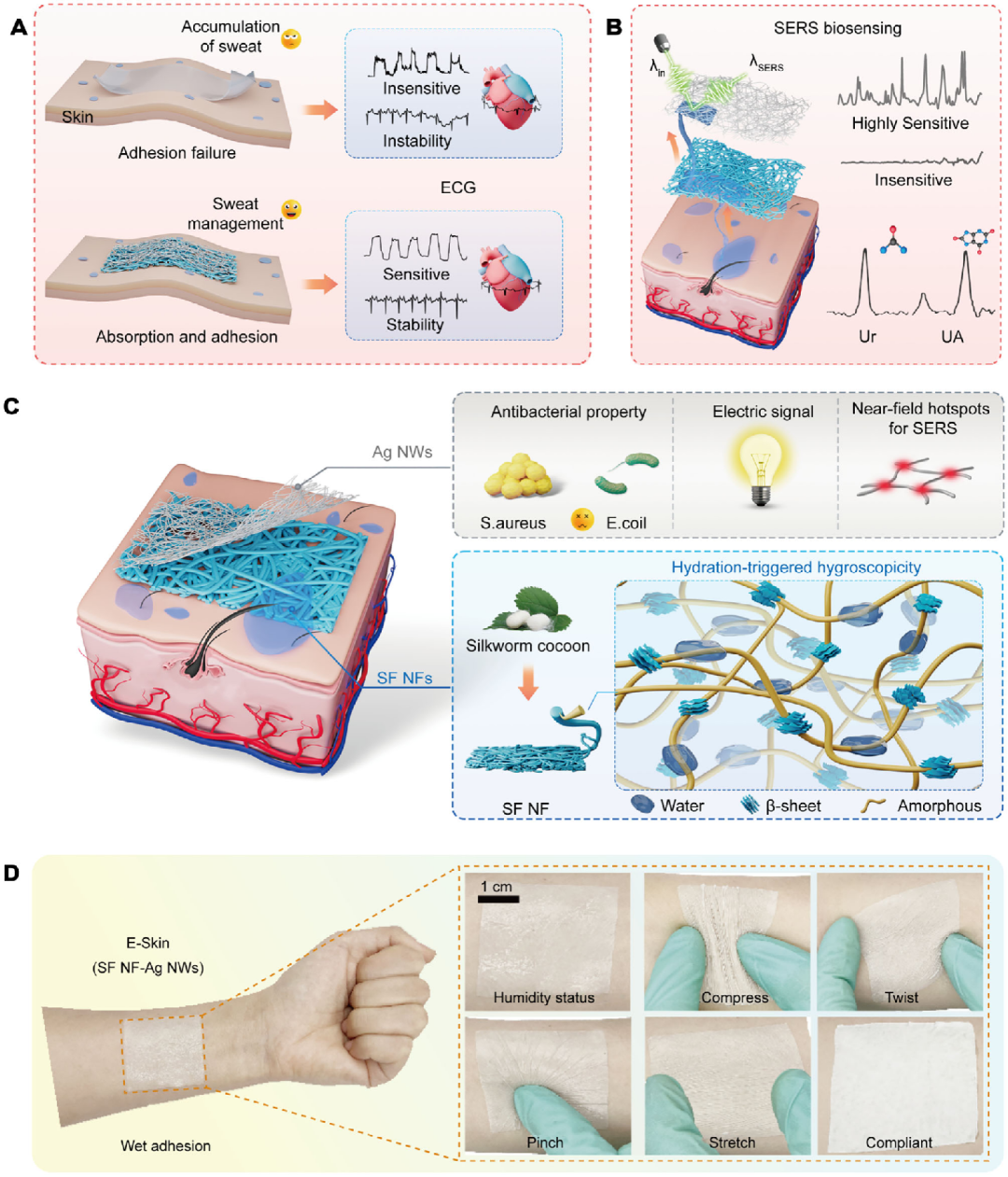
Figure 2
Overall design strategy of the sweat-absorbable wearable HTWB-E-Skin. (A) Schematic comparison between conventional flexible electronic skin (top) and the designed sweat-absorbing SF NF-Ag NW electronic skin (bottom). The SF NF-Ag NW architecture improves sweat management and skin conformability, and enhances signal stability for multimodal biomechanical sensing and ECG monitoring. (B) Schematic of the integrated plasmonic platform for continuous sweat collection, transport and in-situ label-free SERS biosensing. Orange arrows indicate the transport direction of sweat biomarkers. (C) Cross-sectional schematic of the double-layer sweat-wicking electronic skin structure. The top Ag NW layer (gray dashed box) possesses electrical conductivity and antibacterial properties, and forms plasmonic near-field “hotspots” (red dots) to boost SERS detection. The bottom SF NF layer (blue dashed box) derived from natural silkworm cocoons achieves sweat wicking and skin adhesion via hydration-triggered conformational transition; amorphous regions expand to form a porous absorbing network, while crystalline β-sheets maintain mechanical integrity. (D) Optical images demonstrating firm adhesion of the SF NF-Ag NW electronic skin onto moist skin surfaces during sweat accumulation (left) and mechanical deformation (right). Scale bar, 1 cm.
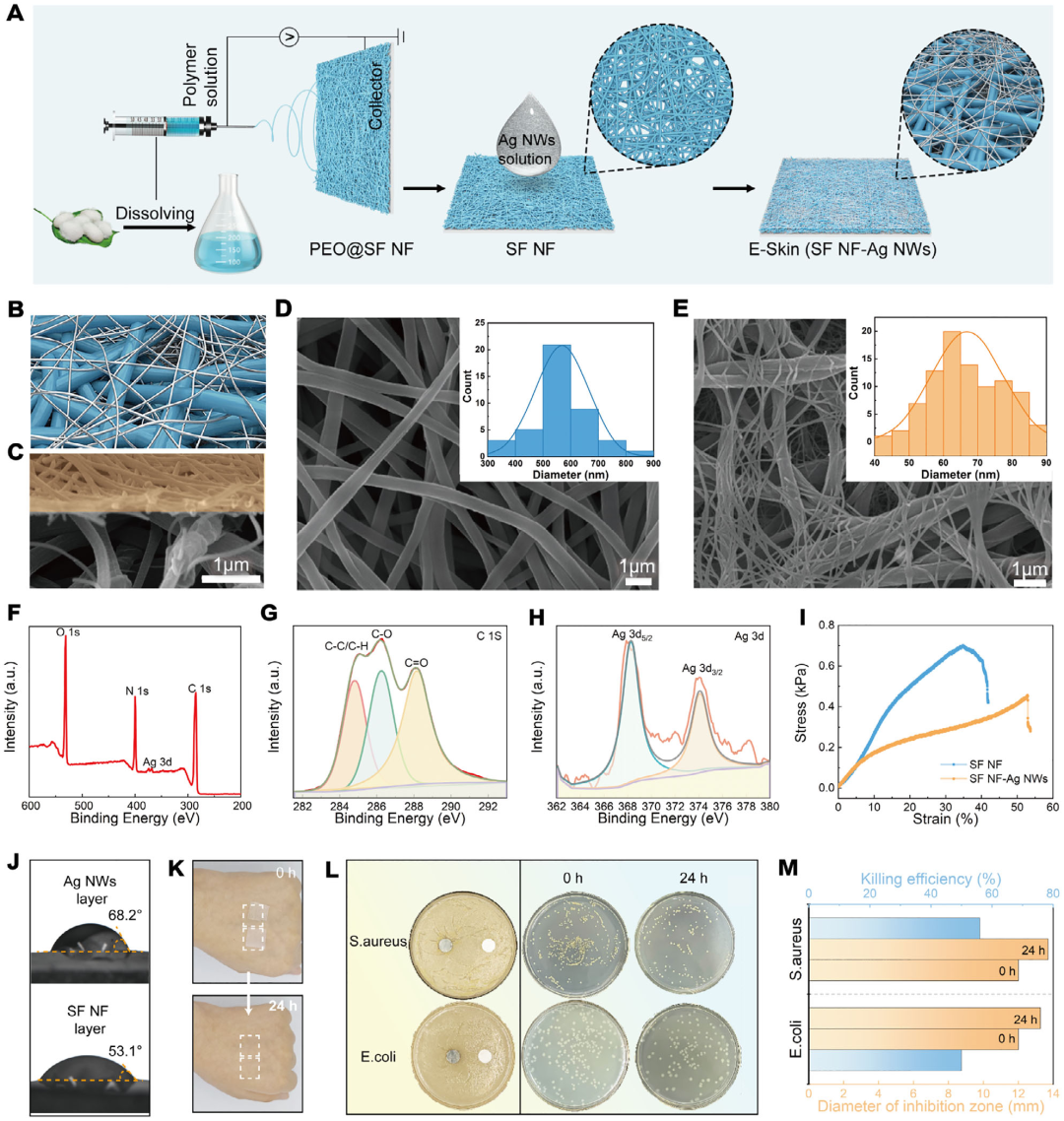
Figure 3
Synthesis, characterization and antibacterial performance of the all-fiber SF NF-Ag NW HTWB-E-Skin. (A) Synthesis schematic of the SF NF-Ag NW e-skin. (B) Schematic illustration of the three-dimensional NF network structure of the e-skin. (C) Cross-sectional SEM image of the SF NF-Ag NW bilayer structure with selective coloring to highlight the top Ag NW layer. (D) SEM image of SF NFs and their diameter analysis. (E) SEM image of the SF NF-Ag NW network and diameter analysis of Ag NWs. (F) XPS survey spectrum of the e-skin film and peak deconvolution for fitted (G) C 1s and (H) Ag 3d. (I) Uniaxial tensile stress–strain curves of the SF NF film and SF NF-Ag NW e-skin film. (J) Water contact angles of the SF NF layer and the Ag NW layer in SF NF-Ag NW e-skin. (K) Comparison of adhesion and comfort performance of the e-skin on human skin within 24 h. (L) Optical images of inhibition zones after 24 h co-cultivation with the e-skin film (left), and optical images of Staphylococcus aureus and Escherichia coli colonies before and after 24 h co-cultivation (right). (M) Inhibition zone diameter and antibacterial efficiency of SF NFs and e-skin films after 24 h incubation.
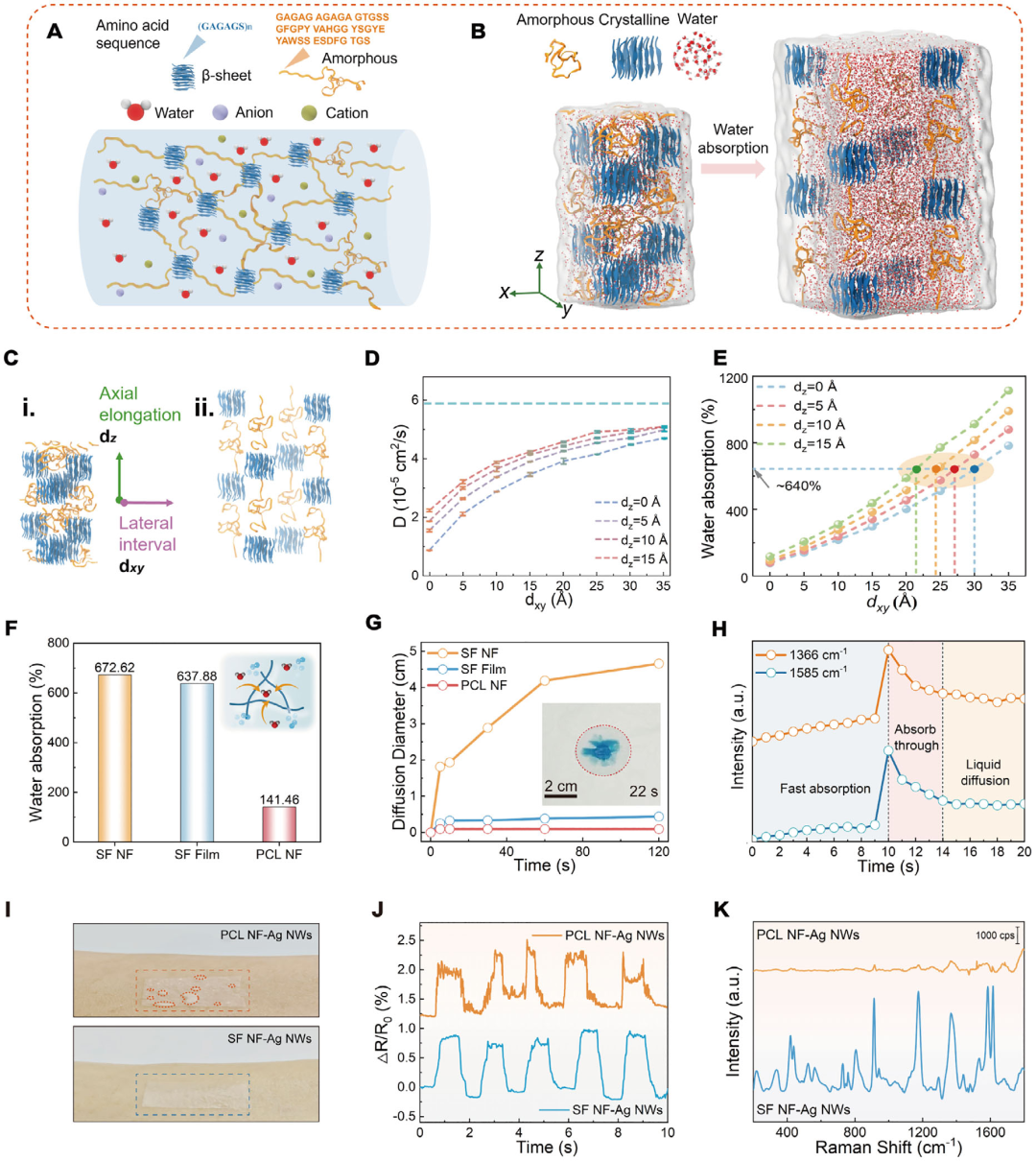
Figure 4
Simulation of water absorption properties and moisture absorption mechanism of HTWB-E-Skin. (A) Structure and components of the SF system. SF consists of two parts: crystalline β-sheets and amorphous random coils. The sequences of β-sheets and random coils are (GAGAS)ₙ and GAGAGAGAGAGTGSSGFGPYVAHGGYSGYEYAAWSSESDFGTGS, respectively. Random coils are shown in orange ribbon style and β-sheets in blue ribbon style. Voids in silk fibers can absorb water and ions; these elements are represented by spheres of different colors: hydrogen in silver, oxygen in red, anions in light purple, and cations in tan. (B) MD models of the SF system before water absorption (left panel) and after water absorption (right panel). Further details of the multiple dynamic simulations are provided in the Methods section.
Summary
Conventional wearable electronic skins often suffer from detachment and signal distortion caused by sweat. This work converts “sweat interference” into a driving force for sensing. The material system is streamlined, consisting only of silk fibroin nanofibers composited with silver nanowires. Upon hydration, silk fibroin undergoes conformational transition, absorbing more than 600% of its own mass in water within 10 seconds and firmly adhering to moist skin. The embedded silver nanowires serve dual functions: they enable stable ECG acquisition under motion and generate plasmonic hotspots for Raman (SERS) sensing. Trace sweat is spontaneously guided to the sensing zone via capillary action, allowing label-free real-time tracking of uric acid and urea dynamics at ultralow concentrations.
Extending from a single composite film to a full hardware system, the team integrated this electronic skin with a portable 12-lead cloud-based ECG module. The integrated platform achieves motion-robust ECG monitoring, voice recognition and whole-body motion sensing simultaneously, with overall performance surpassing commercial electrodes in practical tests. By combining physical electrical signal recording with non-invasive sweat biochemical analysis, this work directly enables personalized nutrition monitoring (e.g., tracking uric acid and urea metabolism after meals) and routine health management. It provides a practical, complete closed-loop strategy for long-term physiological monitoring and point-of-care testing.
Reference:
DOI:10.1002/adfm.77776
We specialize in custom functional nanomedicine materials. We carry out tailored development according to experimental requirements, with tunable material structure, particle size and surface modification. Full characterization services are provided. Formulations can be iteratively optimized with continuous technical support. Our services support research projects including targeted delivery, bioimaging and nanotheranostics. Please send your specifications for custom solution evaluation.
Engineer Zhang: 17715390137
Engineer Chen: 18914047343