已传文件:photo/1795139114.png
This study was published in Nature Communications under the title “Asymmetric hydrophilicity-driven fast water diffusion enabling heterogeneous hygroscopic gels toward high-yield atmospheric water harvest.”
Frontiers in Bionanomaterials
Hygroscopic polymer gels offer a promising route for sustainable sorption-based atmospheric water harvesting (SAWH). Nevertheless, conventional designs relying on homogeneous hydrophilic networks suffer from an inherent trade-off: strong hydrogen-bond-mediated water retention versus osmotic-pressure-driven water transport. Herein, we propose a strategy to construct a heterostructure composed of a hydrophilic pectin shell and a relatively hydrophobic graphene oxide (GO) sheet core for glycerol-integrated hygroscopic polymer “organoids”. The pectin shell serves as the gas–liquid conversion interface to achieve continuous and efficient water condensation. The introduction of a pristine GO interlayer markedly weakens the interaction between adsorbed water molecules and hydrophilic functional groups. This structure enhances glycerol-mediated osmotic pumping to rapidly deliver water into storage and enables efficient solar-driven water release. The resulting organoids exhibit high water uptake capacities ranging from 0.83 to 6.57 g g⁻¹ across a broad relative humidity range of 30%–90%. Under 1.0 sun illumination, their desorption rate reaches 2.06 kg m⁻² h⁻¹, with a daily water yield of up to 2.86 Lwater kg⁻¹sorbent day⁻¹. This heterostructure breaks the traditional paradigm of maximizing hydrophilicity and supports the rational design of next-generation high-performance SAWH materials.
Quick Look at the Literature
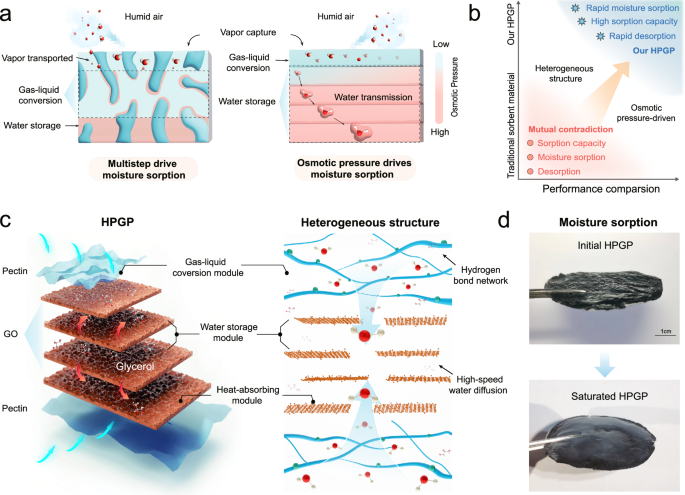
Figure 1
a Comparison between multistep-driven moisture absorption and osmotic-pressure-driven moisture absorption. b Heterostructure and osmotic-pressure-driven strategy are adopted to boost osmotic pressure and maximize the functions of each component, so as to achieve high moisture uptake capacity, fast moisture absorption and rapid desorption in HPGP. c Structural composition and functions of HPGP. The heterostructure enables water molecules to undergo high-speed water diffusion through graphene oxide nanosheets after passing through the hydrogen-bond network of pectin (gas–liquid conversion module). d States of HPGP before and after moisture absorption.
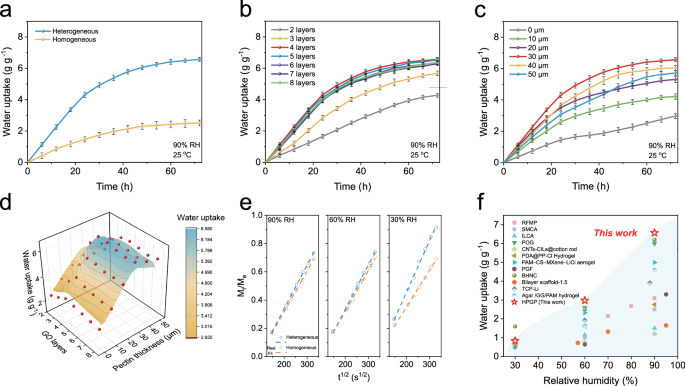
Figure 2
a Comparison of water uptake capacity between heterostructures and homogeneous structures at 25 °C and 90% relative humidity. Error bars denote mean ± standard deviation from five independent experiments. b Trends in water uptake for graphene oxide (GO) interlayers with different layer numbers after immersion in glycerol. Error bars denote mean ± standard deviation from five independent experiments. c Effects of pectin layers with different thicknesses on the water uptake of HPGP. Error bars denote mean ± standard deviation from five independent experiments. d Water uptake of HPGP as a function of GO interlayer layer number and pectin layer thickness. e Normalized uptake ratio (Mt/Me) plotted against t1/2 based on the mass of adsorbed water. Spheres represent experimental data, and lines are fitted according to Fick’s second law. f Comparison of water uptake capacity among different adsorbents 8,10,19,23,24,25,26,27,28,29,30,31. The blue background marks the water uptake performance data of HPGP for easy comparison with other materials.
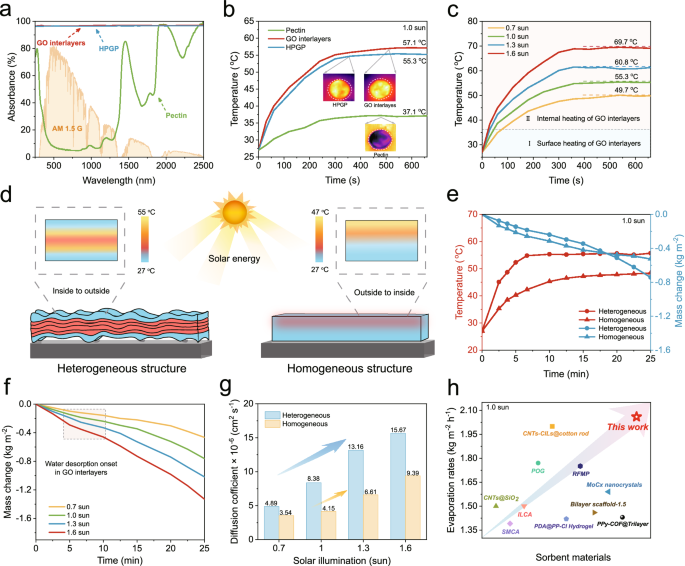
Figure 3
a UV–Vis–NIR absorption properties of the graphene oxide interlayer, pectin and polymer dextran. The yellow shaded region represents solar irradiance weighted by the AM 1.5 G standard solar spectrum. b Surface temperature evolution of the graphene oxide interlayer, pectin and polymer dextran under 1.0 sun illumination. c Surface temperature evolution of fully hydrated polymer dextran under different solar light intensities. d Dispersion of heat-transfer media and heat transfer modes in heterostructures and homogeneous structures. e Surface temperature and average mass changes of heterostructures and homogeneous structures under 1.0 sun illumination. Data are presented as mean ± standard deviation from five independent experiments. f Average mass changes of fully hydrated polymer dextran under different solar light intensities. g Dwd values of heterostructures and homogeneous structures under 0.7, 1.0, 1.3 and 1.6 sun illumination. h Comparison of evaporation rates for different hygroscopic materials under 1.0 sun illumination 7,8,22,23,24,25,26,29,31,35.
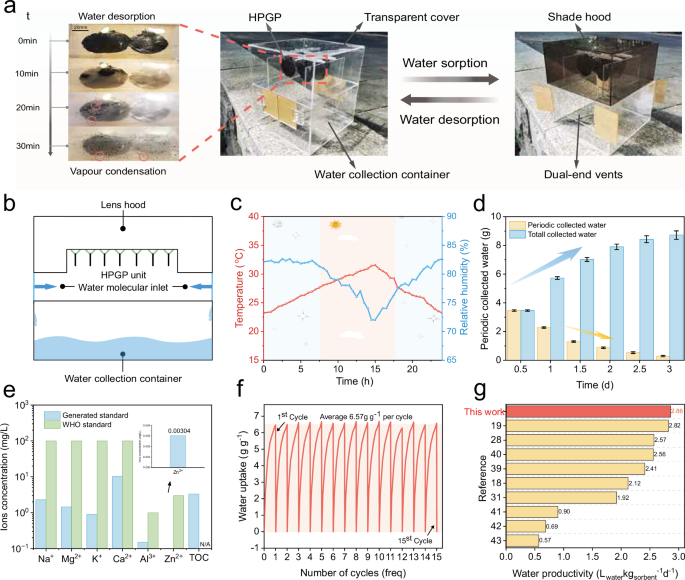
Figure 4
a Physical photograph of the HPGP-based SAWH device and photograph showing water droplets formed on the device wall during solar-driven desorption of HPGP. b Schematic design of the HPGP-based SAWH device. c Variations in average ambient temperature and humidity during outdoor water-harvesting tests. d Changes in total water yield over three days during outdoor water-harvesting tests. e Quality comparison of the collected water against World Health Organization standards. f Cycling stability test of the identical GO interlayer. g Comparison of water productivity with other state-of-the-art sorbent materials (Supplementary Table 7) 18,19,27,30,36,37,38,39,40.
Reference Information
Nature Communications (IF 18.1)
Pub Date: 2026-03-28
DOI: 10.1038/s41467-026-71259-5
We specialize in custom fabrication of functional nanomedicine materials. We can tailor materials according to experimental requirements, including tuning structure, particle size and surface modification. Full characterization services are available, and experimental schemes can be iteratively optimized with continuous technical support. Our services support research projects involving targeted delivery, bioimaging, nanotheranostics and other related fields. Please feel free to share your specifications for solution evaluation.
Engineer Zhang: 17715390137
Engineer Chen: 18914047343