已传文件:photo/1795397017.png
This study is published in Advanced Materials under the title “Tough and Rapidly Relaxing Hydrogels via Programmable Crosslink Kinetics”.
Frontiers in Bionanomaterials
Natural tissues synergistically combine high toughness and rapid stress relaxation. However, synthetic hydrogels suffer from a trade-off between mechanical performance and temporal properties, making it a major challenge to replicate this synergistic feature. Herein, we report a supramolecular hydrogel system. Using a kinetic regulation strategy, the dynamic behavior of crosslinks is precisely tuned via molecular dissociation kinetics. This molecular design enables independent modulation of relaxation kinetics and fracture toughness, decoupling these inherently coupled properties. The resulting hydrogels exhibit stress relaxation times (τ = 0.1–100 s) that are two orders of magnitude faster than conventional networks, while possessing outstanding fracture energy, substantially exceeding that of natural rubber. Slowing the dissociation rate of crosslinks markedly enhances energy dissipation under load, revealing the kinetic toughening mechanism of viscoelastic networks. This work provides molecular-level design principles for engineering soft materials with programmable time-dependent mechanical properties.
Literature Spotlight
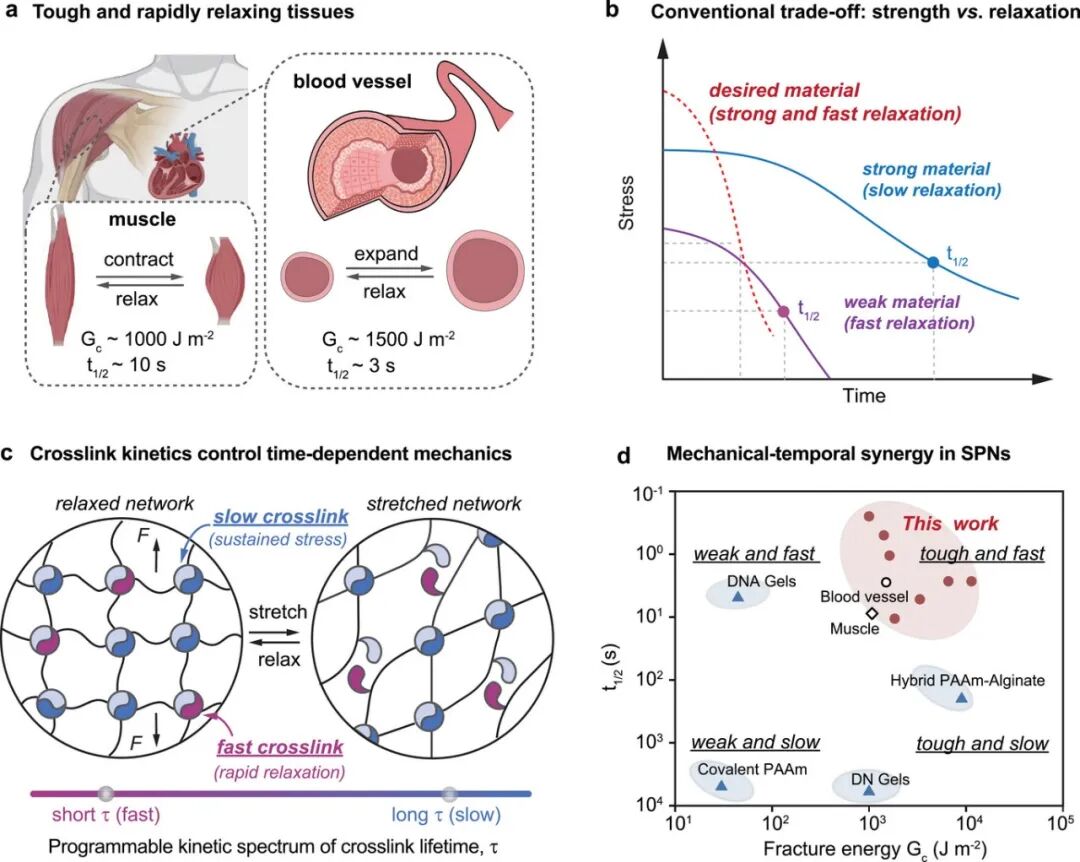
Figure 1
Kinetic control of dynamic crosslinks enables mechanical–temporal synergy in adaptive polymer networks (SPNs). (a) Native load-bearing tissues (e.g., muscles and blood vessels) combine high fracture energy ((G_ ext{c}) ∼ 1000–1500 J m⁻²) and rapid stress relaxation ((t_{1/2}) ∼ 3–10 s) [18–20]. (b) Synthetic hydrogels typically exhibit a trade-off between strength and relaxation: rapidly relaxing materials have low strength, whereas high-strength materials relax slowly ((t_{1/2})). (c) Programmable crosslink lifetime dictates the strength and relaxation kinetics of SPN networks. (d) SPNs achieve mechanical–temporal synergy distinct from conventional hydrogels and comparable to native tissues. Quantitative benchmarks and references are listed in Table S1.
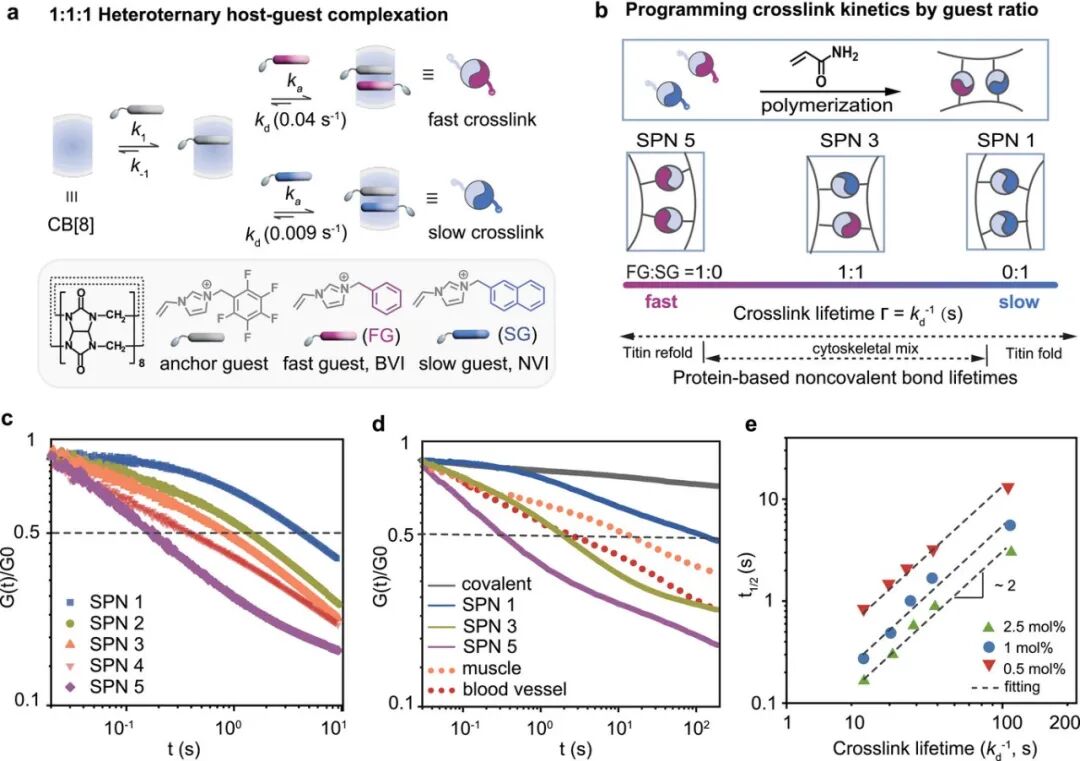
Figure 2
Design principle of supramolecular polymer networks (SPNs) with programmable stress relaxation. (a) Cucurbit[8]uril (CB[8]) mediates the formation of 1:1:1 ternary complexes between anchored guest (5FBVI) and fast guest (FG, BVI) or slow guest (SG, NVI). (b) Mixing fast and slow guests at controlled ratios (0:1, 1:2, 1:1, 2:1, 1:0) enables tuning of crosslink lifetimes for SPN 1–5 within a protein-like kinetic window. (c) Normalized stress relaxation curves of supramolecular polymer networks. (d) Comparison with covalent polyacrylamide (PAAm) hydrogels, blood vessels and muscle. (e) The relaxation half-time varies approximately quadratically with crosslink lifetime, with fitted exponents of 1.96 and −0.97 obtained at different crosslink densities.
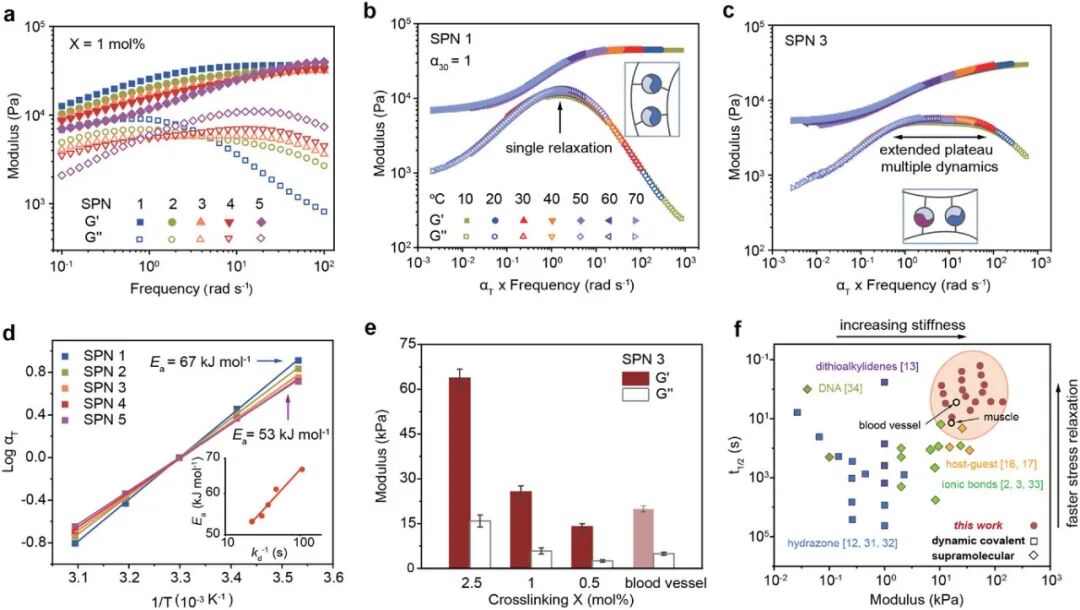
Figure 3
Rheological characterization reveals that the viscoelasticity of supramolecular polymer networks (SPNs) is governed by dynamic crosslinks. (a) Frequency sweep curves of SPN 1–5 (temperature, T = 20 °C). (b) Master curve of SPN 1, showing single relaxation dynamics. (c) Master curve of SPN 3, exhibiting an extended plateau region and multi-modal dynamics. (d) Arrhenius plot of shift factors, corresponding to activation energy (inset: correlation with crosslink lifetime). (e) Storage modulus and loss modulus of SPN 3 at different crosslink densities, compared with blood vessel reference samples. (f) Benchmark plot of stress relaxation half-life versus elastic modulus for representative soft material systems (including dynamic covalent and supramolecular systems). Numbers in parentheses denote reference IDs.
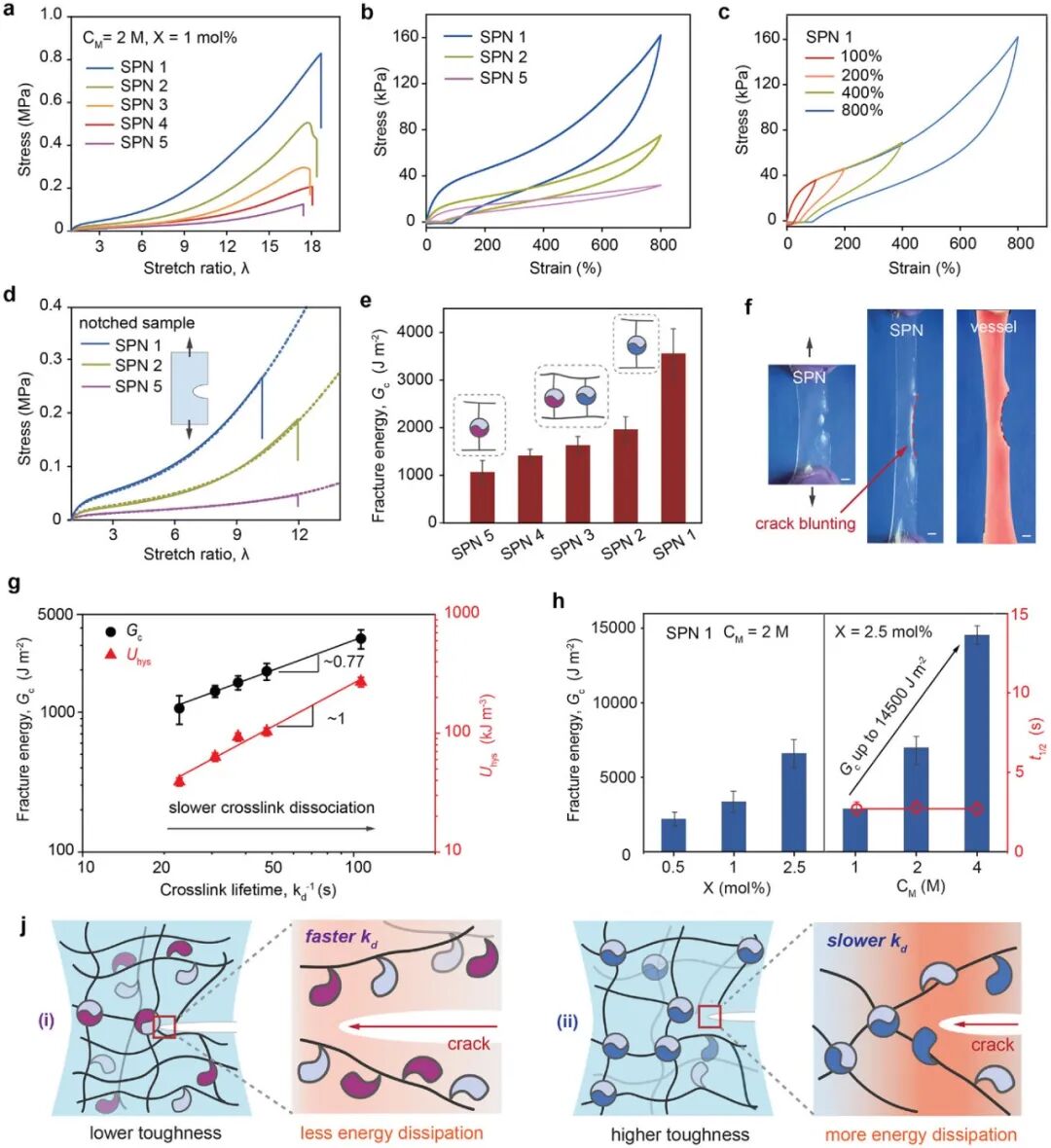
Figure 4
Kinetic modulation of mechanical properties. (a) Uniaxial stress–strain curves of SPNs. (b) Hysteresis behavior: slower crosslink kinetics leads to enhanced energy dissipation. (c) Consecutive loading–unloading cycles, showing full recovery of the material. (d) Stress–strain curves of notched SPNs (dashed lines denote unnotched samples). (e) Fracture energy. (f) Crack blunting is observed in SPNs and blood vessels (scale bar = 3 mm). (g) Scaling relationships of fracture energy and dissipated energy with crosslink lifetime. Power-law fitting yields exponents of 0.77 for fracture energy and 1.02 for dissipated energy. (h) Independent tuning of fracture energy and dissipated energy via crosslink density and monomer concentration. (j) Schematic illustration of fracture mechanisms for (i) fast-dissociating crosslinks and (ii) slow-dissociating crosslinks.
Reference Information
Advanced Materials (IF = 29.1)
Publication Date: 2026-04-09
DOI: 10.1002/adma.202523440
We specialize in custom development of functional nanomedicine materials. We can tailor materials according to experimental requirements to modulate structure, particle size and surface modification. Full characterization services are provided. The formulation can be iteratively optimized with continuous technical support throughout the project. Our services support research projects including targeted delivery, bioimaging and nanotheranostics. Feel free to share your specifications for solution evaluation.
Mr. Zhang: 17715390137
Mr. Chen: 18914047343