已传文件:photo/1795482691.png
 Research Background
This study was published in Advanced Functional Materials under the title “Adaptive Hydrogels With Spatiotemporal Stiffening Using pH‐Modulating Enzymes”.
Frontiers of Bionanomaterials
Biological systems achieve adaptive mechanical responses via reaction–diffusion processes that couple chemical wave propagation with structural transformations. Although synthetic hydrogels equipped with enzymatic reactions offer a platform to recapitulate such autonomous behaviors, the mechanistic principles governing chemomechanical transduction remain poorly understood. Herein, we report a glucose oxidase-embedded polyacrylamide–alginate hydrogel with slow transduction kinetics, which enables independent dissection of chemical waves and mechanical adaptation. Enzymatic pH waves propagate at speeds ranging from 15 to 44 µm min⁻¹ and trigger calcium-mediated alginate crosslinking through pH-responsive dissociation of calcium–ethylenediaminetetraacetic acid (EDTA). Independent tracking of chemical and mechanical waves reveals that the mechanical wavefront (12 µm min⁻¹) lags behind chemical propagation, establishing that transduction serves as the rate-limiting step in this chemomechanical coupling. Notably, the enzymatic system requires continuous chemical energy input to sustain chemical wave propagation and drive persistent mechanical transformation, introducing an energetic cost in reaction–diffusion processes in addition to kinetic constraints. Our adaptive system achieves up to a 2.1-fold increase in stiffness and can autonomously convert local stimuli into system-wide mechanical responses. These mechanistic insights establish design principles for engineering adaptive materials with predictable spatiotemporal control, suitable for soft robotics and biomedical applications.
Paper Spotlight
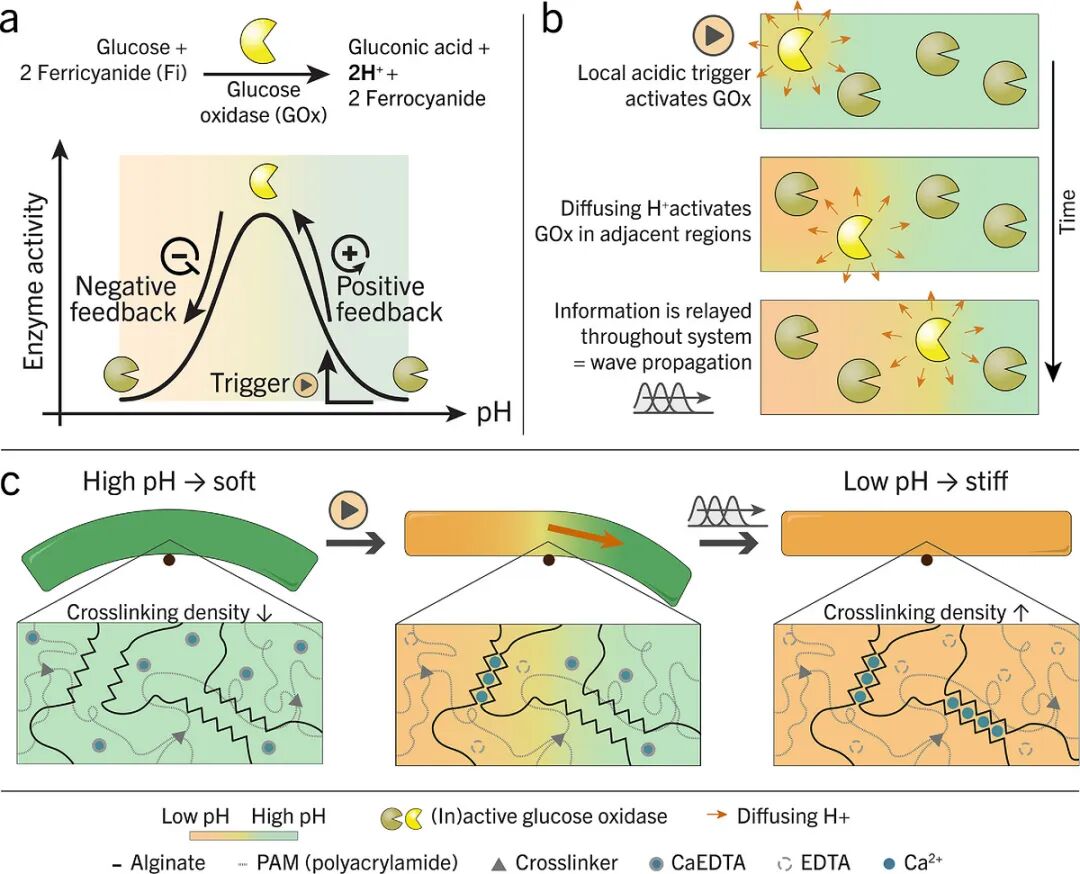
Figure 1
Design and mechanism for triggering autonomous mechanical transformation in adaptive double-network (DN) hydrogels. a) Glucose oxidase (GOx) enzymatic system and its pH-dependent activity profile. Top: GOx catalyzes the oxidation of glucose to gluconic acid, lowering the pH of the system. Bottom: The pH-dependent activity profile of GOx enables rapid autocatalytic positive feedback followed by negative feedback regulation, shifting the pH from alkaline to acidic. At high pH, GOx exhibits negligible catalytic activity, keeping the system in a quiescent (semi-dormant) excitable state that can be triggered by a pH drop, after which GOx autocatalysis proceeds spontaneously. b) Spatiotemporal signal amplification and propagation via local acidic triggering. A local acidic signal activates GOx to initiate autocatalytic acid production, which then diffuses to sequentially activate neighboring GOx molecules and generate a self-sustaining chemical wave. c) Conversion of chemical signals into mechanical transformation (chemomechanical transduction). The polyacrylamide–alginate DN hydrogel undergoes pH-dependent stiffening upon the release of calcium ions (( ext{Ca}^{2+})) from ethylenediaminetetraacetic acid (EDTA) during the enzyme-driven alkaline-to-acidic pH transition, leading to a gradual rise in the crosslinking density of alginate chains. The hydrogel switches from a soft state (alkaline pH, ( ext{Ca}^{2+}) chelated by EDTA) to a stiff state (acidic pH, Ca–alginate crosslinking).
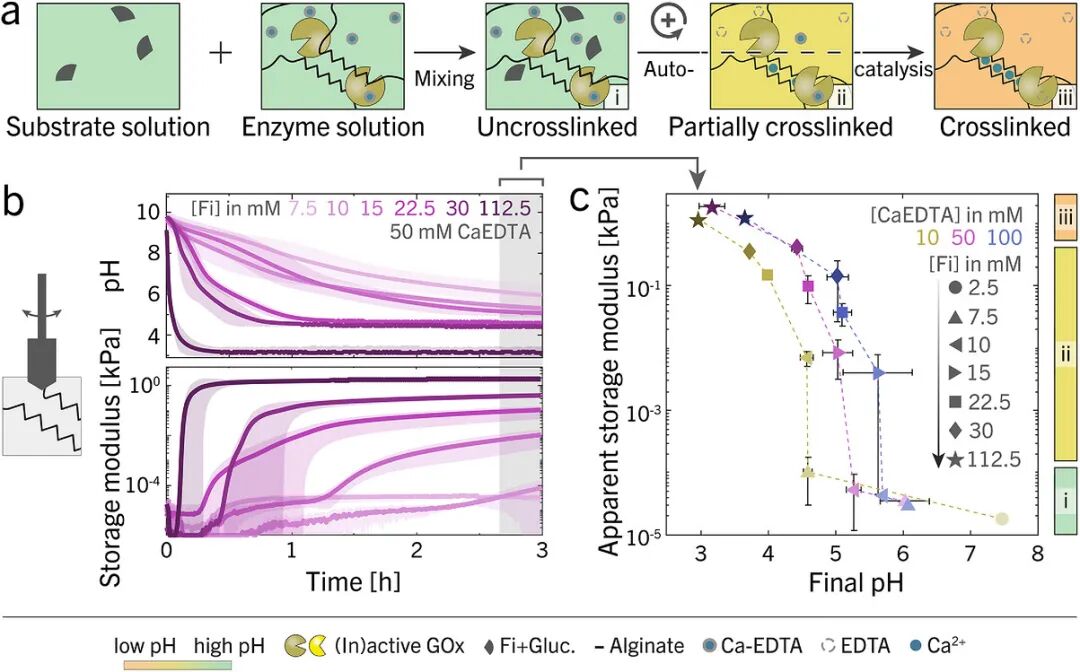
Figure 2
Spontaneous autonomous mechanical transformation in pH-responsive alginate induced by GOx autocatalysis. a) Time-sweep rheology combined with in-situ pH monitoring to characterize autonomous temporal mechanical transformation in the calcium–ethylenediaminetetraacetic acid (CaEDTA)–alginate system. Stock solutions containing Fi and CaEDTA–alginate were mixed immediately before measurement to track the evolution of storage modulus during the GOx-driven pH transition. b) pH transition and time-sweep profiles with Fi concentrations ranging from 7.5 to 112.5 mM at fixed CaEDTA and glucose concentrations (50 mM and 100 mM, respectively). Shaded regions denote standard deviation. c) Apparent storage modulus plotted against final pH. Symbols and colors correspond to different Fi and CaEDTA concentrations; the color bar on the right indicates the alginate crosslinking state described in (A). Error bars in (c) represent the standard deviation of values collected over the final 20 min of measurement.
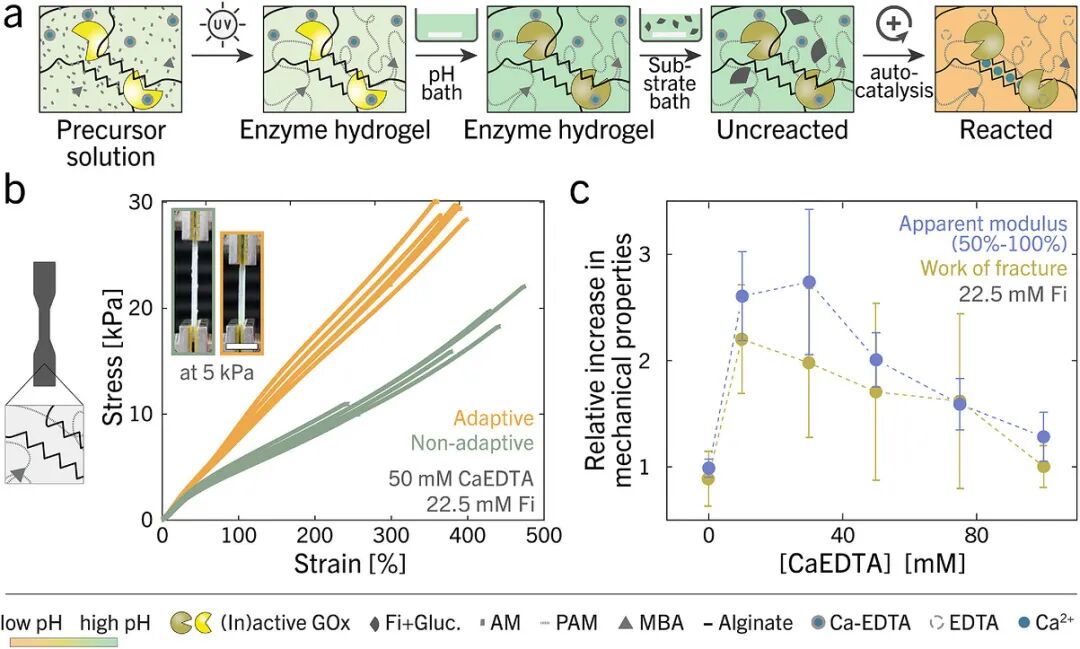
Figure 3
Spontaneous autonomous mechanical transformation in pH-responsive double-network (DN) alginate hydrogels induced by glucose oxidase (GOx) autocatalysis. a) Experimental scheme for quasi-static tensile tests of polyacrylamide (PAM)–calcium ethylenediaminetetraacetic acid (CaEDTA)–alginate DN hydrogels. The PAM network was crosslinked with N,N′-methylenebisacrylamide (MBA) in the presence of uncrosslinked alginate and CaEDTA, followed by substrate and medium loading via immersion. Tensile tests were performed either after the GOx-driven pH transition (adaptive group) or without substrate/medium loading (non-adaptive group). b) Stress–strain curves of adaptive and non-adaptive samples (50 mM CaEDTA, 22.5 mM ferricyanide, 100 mM glucose, n = 6). Scale bar: 1 cm. c) Relative increase in apparent modulus and work of fracture for adaptive versus non-adaptive samples. The apparent modulus was determined by linear fitting over the strain range from 50% to 100%; the work of fracture was calculated from the area under the stress–strain curve. Error bars in (c) represent standard deviation calculated by statistical error propagation. The differences in mechanical properties between adaptive and non-adaptive systems are statistically significant (n = 6 or 7 as defined in the Experimental Section), except for the work of fracture at [CaEDTA] = 0 mM and [CaEDTA] = 100 mM.
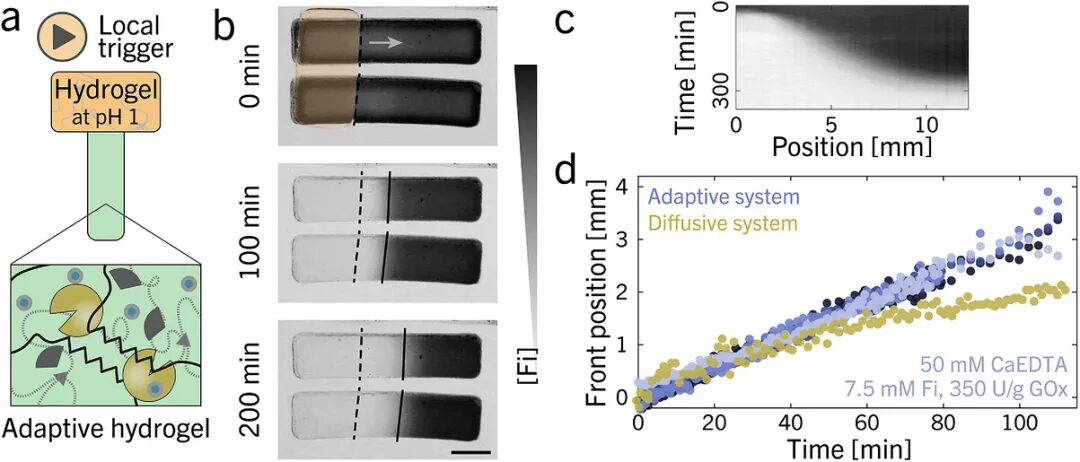
Figure 4
Propagation of self-sustaining chemical waves in double-network (DN) hydrogels. a) Experimental setup to initiate chemical wave propagation in adaptive DN hydrogels. A local chemical signal was delivered by bringing the DN hydrogel into contact with a polyacrylamide hydrogel pre-equilibrated at pH 1 for at least 24 h. b) Representative blue-channel images showing replicate samples at three time points. The triggering hydrogel is pseudo-orange (t = 0 min); the triggering region is marked by a dashed line, and the propagating chemical wavefront is marked by a solid line. Sample composition: glucose oxidase (GOx, 250 U g⁻¹), ferricyanide (Fi, 22.5 mM), calcium–ethylenediaminetetraacetic acid (CaEDTA, 50 mM), polyacrylamide (12.5 wt%), and alginate (2 wt%). Scale bar: 5 mm. c) Representative kymograph showing the spatiotemporal progression of self-sustaining chemical waves within adaptive DN hydrogels. d) Temporal evolution of wavefront positions for four adaptive DN hydrogel samples from the same batch, visualized in blue tones. For comparison, the front position of a pure diffusion system (yellow) is shown, determined by the color change of Alizarin Red S after 1 min of contact between the hydrogel and pH 1 solution. Sample composition: the adaptive system contains GOx (350 U g⁻¹), Fi (7.5 mM), glucose (100 mM), and CaEDTA (50 mM); the diffusion system contains CaEDTA (50 mM). Both systems contain polyacrylamide (12.5 wt%) and alginate (2 wt%). The triggering hydrogel was removed at t = 0 min for all experiments.
Reference Information
Advanced Functional Materials (IF: 19.9)
Publication Date: 2026-03-23
DOI: 10.1002/adfm.202531953
We specialize in custom development of functional nanomedical materials. We tailor materials to meet experimental requirements by tuning their structure, particle size and surface modification. Full characterization services are provided. Schemes can be iteratively optimized with continuous technical support throughout the project. Our services support research projects including targeted delivery, bioimaging and nanotheranostics. You are welcome to share your specifications for solution evaluation.
Mr. Zhang: +86 17715390137
Mr. Chen: +86 18914047343