已传文件:photo/1795483462.png
Abstract:
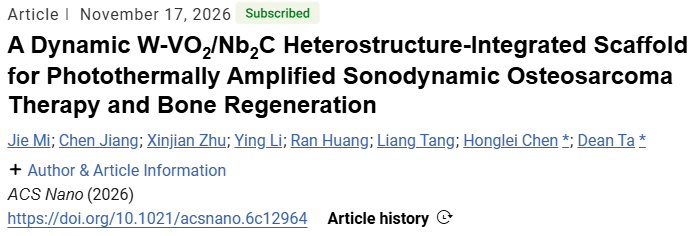
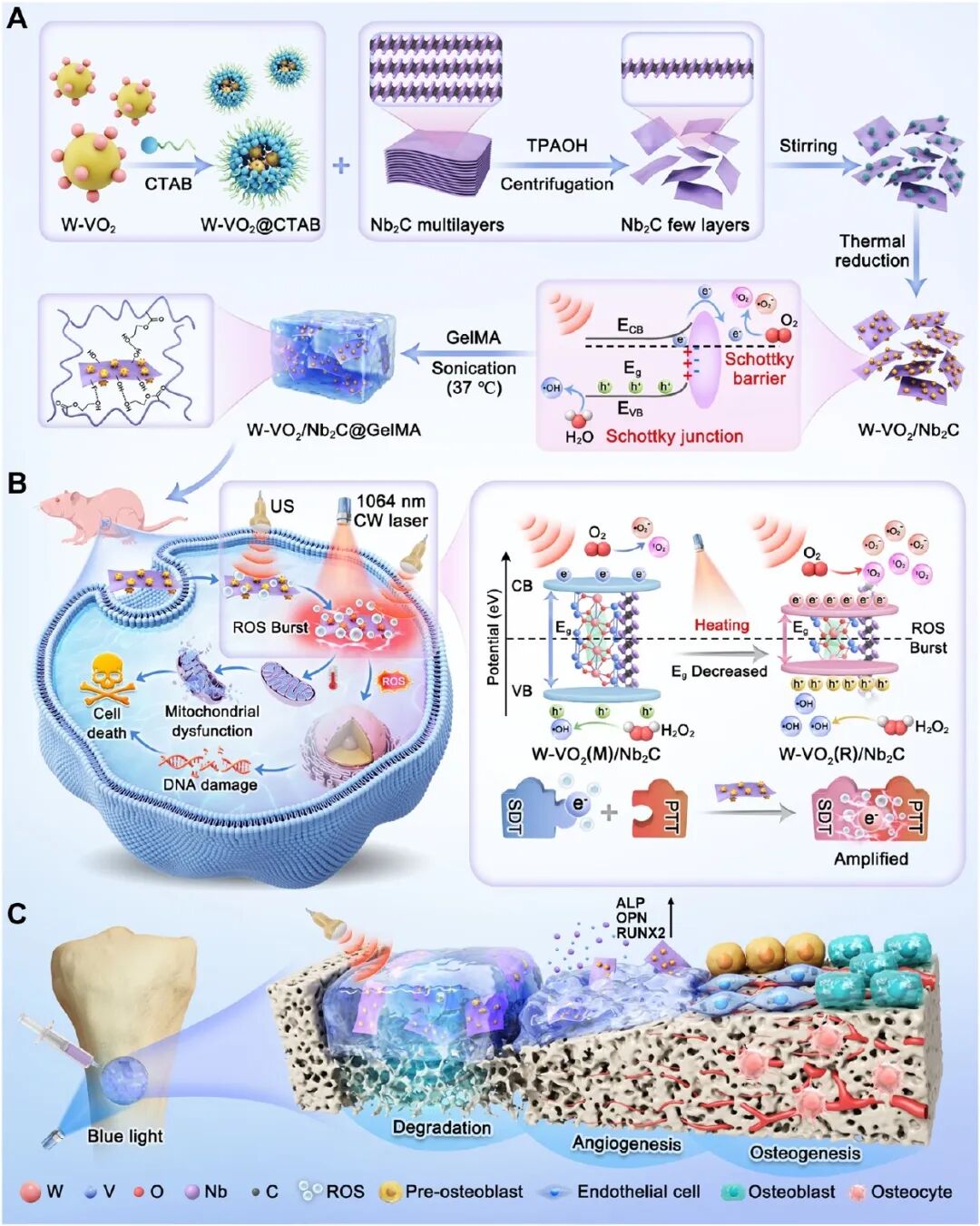
In this work, a WVM@GM scaffold was fabricated by embedding W-VO₂/Nb₂C Schottky heterostructures into porous GelMA. Upon second near-infrared (NIR-II) irradiation, local temperature elevation triggers the metal–insulator transition of W-VO₂, which narrows the bandgap and strengthens the built-in electric field at the interface. Under ultrasound stimulation, carrier separation and reactive oxygen species (ROS) generation are boosted to achieve photothermally augmented sonodynamic therapy. Afterward, switching the stimulation modality enables the release of Nb and V ions together with mechanical cues from low-intensity pulsed ultrasound, which synergistically promotes the coupling of angiogenesis and osteogenesis. In vivo evaluations confirm the reconstruction of bone defects following tumor ablation.
01 Research Background
Osteosarcoma resection commonly requires simultaneous management of residual tumor foci and reconstruction of critical-sized bone defects. Chemoresistance and the disordered local microenvironment further hinder tissue repair. Sonodynamic therapy features noninvasiveness and deep tissue penetration; nevertheless, rapid recombination of ultrasound-excited electron–hole pairs limits its catalytic efficiency. Schottky heterostructures facilitate charge separation, yet static band structures impose an upper limit on carrier concentration. Vanadium dioxide (( ext{VO}_2)) undergoes reversible metal–insulator transition for dynamic bandgap modulation, while its intrinsic transition temperature is relatively high. Tungsten doping can reduce this transition temperature. Nb₂C is conductive and biodegradable, and GelMA is injectable and porous, laying the foundation for fabricating dynamic heterostructure scaffolds.
02 Main Content
The W-VO₂/Nb₂C heterostructure was synthesized and the optimal ratio was screened. Interfacial electron transfer generates a built-in electric field. The heterostructure was embedded into GelMA to prepare WVM@GM. Under second near-infrared (NIR-II) irradiation, the phase transition of W-VO₂ dynamically narrows the bandgap, boosting reactive oxygen species production under ultrasound stimulation and triggering tumor cell apoptosis. After tumor elimination, the scaffold acts as a three-dimensional mechanotransduction interface. Combined with low-intensity pulsed ultrasound and the release of Nb and V ions, it regulates focal adhesion, Wnt, PI3K-Akt and other signaling pathways to promote angiogenesis and osteogenic differentiation, establishing a sequential therapeutic strategy.
03 Study Design
The morphology, crystal phase, chemical state, interfacial charge transfer, band structure, photothermal performance and phase transition behavior of the heterostructure were characterized. Multiple reactive oxygen species were detected using probes and electron spin resonance to evaluate temperature-dependent sonodynamic enhancement. In vitro assays were performed to assess osteosarcoma cytotoxicity, live/dead staining, apoptosis and intracellular reactive oxygen species. A subcutaneous osteosarcoma model was established to evaluate tumor inhibition, and a bone defect model was used for subsequent bone regeneration assessment. Histology, immunofluorescence and transcriptomic analysis were carried out to verify angiogenesis, osteogenesis and related signaling pathways.
04 Results
W-VO₂ is anchored on the surface of Nb₂C in the heterostructure. Electrons transfer from Nb₂C to W-VO₂ at the interface and form a built-in electric field. Photothermal heating triggers the phase transition, accompanied by temperature-dependent bandgap narrowing and amplified reactive oxygen species generation under ultrasound. Cellular experiments demonstrate elevated reactive oxygen species and cell apoptosis, and in vivo animal tests confirm suppressed tumor growth. In the subsequent stage, the scaffold synergizes with low-intensity pulsed ultrasound and ion release to facilitate angiogenesis, upregulate osteogenic markers and repair bone defects. Transcriptomic results indicate the involvement of focal adhesion, Wnt and PI3K-Akt pathways.
05 Outlook
This study demonstrates that dynamic bandgap modulation enables the integration of photothermal therapy, sonodynamic therapy and bone regeneration into a sequential treatment regimen. Future work should clarify the phase-transition temperature window and the correlation between NIR/ultrasound parameters and reactive oxygen species dosage, and evaluate heterostructure interfacial stability and ion release kinetics. The respective contributions of biochemical ions and mechanical stimuli to osteogenesis and angiogenesis need to be distinguished. Long-term therapeutic efficacy should be validated in orthotopic models of bone tumor combined with bone defects, with attention paid to material degradation, tissue response and the osteoimmune microenvironment.
Source:
ACS Nano
Publication Date: 2026-11-17
DOI: 10.1021/acsnano.6c12964
Jie Mi, Chen Jiang, Xinjian Zhu, Ying Li, Ran Huang, Liang Tang, Honglei Chen, Dean Ta
We specialize in custom development of functional nanomedical materials. We tailor materials according to experimental requirements by tuning material structure, particle size and surface modification. Full characterization services are available. Schemes can be iteratively optimized with continuous technical support throughout the project. Our services support research projects on targeted delivery, bioimaging and nanotheranostics. Feel free to share your specifications for solution evaluation.
Mr. Zhang: +86 17715390137
Mr. Chen: +86 18914047343