已传文件:photo/1795657179.png
This work was published in Advanced Science under the title “Integrating TiO₂ Interlayers and NiFe Metal-Organic Framework Cocatalysts for Enhanced Water Oxidation on Hematite Photoanodes”.
Nanomedicine Frontier
Charge recombination and sluggish oxygen evolution reaction (OER) kinetics restrict the capture and utilization of photogenerated holes in hematite photoanodes. Herein, we report a dual-interface strategy that combines a TiO₂ interlayer on Ti-doped Fe₂O₃ with a bimetallic nickel–iron metal–organic framework (NiFe-MOF) overlayer. The TiO₂ interlayer modulates interfacial charge collection, while the NiFe-containing overlayer facilitates hole utilization for water oxidation. The integrated NiFe-MOF/TiO₂/Ti-Fe₂O₃ photoanode delivers a photocurrent density of 4.25 mA cm⁻² at 1.23 V versus the reversible hydrogen electrode (RHE), with a maximum applied bias photon-to-current efficiency (ABPE) of 0.51%. Complementary photoelectrochemical and spectroscopic measurements confirm improved charge collection and interfacial reaction dynamics. Femtosecond transient absorption spectroscopy resolves the evolution of carrier relaxation upon each modification, and density functional theory (DFT) calculations on representative local interfacial models reveal charge redistribution and a reduced free-energy requirement for the formation of the *O intermediate. These results correlate the performance enhancement with the synergistic effects of interfacial engineering and surface catalysis, offering a strategy for the advancement of hematite photoanodes.
Paper Spotlight
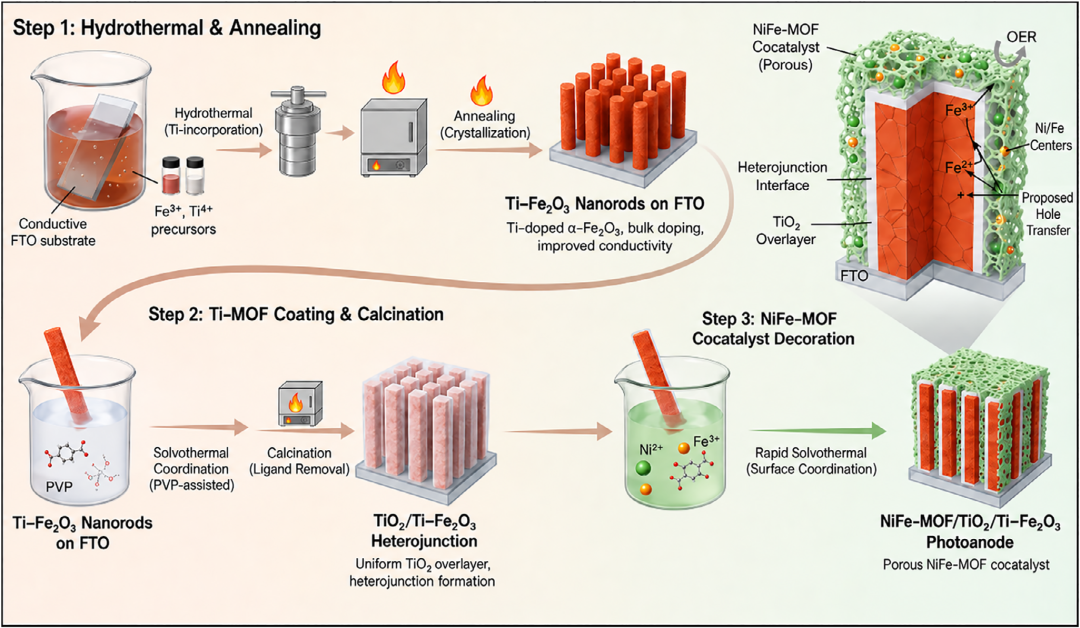
Figure 1
Schematic illustration of the stepwise fabrication of the NiFe-MOF/TiO₂/Ti-Fe₂O₃ photoanode.
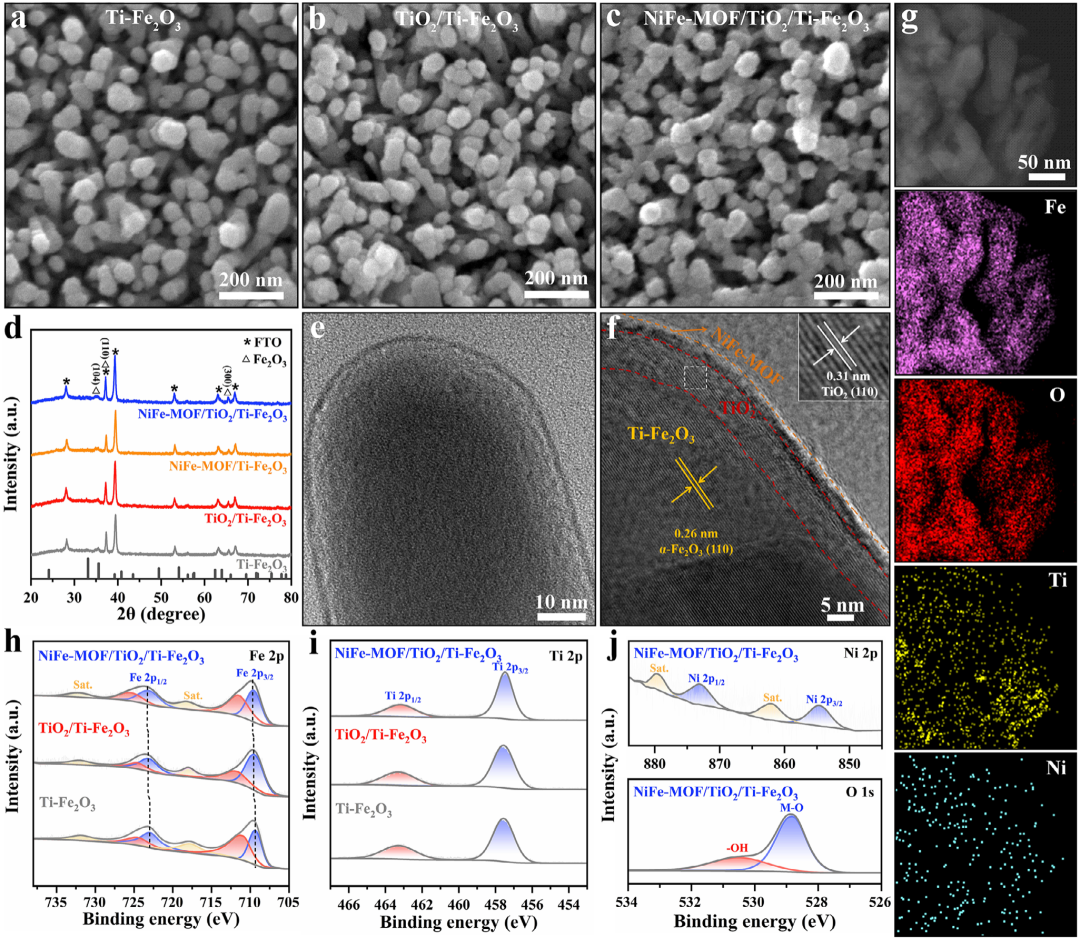
Figure 2
Structural and surface chemical characterizations of the photoanodes. (a–c) Scanning electron microscopy (SEM) images of Ti-Fe₂O₃, TiO₂/Ti-Fe₂O₃, and NiFe-MOF/TiO₂/Ti-Fe₂O₃, respectively. (d) XRD patterns of the photoanodes. (e) TEM and (f) HRTEM images of the NiFe-MOF/TiO₂/Ti-Fe₂O₃. The inset in (f) shows the marked lattice-fringe region. (g) STEM image of NiFe-MOF/TiO₂/Ti-Fe₂O₃ and the corresponding EDS elemental mapping images for Fe, O, Ti, and Ni. High-resolution XPS spectra of Ti-Fe₂O₃, TiO₂/Ti-Fe₂O₃, and NiFe-MOF/TiO₂/Ti-Fe₂O₃: (h) Fe 2p, (i) Ti 2p, and (j) Ni 2p (top) and O 1s (bottom) regions for NiFe-MOF/TiO₂/Ti-Fe₂O₃.
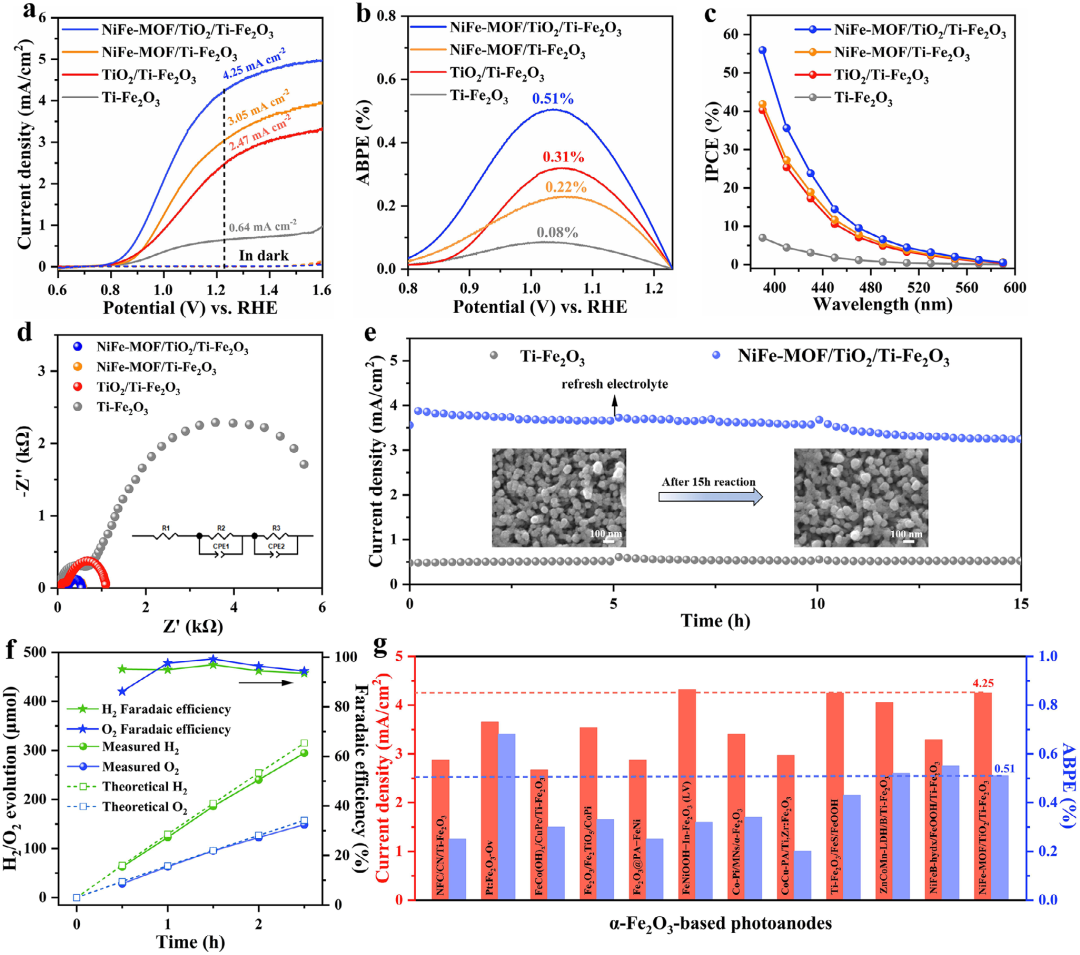
Figure 3
Photoelectrochemical performance of the photoanodes. (a) LSV, (b) ABPE, and (c) IPCE recorded at 1.23 V vs. RHE. (d) EIS Nyquist plots of Ti-Fe₂O₃, TiO₂/Ti-Fe₂O₃, NiFe-MOF/Ti-Fe₂O₃, and NiFe-MOF/TiO₂/Ti-Fe₂O₃; the inset shows the equivalent circuit. (e) Chronoamperometry measurements of Ti-Fe₂O₃ and NiFe-MOF/TiO₂/Ti-Fe₂O₃ at 1.23 V vs. RHE; the inset presents SEM images of the ternary photoanode before and after a 15 h stability test. Arrows indicate electrolyte refreshment. (f) H₂ and O₂ evolution and Faradaic efficiency measured on an electrode area of approximately 2 cm². (g) Comparison of photocurrent density and maximum ABPE with selected hematite photoanodes listed in Table S4. Error bars (where shown) represent the standard deviation from three independently fabricated electrodes.
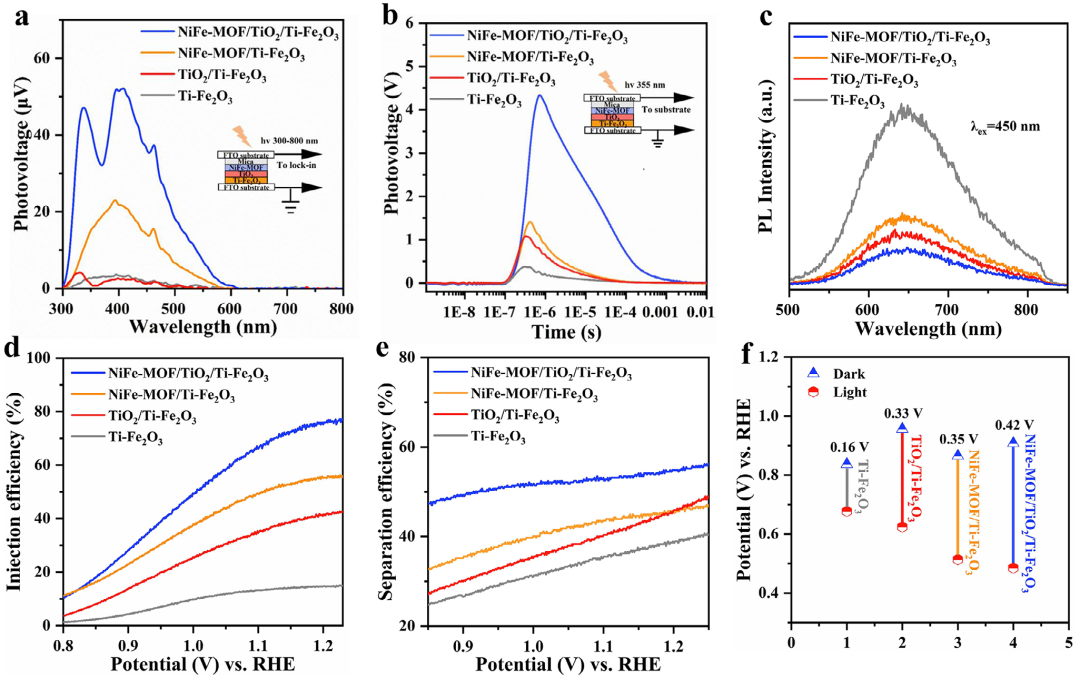
Figure 4
Characterization of charge separation and interfacial charge transfer. (a) Surface photovoltage (SPV), (b) transient photovoltage (TPV), and (c) photoluminescence (PL) spectra. (d) Estimated charge injection efficiency (ηinj) and (e) charge separation efficiency (ηsep). (f) Open-circuit potential (OCP) under dark and illumination conditions for Ti-Fe₂O₃, TiO₂/Ti-Fe₂O₃, NiFe-MOF/Ti-Fe₂O₃, and NiFe-MOF/TiO₂/Ti-Fe₂O₃. The insets in (a) and (b) illustrate the measurement configurations. The PL excitation wavelength is 450 nm, and the TPV measurements are performed with 355 nm pulsed excitation.
Reference Information
Advanced Science (IF: 14.1)
Pub Date: 2026-11-19
DOI: 10.1002/advs.78830
We specialize in the custom fabrication of functional nanomedicine materials. We can tailor materials according to experimental requirements, regulating their structure, particle size and surface modification. Full characterization services are available. The research scheme can be iteratively optimized with continuous technical support. Our services support research projects targeting targeted delivery, bioimaging, and nanotheranostics. Feel free to send your specifications for solution evaluation.
Mr. Zhang: 17715390137
Mr. Chen: 18914047343