已传文件:photo/1795745156.png

Abstract:
In this study, an Ag₂Se thermoelectric coating was fabricated on the surface of 316L Kirschner wires. The temperature gradient between the surface of the percutaneous pin and the surrounding environment generates a Seebeck potential, which alters the surface potential of bacteria and disrupts energy metabolism in the respiratory chain, thereby reducing bacterial viability and biofilm formation while preserving cytocompatibility. Under mixed-bacterial challenge, the thermoelectrically activated coating helps maintain mitochondrial homeostasis of BMSCs and supports osteogenesis and angiogenesis. In an infected external fixation animal model, the coating reduces peripin bacterial burden and inflammation, promotes peripin bone formation, and enhances pull-out strength. These findings suggest that the thermal-gradient-driven thermoelectric interface achieves antibacterial performance and mitigates the risk of pin loosening simultaneously.
01
Research Background
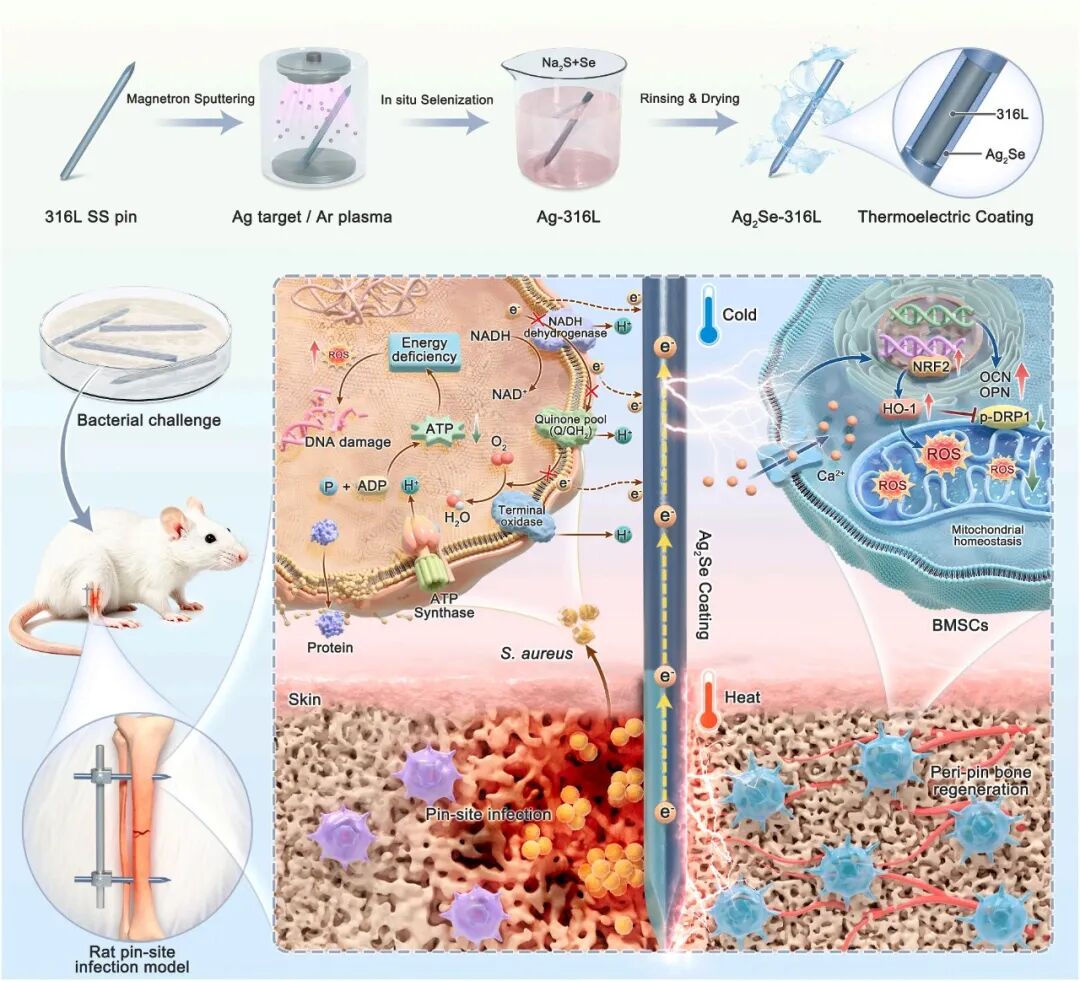
Percutaneous pins for external fixation enable rapid and stable modular fixation, yet they create a persistent conduit between the external environment and deep tissues. Pin tract infection, biofilm formation and infection-associated loosening remain prevalent complications. Current strategies including pin tract care, systemic antibiotic administration and diverse antibacterial coatings are constrained by limited drug or ion release, the requirement for external stimuli, unsatisfactory cytocompatibility and poor coating stability. Moreover, conventional coatings for internal implants cannot readily accommodate the unique biological characteristics of the percutaneous interface, which is simultaneously exposed to air, skin, soft tissue and bone. The bacterial respiratory chain resides on the cell membrane, whereas host oxidative phosphorylation occurs on the inner mitochondrial membrane. This spatial distinction offers a selective window for regulation via interfacial electron transfer. Naturally occurring temperature gradients across the percutaneous pin between the body surface and surroundings can serve as an on-site power source without an external power supply.
02
Main Content
Silver was deposited via magnetron sputtering, followed by room-temperature liquid-phase selenization to in-situ form a continuous Ag₂Se coating on 316L pins. The coating preserves the pin geometry while improving hardness, elastic modulus, adhesion and corrosion resistance, and limiting Ag release. As an n-type thermoelectric material, Ag₂Se generates stable electrical output under the body surface-environment thermal gradient. It modulates the electrostatic state at the bacteria-coating interface, reduces respiratory redox activity and intracellular ATP, elevates ROS levels, induces membrane damage and protein leakage, and suppresses the viability and biofilm formation of both Gram-positive and Gram-negative bacteria. This interface also protects mitochondrial function in BMSCs, upregulates the Nrf2/HO-1 pathway and reduces DRP1 phosphorylation, thereby supporting osteogenesis and angiogenesis.
03 Study Design
Ag₂Se-coated 316L samples were fabricated and characterized for cross-sectional morphology, elemental distribution, phase composition, chemical state, wettability, mechanical properties, adhesion, corrosion resistance and Ag release. Thermoelectric transport properties, open-circuit voltage under different thermal gradients, and post-immersion stability were measured. In vitro evaluations included BMSC live/dead staining, apoptosis, cytoskeleton, cell adhesion, hemolysis and subcutaneous tissue response. Staphylococcus aureus and Escherichia coli were used to assess colony counts, live/dead staining, bacterial morphology and biofilms. Bacterial surface potential, respiratory activity, ATP, ROS and protein leakage were also detected. A rat infected external fixation model was established. Bare pins, Ag-coated pins and Ag₂Se-coated pins were compared. Assessments covered peripin bacteria, inflammation, bone formation, pull-out strength, as well as osteogenesis-, angiogenesis- and osteoclast-related proteins.
04
Results
The Ag₂Se coating is continuous, adherent and corrosion-resistant with low Ag release. It produces stable electrical output under thermal gradients and retains functionality after immersion. Cellular assays demonstrate favorable cytocompatibility and hemocompatibility, and no obvious cellular injury is observed upon thermal gradient exposure. Thermoelectrically activated Ag₂Se‑316L markedly inhibits the viability and biofilm formation of the two bacterial strains, accompanied by altered bacterial surface potential, reduced respiratory activity and ATP, increased ROS and membrane damage. This antibacterial effect is not dependent on massive Ag release. Under mixed-bacterial challenge, the coating maintains mitochondrial homeostasis of BMSCs and facilitates osteogenesis and angiogenesis. In the animal model, the coating reduces peripin bacterial burden and inflammation, enhances peripin bone formation and maximum pull-out strength. The expression of local pro-angiogenic and osteogenic proteins is upregulated while osteoclast-associated signaling is downregulated. No obvious abnormalities are found in major organs.
05
Outlook
This study demonstrates that the intrinsic thermal gradient at the percutaneous interface can act as a local electrical input. The thermoelectric interface regulates bacterial energy metabolism while preserving the compartmentalized respiratory function of host cells. Further investigations are needed to dissect the causal linkage between Seebeck potential, bacterial membrane potential, respiratory chain electron transfer and ATP synthesis, and define the applicability of this coating to different bacterial species, biofilm stages and polymicrobial infections. Stability and Ag release under fluctuating thermal gradients, coating abrasion, long-term immersion and cyclic mechanical loading should be evaluated. Coupling between antibacterial effects and bone regeneration should be analyzed with immune cells and the osteoimmunological microenvironment, and the robustness of this strategy needs to be validated in models that better mimic the practical conditions of external fixation.
Source:
Bioactive Materials
Pub Date: 12 October 2026
DOI: 10.1016/j.bioactmat.2026.09.034
Yiping Luo, Mingyuan Gao, Yitong Wang, Kexin Xu, Qizhen Lu, Xiaojie Lou, Jiaqi Zhou, Xiao Gui, Hao Zhang, Wen Li, Yanzhong Pei, Longpo Zheng
We specialize in custom development of functional nanomedicine materials. We can rationally tailor materials according to experimental requirements with controllable structure, particle size and surface modification. Full characterization services are provided. Iterative scheme optimization and continuous technical support are available. Our services support research projects including targeted delivery, bioimaging and nanotheranostics. Please share your specifications for scheme evaluation.
Engineer Zhang: +86 17715390137
Engineer Chen: +86 18914047343