已传文件:photo/1795572891.png
 Frontiers in Biomedical Materials
The design of metal-acid bifunctional catalysts is critical for selectivity control in tandem catalysis. However, reactive intermediates often suffer from kinetic mismatch between the primary metal-catalyzed and acid-catalyzed steps, which leads to their consumption via competing pathways and formation of undesired products. In this work, we develop a metal-cation-directed Al-site (MCD-Al) strategy to enrich Al sites within the framework of β-zeolite encapsulating Pd nanoparticles (Pd@Beta-MCD). This enables the modulation of Brønsted acid site density in proximity to metal sites by tuning the loading of metal precursors. When Pd@Beta-MCD is applied to benzene hydroalkylation, the spatial proximity between metal and acid sites accelerates the transfer of cyclohexene generated over Pd to adjacent acid sites. Meanwhile, the high density of Brønsted acid sites surrounding Pd nanoparticles greatly facilitates cyclohexene protonation for hydroalkylation. Pd@Beta-MCD achieves a maximum cyclohexylbenzene yield of 48.1% with a corresponding selectivity of 77.5%, outperforming Pd/HBeta (21.1% yield, 30.1% selectivity) and Pd@HBeta (27.7% yield, 38.3% selectivity). This represents the best performance reported to date for this reaction. Furthermore, Pd@Beta-MCD exhibits superior cycling stability over eight runs. We demonstrate that Brønsted acid sites adjacent to metal centers resolve the kinetic mismatch and channel cyclohexene intermediates toward the hydroalkylation-dominated pathway. This work provides an effective strategy to strengthen metal–acid synergistic matching and facilitates precise control of key intermediates in tandem catalysis.
This study was published in Angewandte Chemie International Edition under the title “Brønsted Acid Enrichment Around Zeolite-Encapsulated Pd Promotes Efficient Tandem Catalysis”.
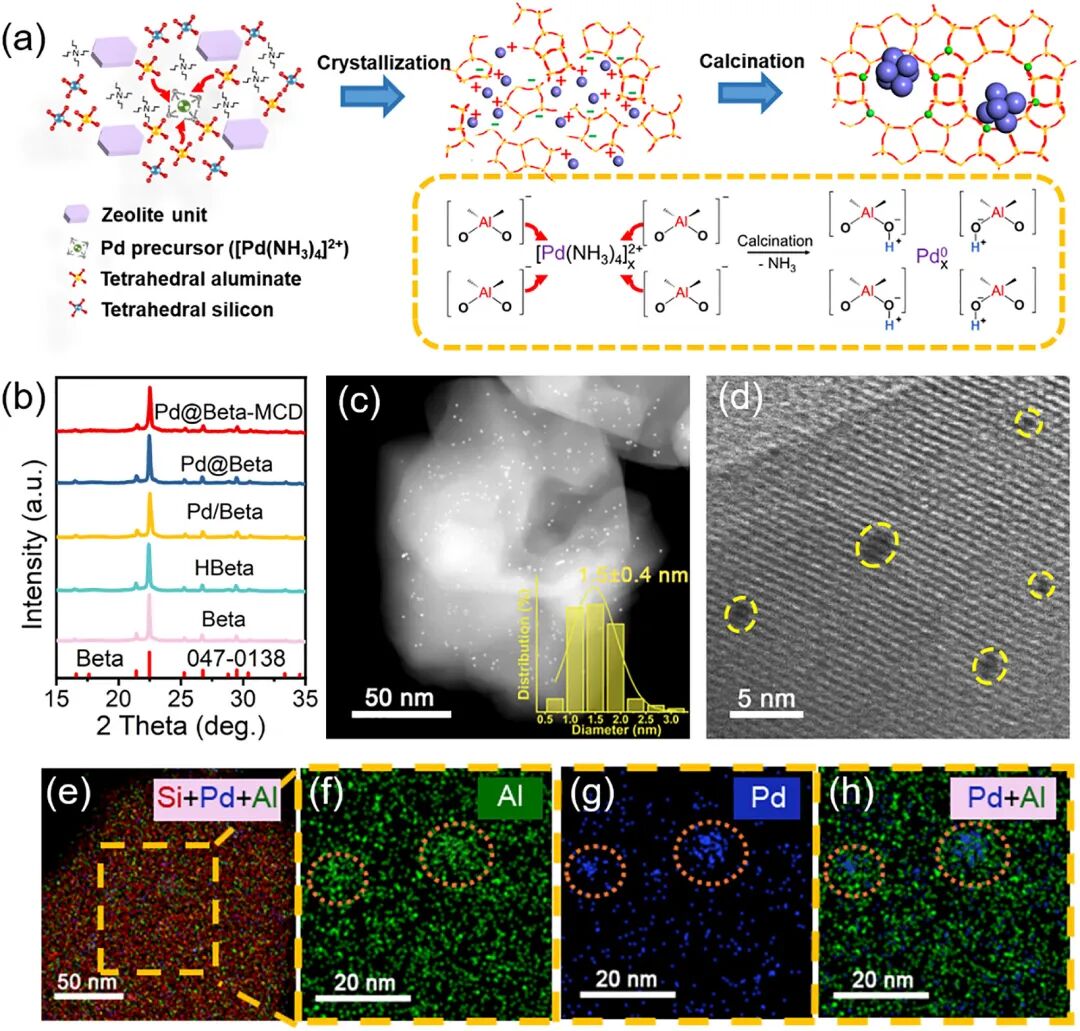
Figure 1
(a) Schematic illustration of the MCD-Al strategy for encapsulating Pd NPs within Beta zeolite and positioning Al sites adjacent to metal centers. (b) XRD patterns of different samples. (c) HAADF-STEM image and (d) corresponding HRTEM image of the ultrathin section of Pd@Beta-MCD. (e–h) EDS elemental mapping of Pd@Beta-MCD.
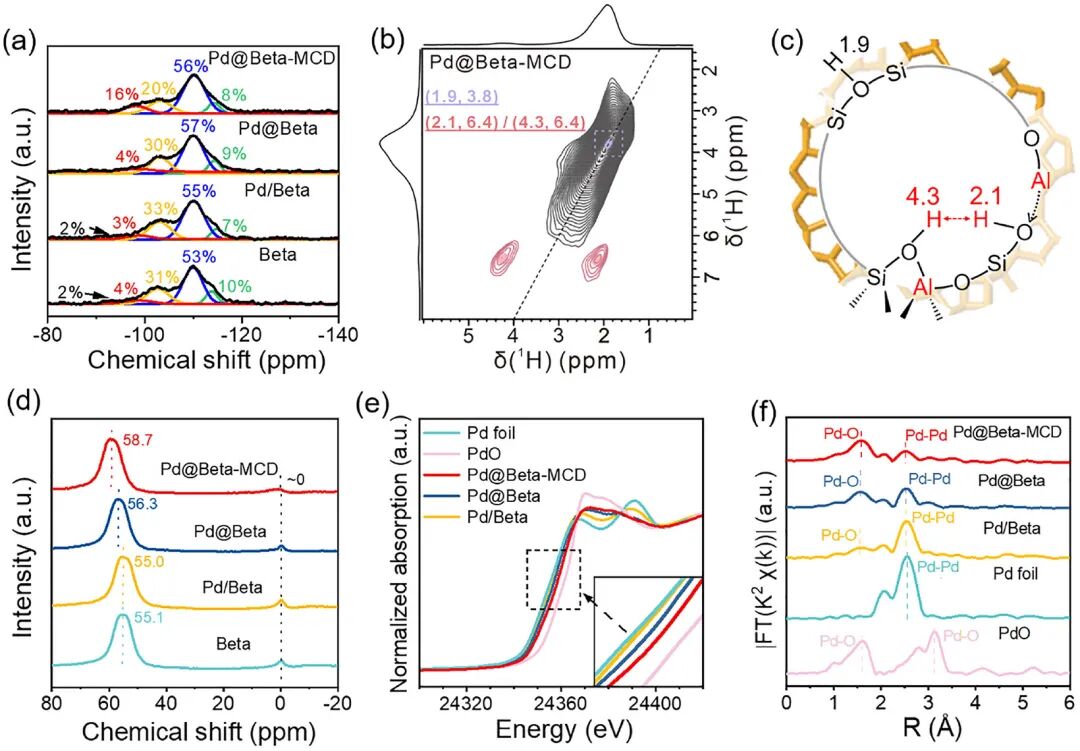
Figure 2
(a) (^{29})Si MAS NMR spectra of different samples. (b) (^1)H DQ/SQ MAS NMR of Pd@Beta-MCD. (c) Schematic diagram of adjacent hydroxyl pairs in Pd@Beta-MCD. (d) (^{27})Al MAS NMR spectra of different samples. (e) Pd K-edge XANES spectra and (f) (k^3)-weighted Fourier-transformed Pd K-edge EXAFS spectra of different samples.
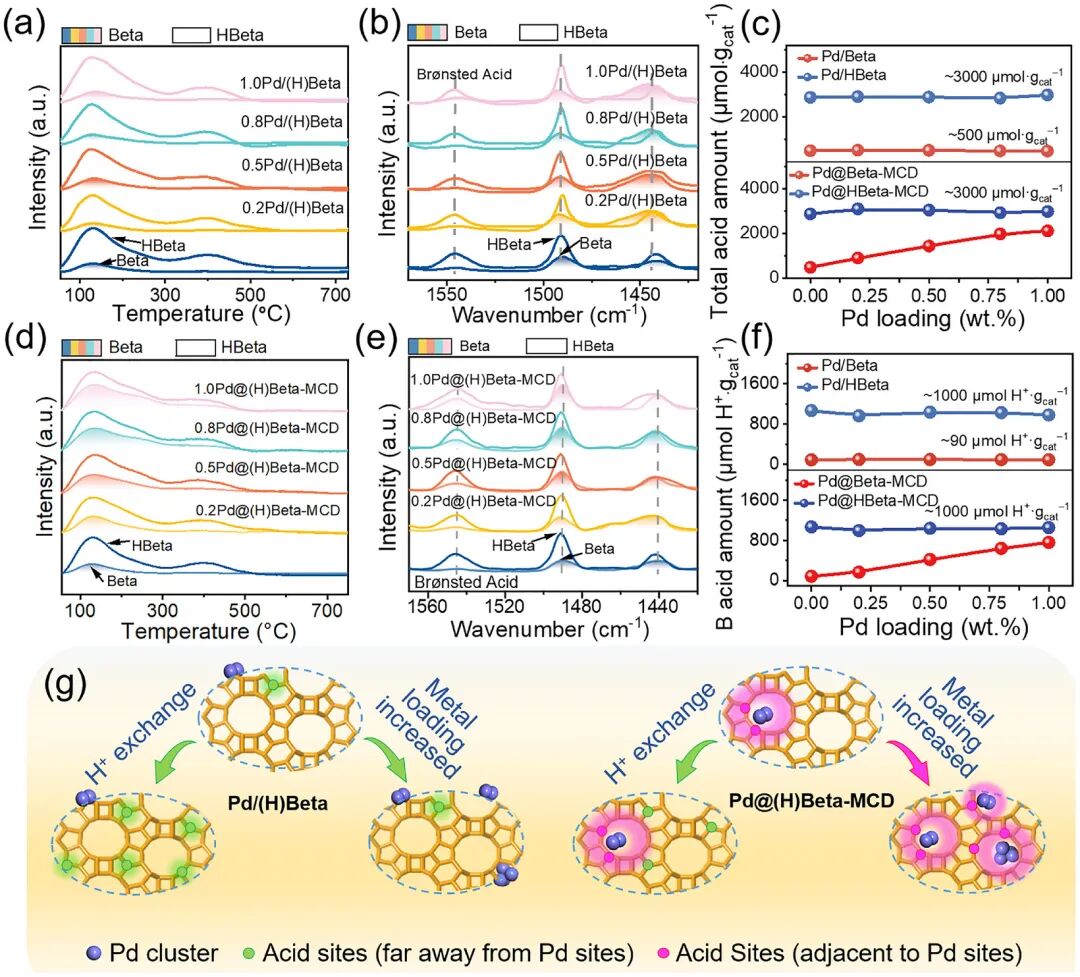
Figure 3
Acid properties as a function of Pd loading. (a) NH₃‑TPD profiles and (b) Py‑IR spectra of xPd/(H)β catalysts. (c) Correlation between the total amount of acid sites quantified by NH₃‑TPD and Pd loading. (d) NH₃‑TPD profiles and (e) Py‑IR spectra of xPd@(H)β‑MCD catalysts. (f) Correlation between Brønsted acid site density quantified by Py‑IR and Pd loading. (g) Evolution of acid sites after H‑exchange with increasing Pd loading for Pd/Beta (left) and Pd@Beta‑MCD (right).
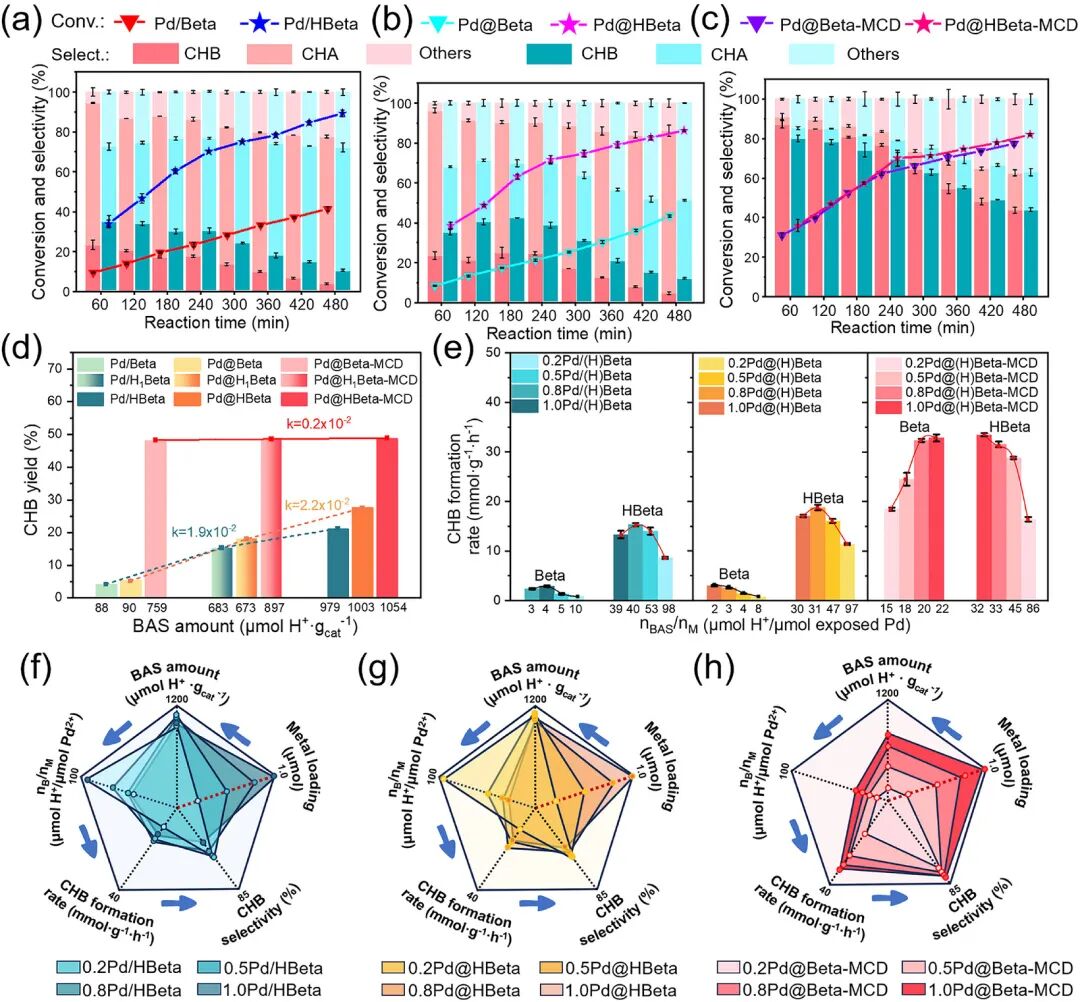
Figure 4
Benzene conversion and product distribution as a function of reaction time for (a) Pd/(H)Beta, (b) Pd@(H)Beta and (c) Pd@(H)Beta-MCD, respectively. (d) CHB yield as a function of Brønsted acid concentration. (e) Comparison of CHB formation rate versus (n_ ext{acid}/n_ ext{metal}). Comparison of the metal–acid site descriptor, CHB formation rate at maximum yield, and selectivity at ca. 40% benzene conversion for (f) xPd/HBeta, (g) xPd@HBeta and (h) xPd@Beta-MCD. Error bars in (a–c) and (e) represent the standard deviation (SD) of three independent experiments (mean ± SD, n = 3).
Summary
In tandem catalysis, kinetic mismatch between metal and acid sites frequently triggers side reactions of reactive intermediates. Instead of blindly increasing the total acid content, this work proposes a metal-cation-directed Al positioning (MCD-Al) strategy. By adjusting the loading of metal precursors, framework Al is precisely enriched around Pd nanoparticles encapsulated within Beta zeolite, enabling on-demand tailoring of the density of adjacent Brønsted acid sites. For benzene hydroalkylation, closely situated metal–acid sites shorten the mass-transfer distance of cyclohexene and accelerate its protonation, steering the reaction toward the alkylation pathway. A record-high cyclohexylbenzene yield of 48.1% is achieved, alongside stable performance over eight catalytic cycles.
This work overcomes the limitations of randomly distributed active sites in conventional catalysts and demonstrates that precise matching of the local microenvironment matters more than simply accumulating macroscopic active sites. The strategy of in-situ directing heteroatom positioning on supports via electrostatic interactions of precursors exhibits great generality. It can be extended to other metals such as Pt and Ru as well as zeolites with diverse topological structures. This approach is applicable to sophisticated tandem reactions including hydrocracking of polyolefins and hydrodeoxygenation of biomass. It also offers a general material-design paradigm for capturing highly reactive intermediates and suppressing competing side reactions in multistep catalysis.
References:
DOI:10.1002/anie.5221331
We specialize in custom fabrication of functional nanomedicine materials. We can develop materials tailored to your experimental requirements, with controllable structure, particle size and surface modification. Full characterization services are provided. We support repeated optimization of schemes and full-process technical communication. Our services cover research projects such as targeted delivery, bioimaging and nanotheranostics. Feel free to send your specifications for scheme evaluation.
Mr. Zhang: +86 17715390137
Mr. Chen: +86 18914047343