已传文件:photo/1795658839.png
 Frontiers in Biomedical Materials
Fabrication of optimized biosensing interfaces is critical for electrochemical biosensing. Herein, we realize the controllable construction of macroporous covalent organic framework (COF) nanostructures via a template‑assisted assembly and growth strategy, yielding well‑ordered morphologies highly suitable for advanced electrode materials. These macroporous architectures with distinctive pore microenvironments can efficiently immobilize biorecognition elements through structure‑confined supramolecular interactions. Notably, such three‑dimensional hierarchically macroporous COF superstructures enable the construction of improved biosensing interfaces, which facilitate enzyme immobilization, boost mass and charge transport, and achieve efficient substrate enrichment, thereby substantially enhancing biosensing performance. Accordingly, the developed biosensing electrode loaded with acetylcholinesterase (AChE) exhibits high sensitivity, favorable stability and strong anti‑interference capability for the electrochemical detection of various organophosphorus pesticides (OPs), with an ultra‑low limit of detection down to the sub‑pg/mL level. Furthermore, portable biosensing devices integrated with AChE‑loaded HMSCOF achieve reliable recoveries ranging from 96.4% to 105.3% for OPs detection in river water and leafy vegetables, highlighting their practical application potential. This work demonstrates that the combination of macroporous COF‑based materials and biorecognition elements offers a promising strategy to advance high‑performance portable electrochemical biosensors for environmental monitoring and food safety.
This study was published in Exploration under the title “Customizing 3D Hierarchically Macroporous Covalent Organic Framework Superstructures for Improved Biosensing Interfaces in Highly Sensitive Electrochemical Biosensors”.
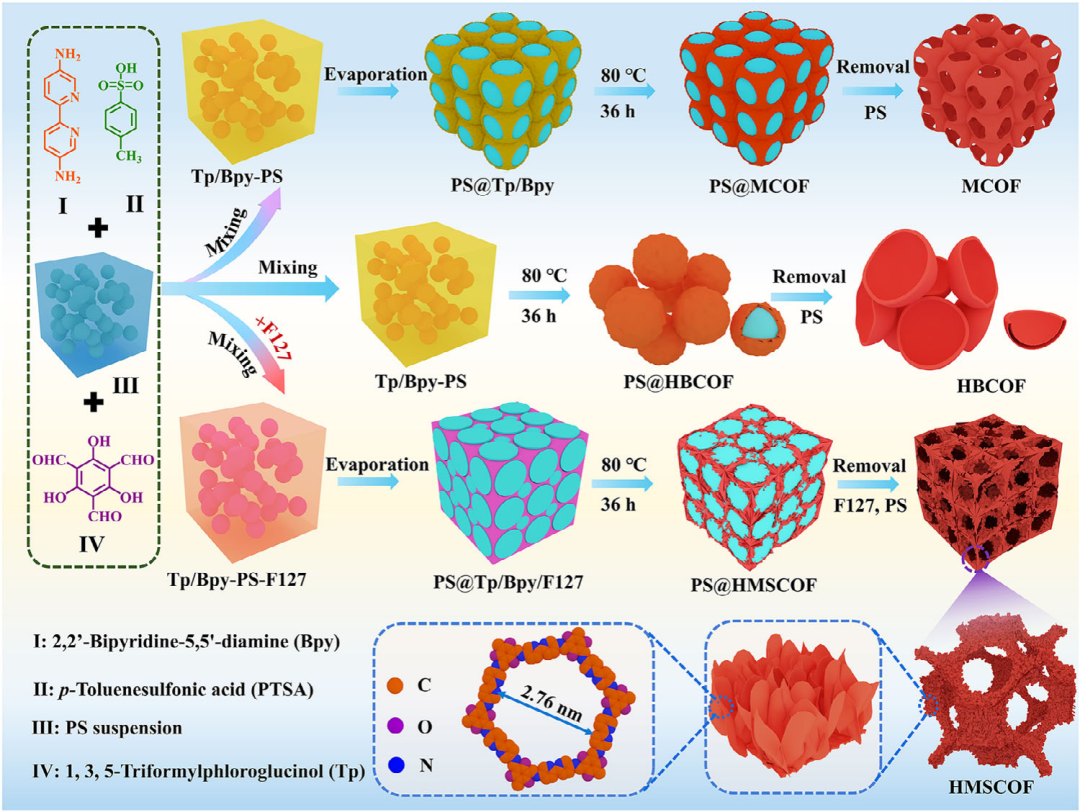
Figure 1
Schematic illustration for the fabrication of MCOF, HBCOF and HMSCOF with distinctive nanostructures
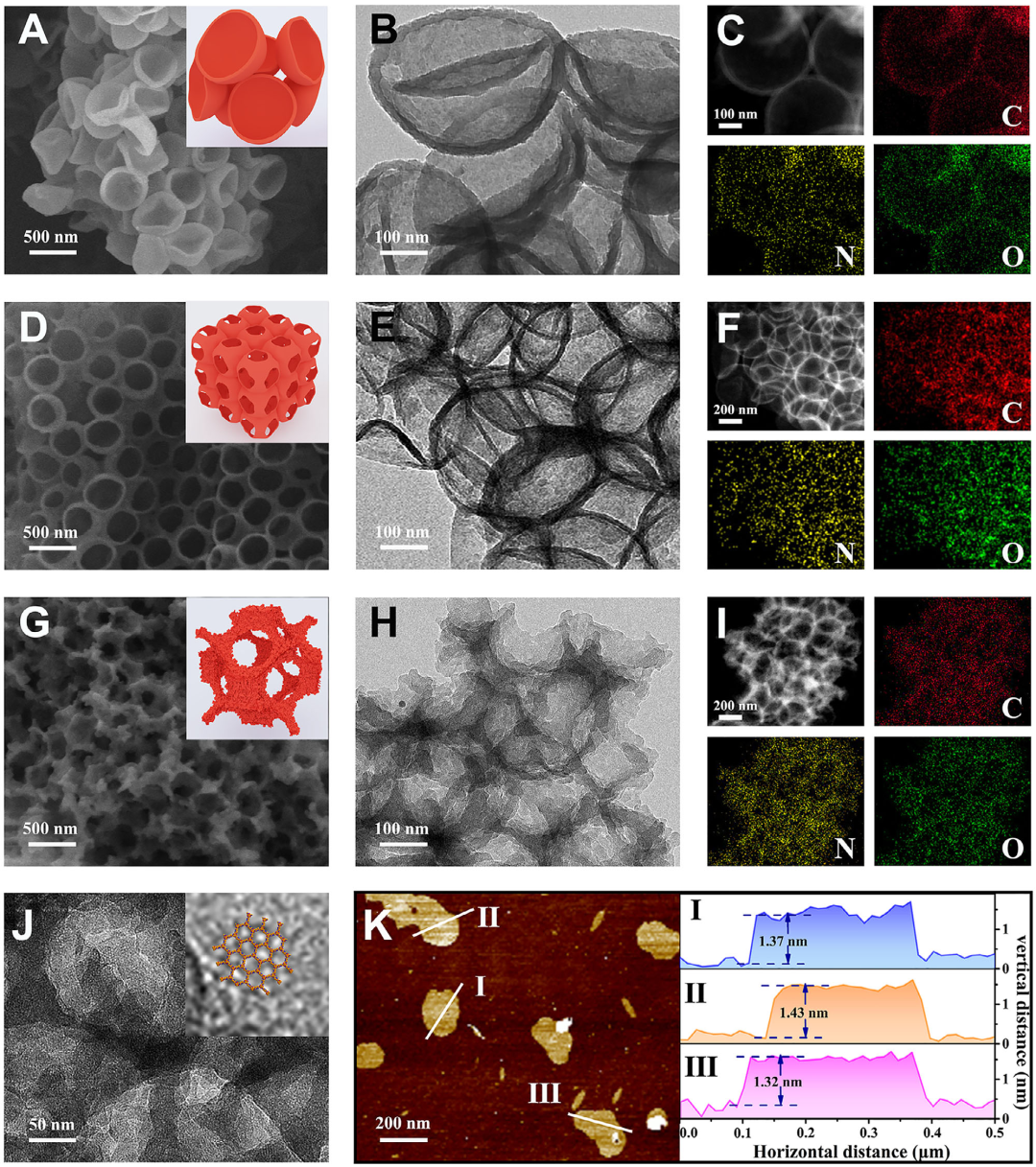 Figure 2
Morphological characterization of covalent organic framework nanomaterials: SEM images (insets: structural models), TEM images, HAADF‑STEM images, and the corresponding EDX elemental mapping (C, N and O) for (a–c) HBCOF, (d–f) MCOF and (g–i) HMSCOF, respectively. (j) HRTEM image (inset: 2D honeycomb crystal structure of COF-TpBpy). (k) AFM image of COF-TpBpy nanosheets in HMSCOF and the corresponding height distribution curve.
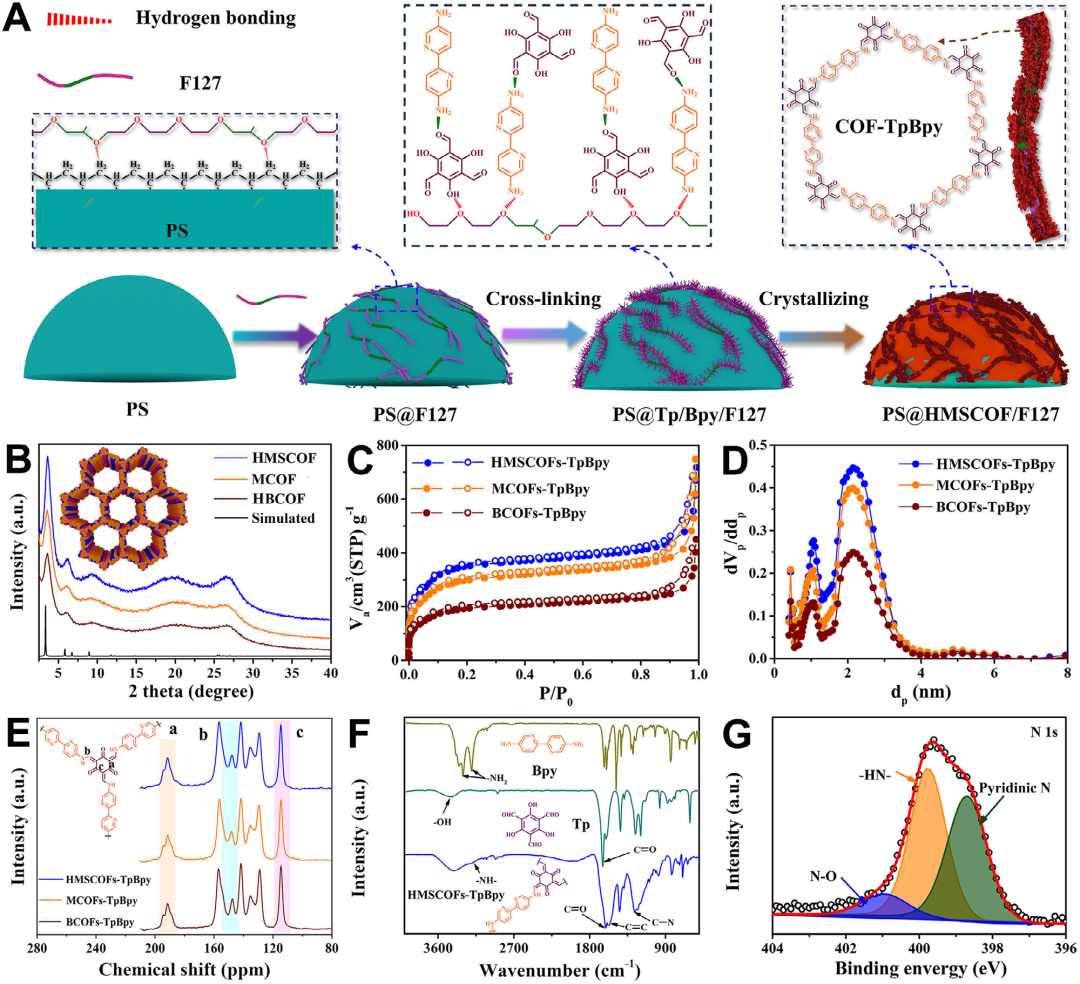
Figure 3
Assembly growth mechanism and structural characterization of covalent organic framework nanomaterials: (a) Schematic illustration of the assembly and growth mechanism of HMSCOF; (b) Simulated and experimental PXRD patterns (inset: space‑filling packing diagram of COF‑TpBpy); (c) N₂ adsorption isotherms; (d) Corresponding pore size distribution; (e) ¹³C CP‑MAS NMR spectra of HMSCOF, MCOF and HBCOF; (f) FT‑IR spectra; and (g) High‑resolution N 1s XPS spectrum of HMSCOF.
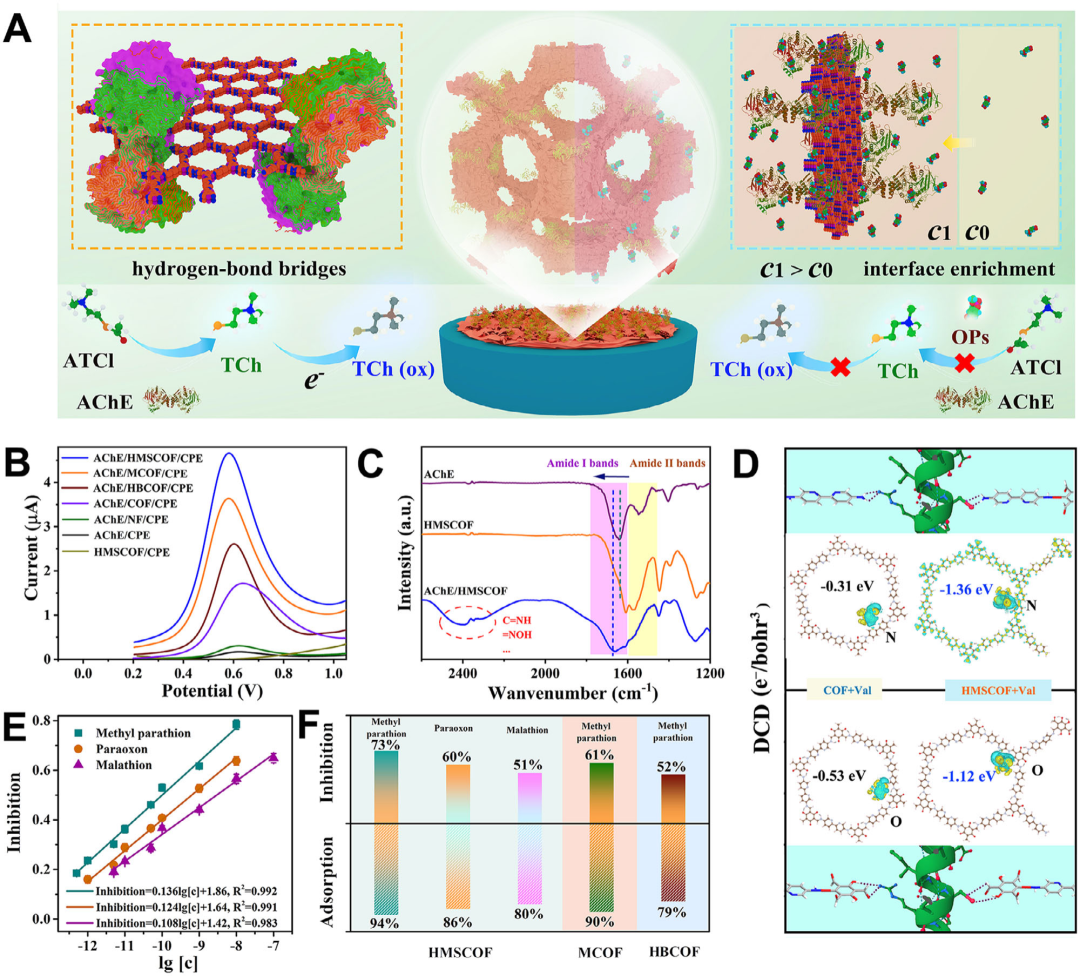
Figure 4
Electrochemical biosensing for organophosphorus compounds: (a) Schematic illustration of the electrochemical biosensing mechanism and the optimized biosensing interface, which facilitates AChE immobilization, mass and charge transport, and substrate enrichment; (b) DPV curves of different biosensing electrodes in 0.1 M phosphate-buffered saline (PBS, pH 7.0) containing 1.5 mM ATCl; (c) FT‑IR spectra of AChE, HMSCOF and AChE/HMSCOF; (d) Schematic diagram of hydrogen bonds between residual groups on the enzyme protein surface and organic linkers of covalent organic frameworks, together with differential charge density distributions of HMSCOF and COF‑TpBpy after valine adsorption near N and O atoms; (e) Inhibition curves of AChE/HMSCOF/CPE for the determination of parathion-methyl, paraoxon and malathion (error bars represent the coefficient of variation from three replicate tests); (f) Inhibition efficiencies of different modified electrodes toward 50 ng mL⁻¹ parathion-methyl, paraoxon and malathion at 15 min, and adsorption efficiencies of different COFs toward 5 µg mL⁻¹ parathion-methyl, paraoxon and malathion at 15 min.
Summary
This work focuses on optimizing electrochemical biosensing interfaces. A template‑assisted assembly strategy was adopted to precisely fabricate three‑dimensional hierarchically macroporous covalent organic frameworks (HMSCOF). The unique pore microenvironment anchors acetylcholinesterase firmly via spatially confined supramolecular interactions, while unblocking pathways for mass and charge transport and enabling efficient substrate enrichment. Benefiting from these synergistic effects, the sensing electrode achieves a limit of detection down to the sub‑pg/mL level for organophosphorus pesticides, with favorable anti‑interference capacity and stability. Finally, the material was integrated into portable devices, achieving recoveries ranging from 96.4% to 105.3% in river water and vegetable samples, which completes the closed loop from material synthesis to on‑site rapid detection.
Beyond pesticide residue detection, this interface design strategy of “hierarchically macroporous skeleton + spatially confined immobilization” can serve as a universal platform. By replacing the recognition element with aptamers, antibodies or other cascade enzymes, the system can be readily adapted to early screening of disease biomarkers, heavy metal monitoring and other medical diagnosis and environmental monitoring scenarios. Furthermore, building on the reliable performance verified by portable device tests, such ordered macroporous COF films, if further integrated with microfluidic chips and flexible wearable substrates, are expected to break the dependence on bulky conventional instruments and accelerate the translation of high‑sensitivity electrochemical sensors into low‑cost, high‑throughput commercial test strips.
Reference:
DOI: 10.1002/exp2.70141
We specialize in custom development of functional nanomedicine materials. We provide targeted material fabrication according to experimental requirements, including tunable structure, particle size and surface modification, together with full characterization support. Solutions can be iteratively optimized with continuous technical communication. Our services cover targeted delivery, bioimaging, nanotheranostics and other research projects. Feel free to send your specifications for solution evaluation.
Mr. Zhang: 17715390137
Mr. Chen: 18914047343